
Put On Jacket Visual Support
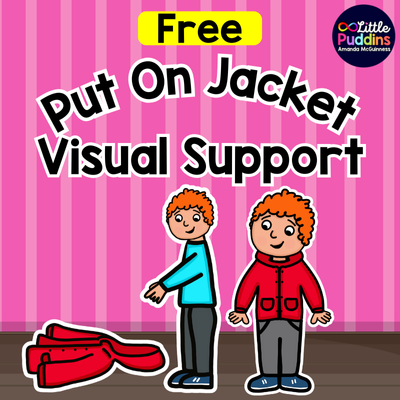
Put On Jacket Visual Support
Getting ready to go outside is a routine moment that is often underestimated in early years settings. For many Autistic children, putting on a jacket or coat involves multiple layers of processing. Sensory input, sequencing, motor planning, time pressure, and adult expectations can quickly combine to create stress rather than readiness.
At Little Puddins, visual supports are viewed as environmental accommodations rather than teaching tools. They reduce cognitive load, support predictability, and allow children to engage with routines in ways that protect autonomy and dignity. The Put On Jacket Visual Support is a free resource designed with these principles in mind.
Why putting on a jacket can be challenging
Putting on a jacket requires a sequence of actions that are not always intuitive. Children must locate the jacket, orient it correctly, manage sleeves, and complete the task while often being rushed or verbally prompted. For Autistic children, this can be particularly demanding due to differences in motor planning, sensory processing, and auditory processing.
From a neuroaffirmative perspective, difficulty with this routine is not a skill deficit. It is often a signal that the environment is placing too many demands on the child at once. Visual supports help shift the demand away from verbal instruction and into a clear, predictable structure.
What is the Put On Jacket Visual Support?
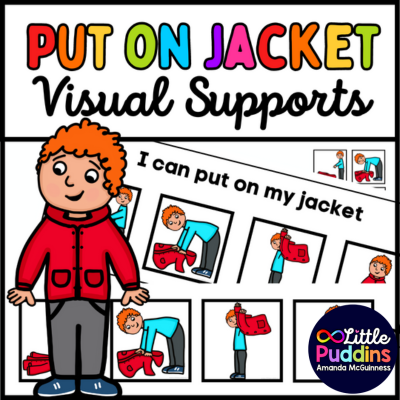
This free visual support breaks the task of putting on a jacket or coat into clear, visually represented steps. The resource includes a simple visual sequence showing the jacket on the ground, picking it up, placing arms into sleeves, and standing with the jacket on. Versions using both the words “jacket” and “coat” are included to reflect everyday language differences across settings.
Each step is visually distinct and uncluttered, allowing the child to see what comes next without being overwhelmed by information. The visuals can be displayed as a strip, used individually, or adapted to suit the physical layout of the setting.
How this visual support helps Autistic children
Visual sequencing supports Autistic children by:
Reducing reliance on verbal instructions
Supporting executive functioning and motor planning
Increasing predictability during transitions
Allowing children to work through steps independently or with shared attention
Reducing anxiety associated with time pressure and uncertainty
Importantly, the visual does not require the child to complete the task independently. It simply provides access to the information needed, allowing support to be offered relationally rather than through repeated prompting.
Using the visual support in early years settings
The Put On Jacket Visual Support can be used flexibly across early years environments, including nurseries, preschools, and early primary classrooms. Common uses include:
Displaying near coat pegs or exits
Using as a reference during outdoor transitions
Laminating and attaching with Velcro for portable use
Offering as a shared visual during co-regulation moments
There is no expectation that children must follow the steps in order or complete the routine within a set time. Pausing, stepping away, returning later, or asking for help are all valid responses.
A neuroaffirmative approach to independence
Neuroaffirmative practice recognises that independence is not about doing tasks alone. It is about having access to the right supports at the right time. Visual supports do not reduce independence. They enable it by removing unnecessary barriers.
By embedding visual supports into everyday routines such as putting on a jacket, early years settings create environments that are calmer, more predictable, and more inclusive for all children.
Free download for early years educators
The Put On Jacket Visual Support is available as a free download for early years educators, schools, and families. It has been designed to be practical, respectful, and easy to integrate into existing routines without additional training or specialist equipment.
If you are looking for a simple, neuroaffirmative way to support transitions and self-care routines in your setting, this visual support is a meaningful place to begin.
