Free Autism First Holy Communion Resource
Supporting Autistic Children to Prepare for First Holy Communion
A Neuroaffirmative, Visual, and Child-Centred Approach
Preparing for First Holy Communion can be a meaningful experience for many families. For Autistic children, however, the process can also bring uncertainty, sensory challenges, unfamiliar language, and social expectations that are often left unexplained. A neuroaffirmative approach recognises that meaningful participation is not about compliance or performance, but about understanding, felt safety, and access to communication.
With the right supports in place, Autistic children can engage with Communion preparation in ways that respect their neurodivergent processing, honour their autonomy, and support genuine inclusion.
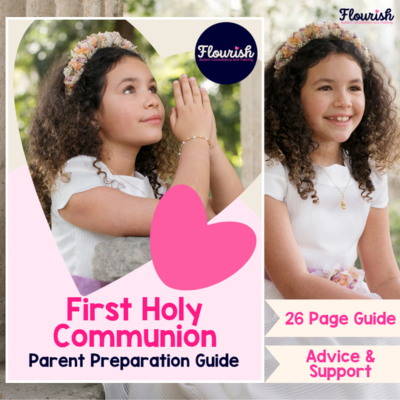
Understanding the Autistic Experience of Communion Preparation
From a neuroaffirmative perspective, it is important to recognise that Communion preparation involves far more than a single event. It includes repeated exposure to new environments, unfamiliar rituals, symbolic language, extended periods of sitting or standing, and changes to routine.
Autistic children may experience:
difficulty understanding abstract religious language
sensory dysphoria related to sound, crowds, clothing, or taste
fear around unfamiliar sequences or expectations
differences in processing with expressive or receptive communication
pressure to participate in ways that do not align with their capacity
These experiences are not barriers to inclusion. They are indicators of where support, clarity, and adaptation are needed.
Why Visual and Concrete Supports Matter
Many Autistic children process information more effectively when it is visual, predictable, and concrete. Verbal explanations alone are often insufficient, particularly when concepts are symbolic or unfamiliar.
Visual supports help by:
making expectations explicit rather than implied
reducing cognitive and language load
supporting sequencing and predictability
offering access to communication without pressure
increasing felt safety through familiarity
When children understand what will happen, who will be there, and what the words mean, participation becomes more accessible, and meaningful.
Using Visual Vocabulary to Build Understanding and Confidence
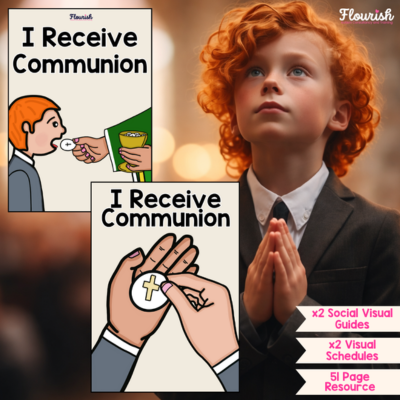
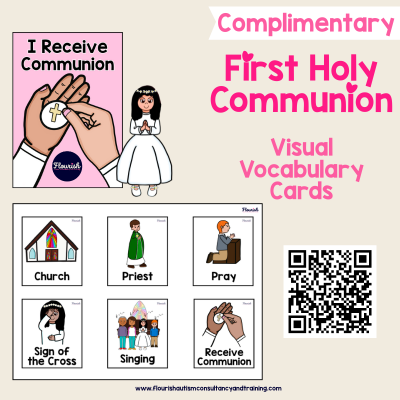
One effective way to support Communion preparation is through visual vocabulary cards that break down key words, actions, and people involved in the ceremony.
The complimentary Autism Communion Visual Vocabulary Cards include clear, supportive visuals for concepts such as:
Church
Priest
Pray
Singing
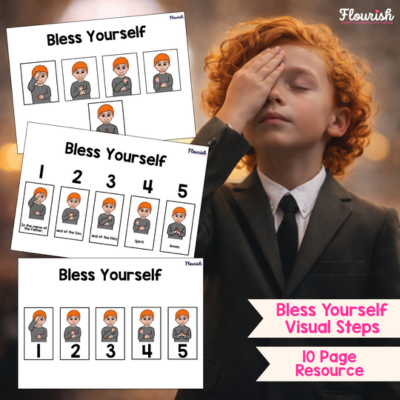
Sign of the Cross
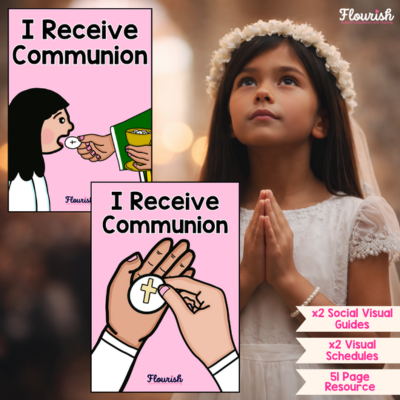
Receive Communion
These cards allow children to build understanding gradually, revisit concepts as often as needed, and communicate about the experience in ways that feel safe and accessible.
Rather than expecting children to memorise or perform rituals, visual vocabulary supports meaning-making and shared understanding.
Practical Ways to Use Communion Vocabulary Cards at Home
Families can use visual vocabulary cards in flexible, child-led ways, including:
introducing one card at a time during grounded moments
pairing visuals with short, neutral declarative explanations
using cards to preview what will happen at church
supporting children to ask questions or make comments using the visuals
revisiting cards before and after church visits
Respecting Choice, Capacity, and Autonomy
A neuroaffirmative approach recognises that Autistic children may engage differently with religious preparation. Some may wish to participate fully, others partially, and some may need adaptations that change over time.
Supportive preparation includes:
respecting when a child needs breaks or space
adapting expectations around participation
recognising that communication may be non-verbal or supported
understanding that capacity can fluctuate
Communion as a Relational Experience
For Autistic children, felt safety is often shaped by the responses of trusted adults. Predictable, and respectful support communicates that the child is safe to be themselves.
Visual supports, including vocabulary cards, play a key role in creating this relational safety by reducing uncertainty and supporting shared understanding.
