
Autism and Constipation

Using the Bristol Stool Chart and a Poo Diary for Better Bowel Health
Constipation is a common and often distressing health concern for many Autistic children and adults. Changes in routine, sensory processing differences, diet, and challenges in interoception (internal body awareness) can all contribute to difficulties with bowel regulation. As a result, families and professionals often seek clear, practical ways to monitor bowel health in order to support timely, compassionate interventions.
In this post, I’ll share two essential tools, the Bristol Stool Chart and a Poo Diary, that can help families track bowel movements and communicate health concerns clearly with healthcare professionals. These resources, when used consistently, can provide meaningful insights into patterns of constipation and support proactive care.

Understanding the Link Between Autism and Constipation
Many Autistic individuals experience chronic constipation. This may be related to sensory sensitivities around toileting, a restricted diet, anxiety related to using the toilet, or difficulty recognising internal body cues.
ERIC, The Children’s Bowel and Bladder Charity, highlights that constipation can become severe if not treated early, and they provide clear, accessible information for families and educators on managing bladder and bowel health. Their resources are particularly valuable for those supporting Autistic children, as they acknowledge the unique sensory and communication needs that can affect toileting.

What Is the Bristol Stool Chart?
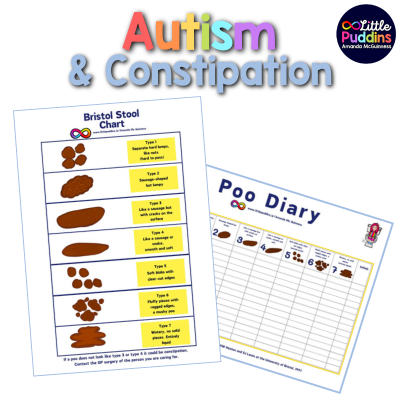
The Bristol Stool Chart is a medical tool that visually categorises different types of stool (poo) into seven types, from hard lumps (Type 1 – severe constipation) to watery stool (Type 7 – diarrhoea). This simple visual guide allows parents, carers, and professionals to assess the type of stool a child is producing and identify signs of constipation early.
ERIC recommends using the Bristol Stool Chart to build a shared understanding of what healthy bowel movements look like, especially when communicating with GPs or paediatricians. It is also helpful for Autistic individuals who may find visual information easier to understand than verbal descriptions.
You can download a free visual Bristol Stool Chart from Little Puddins to use at home or in school settings.
We know that 1 in 3 children (includes Autistic and non-Autistic children) experience constipation.
The Bristol Stool Chart can support us in conjunction with a poo diary to have information readily available regarding our children’s bowel movement (type/consistency and frequency) that we can use to provide a medical health professional with an accurate account of our children’s bowel movement.
Why Use a Poo Diary?
A Poo Diary is a daily tracking tool that helps families record the frequency, appearance, and ease of bowel movements. It can include details such as:
Type of stool (based on the Bristol Stool Chart)
Time of day
Signs of discomfort or pain
Notes on fluid intake, diet, or medication
ERIC encourages the use of poo diaries to support early identification of constipation and ensure that healthcare providers have an accurate picture of a child’s bowel health. A well-kept diary is especially valuable for Autistic children who may struggle to explain how they are feeling or when something feels wrong.
Supporting Autistic Children with Constipation
It’s important to approach constipation support with compassion, patience, and a neuroaffirmative understanding. Some Autistic children may experience distress around discussing or managing toileting. Visual tools, predictable routines, and gentle language can go a long way in reducing anxiety and supporting independence.
The Bristol Stool Chart and Poo Diary are excellent tools to include in a broader toileting support plan that may also involve visual schedules, sensory-friendly bathroom adaptations, and collaborative medical care.
For further information and professional guidance, I highly recommend visiting the ERIC Bladder and Bowel Charity website. They offer excellent advice, downloadable resources, and a helpline for families navigating constipation and other toileting difficulties.
If you are concerned that your child may be constipated always consult your medical health professional for medical advice on how to support your child.
Download Your Free Autism Poop Resources Today
At Little Puddins, I’ve created clear, accessible versions of both the Bristol Stool Chart and Poo Diary, designed with the Autistic community in mind. These are free to download and can be used at home, in school, or in clinical settings.
Supporting your child’s bowel health doesn’t have to be overwhelming. With the right tools, knowledge, and a neuroaffirmative approach, you can take positive steps toward relieving discomfort and promoting well-being.
References
Fu SC, Lee CH, Wang H. Exploring the Association of Autism Spectrum Disorders and Constipation through Analysis of the Gut Microbiome. Int J Environ Res Public Health. 2021 Jan 14;18(2):667. doi: 10.3390/ijerph18020667. PMID: 33466802; PMCID: PMC7830459.
Maslen C, Hodge R, Tie K, Laugharne R, Lamb K, Shankar R. Constipation in autistic people and people with learning disabilities. Br J Gen Pract. 2022 Jun 30;72(720):348-351. doi: 10.3399/bjgp22X720077. PMID: 35772989; PMCID: PMC9256070.
McElhanon, B. O., McCracken, C., Karpen, S., & Sharp, W. G. (2014). Gastrointestinal symptoms in autism spectrum disorder: a meta-analysis. Pediatrics, 133(5), 872–883. https://doi.org/10.1542/peds.2013-3995
Mulay, Kalyani Vijaykumar, and Sivaramakrishnan Venkatesh Karthik. “Managing Constipation in Children with ASD – a Challenge Worth Tackling.” Pediatrics & Neonatology, Jan. 2022, https://doi.org/10.1016/j.pedneo.2021.11.009. Accessed 14 Mar. 2022.
Heaton, K W & Lewis, S J 1997, ‘Stool form scale as a useful guide to intestinal transit time’. Scandinavian Journal of Gastroenterology, vol.32, no.9, pp.920 – 924.
Harvey S, Matthai S, King DA – How to use the Bristol Stool Chart in childhood constipation –Archives of Disease in Childhood – Education and Practice 2023;108:335-339.
