
Dr Luke Beardon’s 9 Energies Theory
Dr Luke Beardon’s 9 Energies Theory: An Interpretation for Families and Schools
Energy management is one of the most significant yet overlooked aspects of Autistic life. Autistic individuals often expend disproportionate amounts of energy navigating environments, demands, and social expectations that are designed with neuronormative needs in mind. Dr Luke Beardon’s What Works for Autistic Adults (2020) provides a valuable framework for understanding this reality through his articulation of the Nine Energies Theory.
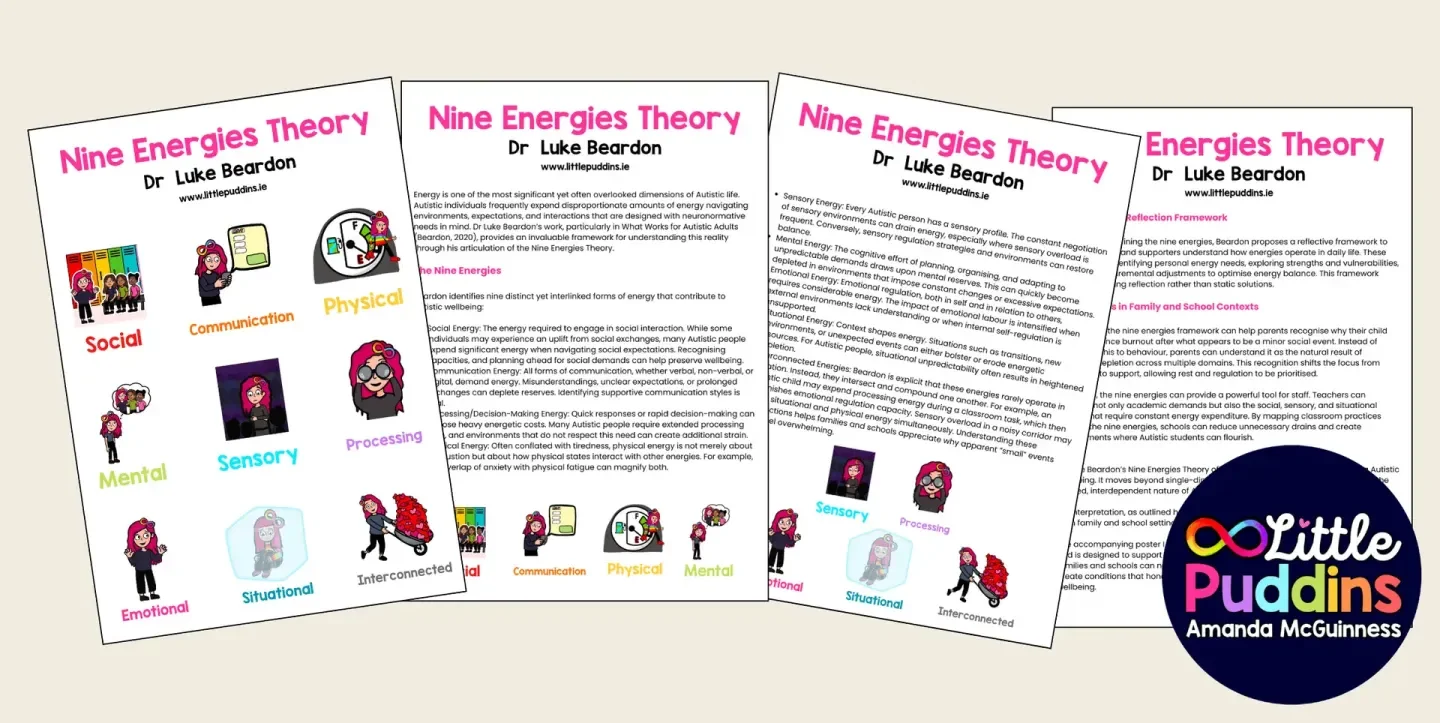
In this post, I share my interpretation of Beardon’s theory and outline how it can be applied within both family and school contexts. Alongside this article, I have created a free downloadable poster and resource that captures the key themes and serves as a practical tool for reflection and planning.
The Nine Energies
Dr Beardon identifies nine distinct but interconnected energies:
Social Energy – The energy required to engage in social interaction. For some individuals, social contact is uplifting, while for many Autistic people, it can be draining. Recognising limits and planning around social demands helps preserve wellbeing.
Communication Energy – All forms of communication, whether verbal, non-verbal, or digital, require energy. Miscommunication, unclear expectations, or prolonged interactions can lead to rapid depletion. Identifying communication styles that are supportive is essential.
Processing/Decision-Making Energy – The demand for quick responses can be exhausting. Many Autistic people need extended time to process information before making decisions, and pressure to respond immediately can heighten stress.
Physical Energy – Physical tiredness is not the same as energetic depletion, but the two are closely linked. Physical states, especially when combined with anxiety or sensory overload, can magnify overall exhaustion.
Positive Energy – Activities that create joy, fulfilment, and satisfaction provide positive energy, which can replenish other forms of energy. Investing in meaningful, interest-led experiences can act as a protective factor.
Sensory Energy – Every Autistic person has a unique sensory profile. Negotiating sensory environments, particularly those that are overwhelming, requires significant energy. Conversely, sensory regulation strategies can restore equilibrium.
Mental Energy – Planning, organising, and adapting to unpredictable change requires mental energy. When demands exceed available reserves, mental energy quickly becomes depleted.
Emotional Energy – Emotional regulation consumes energy, both in self and in relation to others. Without adequate support, this can be one of the most draining forms of energy expenditure.
Situational Energy – Context matters. Transitions, new environments, or unexpected changes often heighten energy demands for Autistic people. Predictability and preparation are essential to reduce situational depletion.

Interconnected Energies
These nine energies rarely operate in isolation. Instead, they are interdependent and cumulative. For example, sensory overload in a classroom may simultaneously drain sensory, emotional, and processing energy. Understanding this interconnection helps explain why apparently minor events may trigger overwhelming exhaustion.
The Nine-Step Reflection Framework
Beardon proposes a reflective framework to help identify, analyse, and manage the nine energies. This includes:
Mapping personal strengths and vulnerabilities.
Recognising energy patterns in daily life.
Identifying adjustments that support balance.
Reflecting regularly and adapting strategies as circumstances change.
This process is not a one-time solution but an ongoing practice of self-understanding and environmental adjustment.
Applications in Family and School Contexts
In families, recognising the nine energies can transform how parents interpret their child’s experiences. For example, a child who appears “overreactive” after a social event may, in reality, be experiencing depletion across multiple energy domains. Instead of viewing this through a behavioural lens, families can prioritise rest, recovery, and supportive regulation.
In schools, the nine energies provide staff with a structured framework for reflecting on classroom demands. Teachers can consider not only academic workload but also the social, sensory, and situational pressures placed upon Autistic students. By proactively reducing unnecessary energy drains, schools can create environments that allow Autistic learners to thrive.
Dr Luke Beardon’s Nine Energies Theory offers a profound framework for understanding Autistic experiences of energy. It provides a layered and nuanced model that moves beyond simplistic metaphors, recognising the complex interplay of different energetic demands.
My interpretation of Beardon’s work highlights how this theory can be used in practical ways across family and school contexts. To support this, I have developed a free downloadable poster and resource that captures the nine energies in a clear and accessible format, offering families, teachers, and professionals a practical tool for everyday reflection.
Reference:
Beardon, L. (2020). What Works for Autistic Adults. London: Sheldon Press.
