
Autism Swim Safety Poster
Autism Water Safety
Summer Tips, Strategies & Free Visual Supports
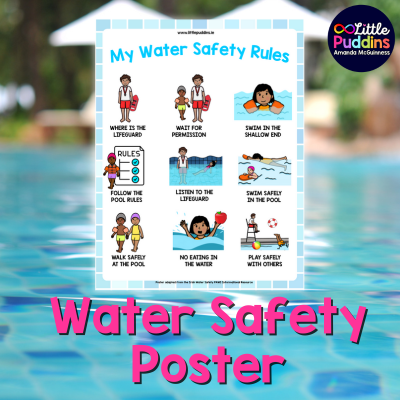
As summer arrives across Ireland, families begin to enjoy trips to beaches, pools, rivers, and lakes. For Autistic children, water can bring both immense joy and significant risk. In this post I provide strategies of support together with a FREE Autism Water Safety Poster for your to download.
Why Are Autistic Children More Vulnerable Around Water?
Drowning is one of the leading causes of accidental death in Autistic children worldwide. When considering how to keep Autistic children safe around water, we need to also consider some of the differences Autistic children experience regarding water.
1. Sensory Regulation & Attraction to Water
Water can regulate and calm many Autistic children due to its deep sensory input. However, this attraction may lead them toward water environments without an awareness of danger.
2. Communication Differences
Some Autistic children may be non-speaking or may not for a variety of reasons have the capacity to call for help when in difficulty in water.
3. Executive Functioning and Risk Awareness
Differences in spatial awareness, planning, and understanding of danger can lead to impulsive decisions, such as entering water alone or underestimating depth or current.
4. Inaccessible Water Safety Education
Water safety education may not meet the needs of Autistic children, especially if the programs rely heavily on verbal instructions, abstract rules, or group dynamics.
How to Keep Autistic Children Safe Around Water
Here are some neuroaffirmative, practical strategies for reducing water-related risk while preserving your child’s dignity and joy.
Choose Safe, Familiar Locations
Opt for swimming areas with trained lifeguards and clear flag systems. Return to the same locations where possible to reduce anxiety and increase predictability.
Create Predictable Routines Around Swimming
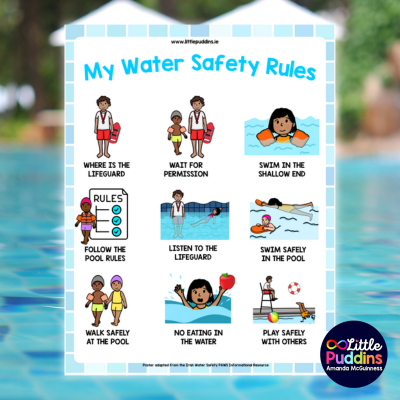
Use a visual schedule for swimming trips (e.g. changing clothes, checking flags, waiting for permission). Social narratives can help prepare for each step.
Teach the “Float to Live” Technique
Practice this with your child in a calm setting: lie back, spread arms and legs, float, breathe slowly, and signal for help. Use visual modelling if verbal instruction is challenging, as recommended by Water Safety Ireland.
Make a Personal Water Safety Plan
Document what helps your child stay regulated, their communication preferences, and emergency contacts. Share this plan with other adults present.
Use Water Safety Social Stories
Use water safety social stories to explain in visual format what is safe to do near water and what is not. Help your students or children learn about the water safety rules.
Water Safety Ireland
For more information on how to keep your loved one safe in the water, check out the Water Safety Ireland website.
Autism Water Safety Poster Download
I hope you have found this post helpful. You can find your free Autism Water Safety Poster here.
References:
Guan, J. and Li, G., 2017. Injury mortality in individuals with autism. American Journal of Public Health, 107(5), pp.791–793. Available at: https://doi.org/10.2105/AJPH.2017.303696 [Accessed 113 Jun 2025].
National Autism Association, 2012. Lethal outcomes in ASD wandering incidents. [online] National Autism Association. Available at: https://nationalautismassociation.org [Accessed 11 Jun 2025].
Centers for Disease Control and Prevention (CDC), 2020. Wandering among children with autism. [online] CDC. Available at: https://www.cdc.gov/ncbddd/autism/safety.html [Accessed 13 Jun 2025]
Water Safety Ireland, n.d. Primary Aquatics Water Safety (PAWS) Programme. [online] Available at: https://www.watersafety.ie/paws/ [Accessed 10 Jun 2025].
