
What is Declarative Language?
Autism and PDA
For many Autistic and neurodivergent individuals, communication is shaped by far more than spoken words alone. Nervous system safety, processing demands, predictability, autonomy, emotional regulation, and relational trust can all influence how communication is experienced within everyday interactions.
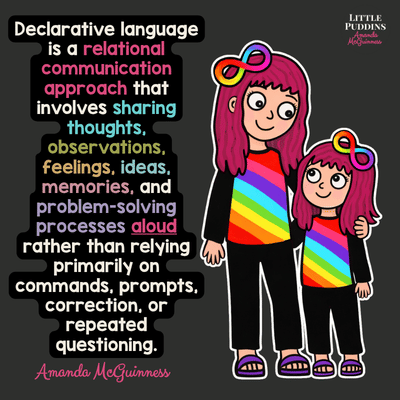
Communication that feels highly directive, urgent, evaluative, or outcome-focused may increase stress, vigilance, overwhelm, or shutdown for some individuals, particularly those with a PDA profile. In contrast, communication that prioritises collaboration, transparency, autonomy, and relational safety may support more regulated and connected interaction.
One communication approach that has become increasingly recognised within neuroaffirmative and PDA-informed spaces is declarative language.
What Is Declarative Language?
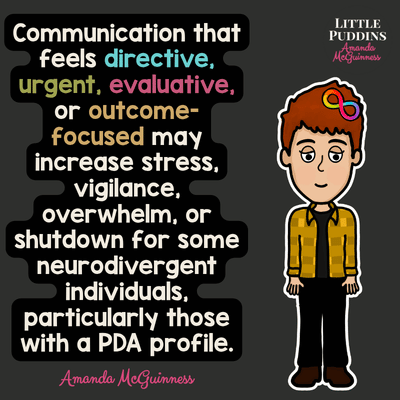
Declarative language is a relational communication approach that involves sharing thoughts, observations, feelings, ideas, memories, and problem-solving processes aloud rather than relying primarily on commands, prompts, correction, or repeated questioning.
Speech and Language Pathologist Linda Murphy, whose work has significantly shaped contemporary declarative language frameworks, originally described declarative language as:
“stating out loud what one knows or thinks, in the form of a comment.”

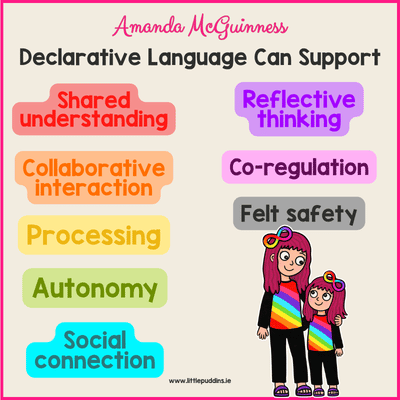
Rather than focusing on obtaining compliance or “correct” responses, declarative language aims to support:
shared understanding
collaborative interaction
processing
autonomy
social connection
reflective thinking
co-regulation
felt safety
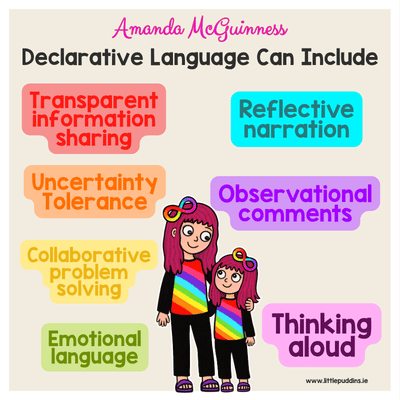
Declarative language often includes:
thinking aloud
observational comments
reflective narration
emotional language
collaborative problem solving
uncertainty tolerance
transparent information sharing
Examples may include:
“I’m noticing the room is getting noisy.”
“I’m wondering what might help here.”
“I need a moment to think about this.”
“I remember that felt difficult yesterday.”
“I can see that was frustrating.”
Declarative language is about sharing experience and information in a way that reduces unnecessary pressure within communication.
Declarative vs Imperative Language
Declarative language is often contrasted with imperative language.
Imperative Communication
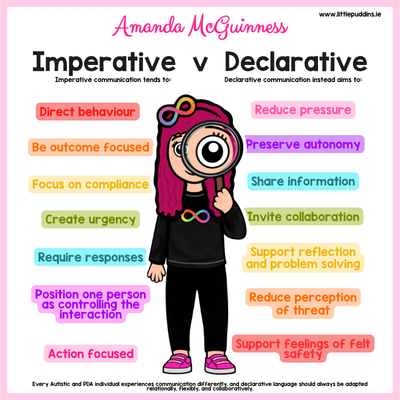
Imperative communication tends to:
direct behaviour
require responses
focus on compliance
create urgency
be outcome focused
position one person as controlling the interaction
Examples may include:
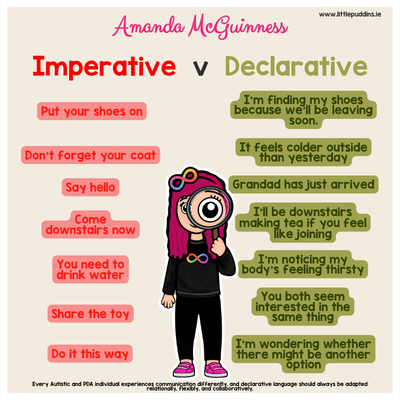
“Put your shoes on.”
“Look at me.”
“What do you say?”
“Hurry up.”
“Why did you do that?”
Declarative Communication
Declarative communication instead aims to:
reduce pressure
preserve autonomy
share information
invite collaboration
support reflection and problem solving
For example:
Imperative:
“Put your coat on.”
Declarative:
“It’s cold outside today. I’m getting my coat ready.”
Declarative language shifts communication towards relational understanding and collaboration.
What is Persistent Drive for Autonomy?
We have created a comprehensive guide that explains PDA comprehensively.
If you would like to understand what PDA is, current perspectives, autonomy, regulation, communication, education and practical support, start with our detailed guide before continuing with this article.
Communication, PDA, and Nervous System Safety
For many PDA’ers, communication itself can sometimes become experienced as pressure.
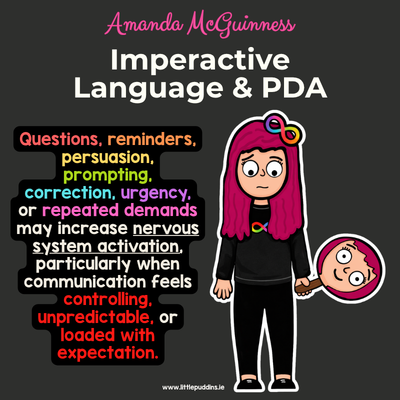
Questions, reminders, persuasion, prompting, correction, urgency, or repeated demands may increase nervous system activation, particularly when communication feels controlling, unpredictable, or loaded with expectation.
Many PDA-informed frameworks conceptualise these perceived threat activated responses through a nervous system lens, where autonomy and felt safety play significant roles in how interactions are processed.
According to Polyvagal Theory, developed by Dr Stephen Porges, the nervous system continuously scans interactions for cues of:
safety
danger
predictability
control
relational connection.
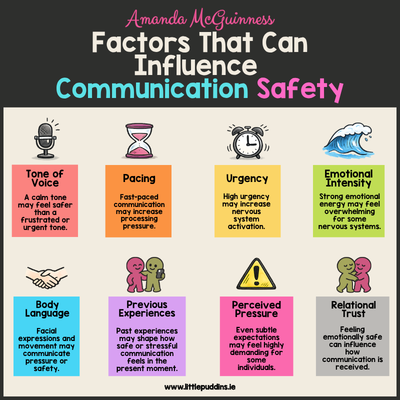
Tone of voice, pacing, urgency, emotional intensity, body language, and perceived pressure may all influence how communication is experienced neurobiologically.
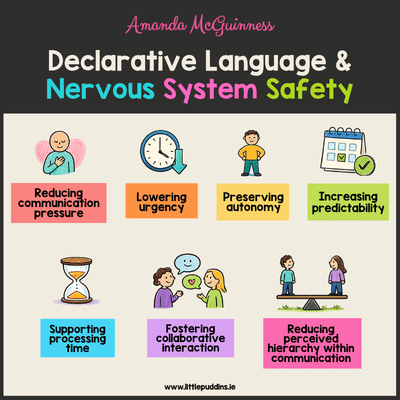
Declarative language may support nervous system safety by:
reducing communication pressure
lowering urgency
preserving autonomy
increasing predictability
supporting processing time
fostering collaborative interaction
reducing perceived hierarchy within communication.
One of the most important misunderstandings about declarative language is the idea that it is simply a collection of sentence starters or softer wording.
PDA & Declarative Communication
Communication is shaped not only by wording, but also by:
emotional tone
pacing
relational safety
underlying intention
nervous system state
authenticity within the interaction.
Many Autistic and PDA individuals describe being highly attuned to hidden expectations or communication that feels indirectly controlling, even when phrased softly.
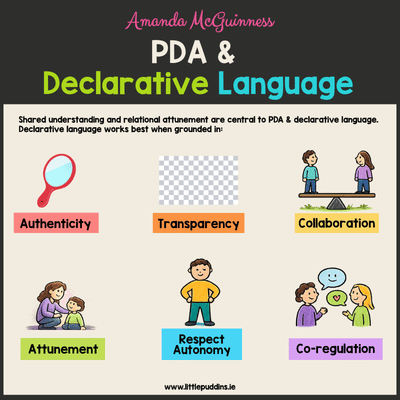
For this reason, declarative language works best when grounded in:
authenticity
transparency
collaboration
attunement
co-regulation
respect for autonomy.
Shared understanding and relational attunement are central to PDA & declarative language.
Thinking Aloud and the Development of an “Inner Voice”
An important aspect of Linda Murphy’s work is the idea of modelling reflective thinking through “thinking aloud.”
This may involve narrating:
problem solving
emotional reflection
planning
noticing
uncertainty
flexible thinking.
For example:
“I’m trying to decide what feels manageable right now.”
“I noticed I started feeling overwhelmed when the room got loud.”
“Last time this happened, taking a break helped me.”
This type of reflective narration may support:
emotional literacy
self-awareness
flexible thinking
planning skills
self-reflection
internal problem solving.
Over time, this can help support the development of an internal reflective “inner voice.”
Declarative Language and Co-Regulation
Declarative language is also shaped by the wider relational interaction.
Communication that supports co-regulation often includes:
slower pacing
reduced urgency
pauses for processing
emotionally safe tone
open body language
authentic curiosity
collaborative presence.
Silence can also be supportive - not every interaction requires an immediate response.
Within neuroaffirmative and PDA-informed approaches, declarative language is increasingly understood not simply as a communication technique, but as part of a broader relational and nervous-system-informed approach to interaction.
A Neuroaffirmative Perspective on Declarative Language
Declarative language supports the creation of communication environments that:
reduce unnecessary pressure
support autonomy
foster relational safety
acknowledge processing differences
support collaborative interaction
prioritise connection over compliance.
Declarative language supports the recognition that:
communication is relational
safety shapes engagement
autonomy matters
processing differences are valid
social understanding is mutual.
Declarative language can create safer, more respectful, and more collaborative communication experiences.
Learning More About Declarative Language
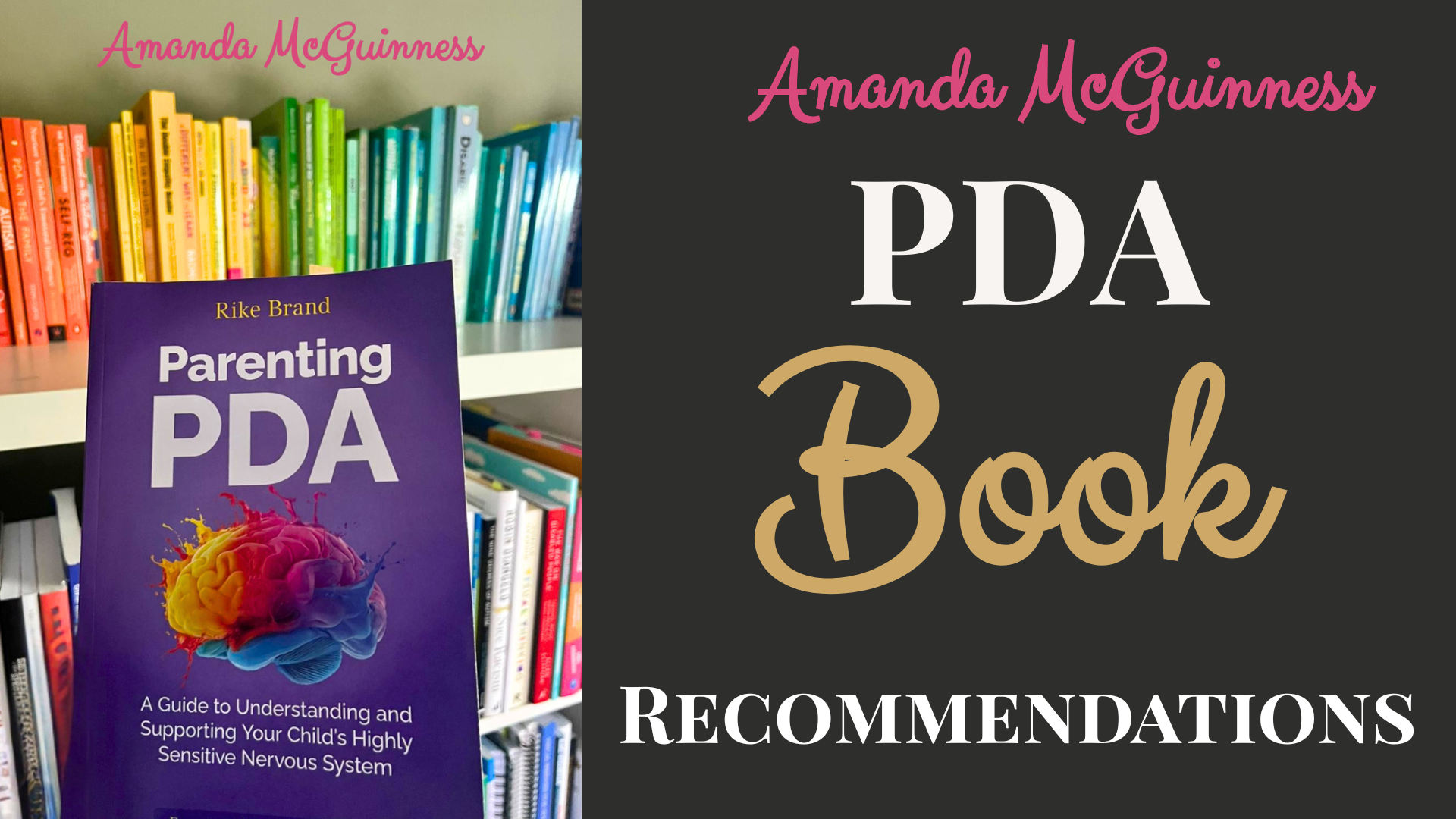
Much of the contemporary understanding of declarative language has been shaped by the work of Speech and Language Pathologist Linda Murphy, MS, CCC-SLP.
I first purchased Linda Murphy’s Declarative Language Handbook in late 2020, and it has remained one of the professional resources I have consistently recommended to parents, educators, therapists, and support professionals in the years since. Her work has played an important role in shaping broader conversations around autonomy-supportive communication, co-regulation, social information processing, and reducing pressure within interactions for Autistic and neurodivergent individuals.
You can explore her work here:
Linda Murphy Declarative Language Resources
References
Murphy, L. (2010). The Critical Importance of Declarative Language Input for Children with ASD. Autism Spectrum Quarterly, Winter 2010.
Murphy, L. (2018). What We Say and How We Say It Matters!. Autism Asperger’s Digest.
Murphy, L. Declarative Language professional resources and handbook materials. Available at:
Declarative Language WebsitePorges, S. (2011). The Polyvagal Theory: Neurophysiological Foundations of Emotions, Attachment, Communication, and Self-Regulation. New York: Norton.
Milton, D. (2012). “On the ontological status of autism: the ‘double empathy problem’.” Disability & Society, 27(6), 883–887.
Murray, D., Lesser, M., & Lawson, W. (2005). “Attention, monotropism and the diagnostic criteria for autism.” Autism, 9(2), 139–156.
