
What is Gestalt Language Processing
What Is Gestalt Language Processing?
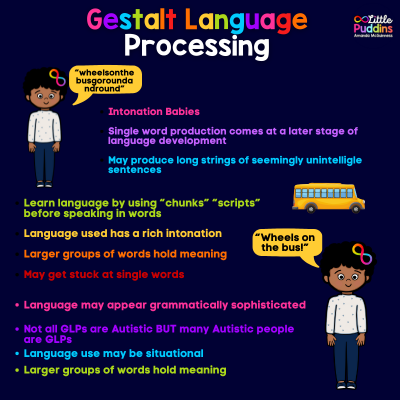
Gestalt Language Processing (GLP), sometimes referred to as Gestalt Language Acquisition, describes a recognised and natural pathway of language development in which an individual initially learns and uses language in larger units rather than single words. These units may include phrases, scripts, or whole sentences that have been heard in meaningful contexts, such as interactions with caregivers, peers, or exposure to media and the wider social environment.
Rather than acquiring language word by word, gestalt language processors begin with these larger “chunks” of language and gradually move towards more flexible, self-generated expression over time.
Understanding Gestalt Language Processing
Gestalt Language Processing is a valid and developmentally appropriate way of acquiring language. It is not a delay, deficit, or disorder. Like all forms of language development, it follows a predictable progression and can lead to rich, spontaneous, and generative communication.
This language profile is particularly common within the Autistic population, though it is not exclusive to Autistic individuals. Gestalt language processing may be observed in both speaking and non-speaking individuals and can occur alongside a wide range of communication modalities, including AAC.
Language produced through gestalts is meaningful. Each phrase or script serves a communicative purpose, even when that purpose is not immediately obvious to unfamiliar listeners.
The Natural Language Acquisition Framework
Marge Blanc’s Natural Language Acquisition (NLA) framework outlines a series of stages that describe how gestalt language processors move from echolalic or scripted language toward flexible, self-generated communication.
While individual pathways vary, the framework broadly describes six stages:
Stage 1: Use of whole gestalts. These are complete phrases or scripts learned from language models in the individual’s environment.
Stage 2: Mitigation, where gestalts begin to be shortened or combined.
Stage 3: Emergence of single words and early recombinations.
Stages 4–6: Increasing use of grammar, sentence structure, and original language.
Progression through these stages is not linear or time-bound. Movement between stages reflects increased language flexibility rather than mastery of specific forms.
Gestalt Language Processing and Autism
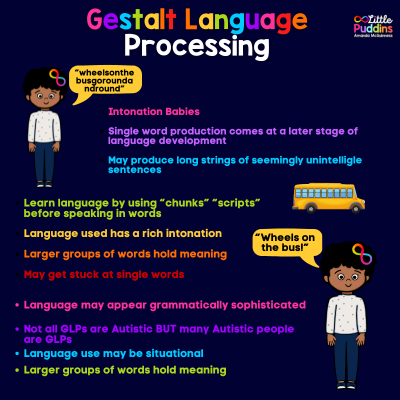
For many Autistic individuals, gestalt language processing aligns with broader patterns of learning and cognition, including pattern recognition, monotropism, and meaning-based language use. Gestalt language can be a highly efficient way to communicate needs, emotions, and experiences.
Importantly, echolalia and scripting are not behaviours to be extinguished or redirected. They are meaningful forms of communication and an essential part of language development for gestalt language processors.
Neuroaffirmative practice recognises echolalia as communicative and developmental, rather than viewing it as something that must be replaced.
Identifying Gestalt Language Processing
Identification of gestalt language processing is best supported by a Speech and Language Therapist who is trained in the Natural Language Acquisition framework. However, parents, caregivers, and educators also play a vital role in observing communication patterns across environments.
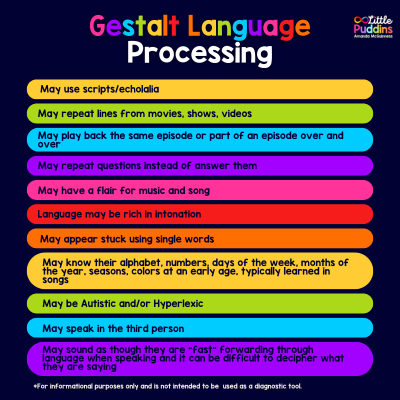
Some individuals may consistently use phrases learned from familiar sources, show strong recall of language linked to specific contexts, or communicate more effectively through scripts than through single words. These patterns can indicate a gestalt language processing profile, though formal identification should always be undertaken by an appropriately trained professional.
Supporting Gestalt Language Processors
Effective support for gestalt language processors prioritises:
respect for all forms of communication
modelling meaningful, emotionally attuned language
avoiding pressure to produce single words prematurely
providing rich, functional language input
supporting communication across modalities, including AAC
The goal is not to accelerate movement through stages, but to support communication that is authentic, regulated, and meaningful for the individual.

Further Resources
A free downloadable Gestalt Language Processing Terms Guide is available to support families and professionals in understanding commonly used terminology within this framework. This resource is provided for informational purposes and is intended to support shared understanding rather than diagnosis or clinical decision-making.
References
Arnold, C. (2019). Flipping the script: Prioritising the Autistic voice in the understanding of scripting as key to the Autistic identity. Doctoral dissertation, University of San Francisco.
Blanc, M. (2012). Natural language acquisition on the Autism spectrum: The journey from echolalia to self-generated language. Communication Development Center.
Peters, A. M. (1983). The units of language acquisition. Cambridge University Press.
Prizant, B. M. (1983). Language acquisition and communicative behaviours in Autism. Journal of Speech and Hearing Disorders. https://doi.org/10.1044/jshd.4803.296
Prizant, B. M., and Rydell, P. J. (1984). Analysis of functions of delayed echolalia in Autistic children. Journal of Speech and Hearing Research. https://doi.org/10.1044/jshr.2702.183
Stiegler, L. (2015). Examining the echolalia literature: Where do speech and language therapists stand? American Journal of Speech-Language Pathology. https://doi.org/10.1044/2015_AJSLP-14-0166
