Autism Friendly Period Products

Autism and Supporting Autistic Teens to Use Sanitary Products
Learning to manage menstruation is not a single skill but a layered process that involves sensory processing, emotional regulation, executive functioning, and body autonomy. For Autistic teens, this learning often requires a different pace, different supports, and different assumptions than those found in standard puberty education.
Supporting Autistic teens to use sanitary products effectively is not about independence as an outcome. It is about access, dignity, and choice. When learning is scaffolded in a neuroaffirmative way, teens are more likely to feel safe, informed, and confident in caring for their bodies.
To support this learning, we are also providing a free downloadable guide to Autism-friendly period products, designed to help families and professionals navigate product choices through a sensory-aware and Autistic-led lens.
Understanding how Autistic teens experience period care
Autistic teens may experience menstruation differently due to differences in sensory processing and interoception. The physical sensations of bleeding, dampness, pressure, smells, or internal discomfort can be intense and distracting. Combined with hormonal changes, this can significantly reduce tolerance for additional demands.
Learning to use sanitary products therefore needs to happen in calm, low-pressure contexts. Many Autistic teens benefit from explicit teaching that is concrete, predictable, and respectful of sensory boundaries.
Common factors that influence learning include:
Sensitivity to textures, adhesives, seams, or tightness
Discomfort with scented or chemically treated products
Anxiety around leaks or unfamiliar bodily sensations
Difficulties with sequencing and motor planning
A strong need for privacy alongside reliable support
Recognising these factors helps adults respond with accommodation rather than urgency.
How to support learning in a neuroaffirmative way
Effective support focuses on understanding before instruction. Helpful approaches include:
Clear, literal information about what periods are and why products are used, without euphemisms or assumptions
Gradual exposure to products outside of active menstruation, allowing time to touch, open, and explore them
Step-by-step explanations delivered visually, verbally, or through demonstration depending on the teen’s learning preferences
Repetition without pressure, understanding that confidence builds over time rather than in one lesson
Respect for refusal or hesitation, which often signals sensory or emotional overwhelm rather than unwillingness
Learning should always be collaborative. The teen’s feedback about comfort, discomfort, and preference is central.
Choosing Autism-friendly period products
There is no universal “best” sanitary product. What works well for one Autistic teen may be intolerable for another. Sensory experience is often the deciding factor, rather than absorbency or brand familiarity.
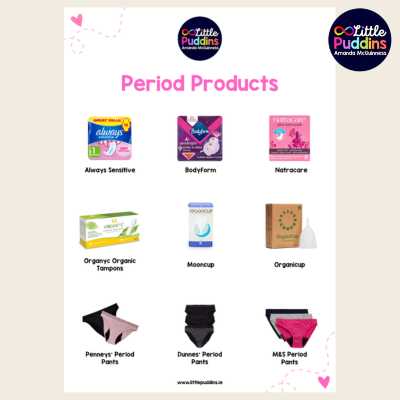
To support informed choice, we have created a free downloadable guide to Autism-friendly period products, highlighting commonly available options in Ireland and outlining why certain products may feel more manageable from a sensory perspective Autism Friendly Period Products.
The guide includes examples of:
Sensitive and fragrance-free pads, which may reduce irritation and sensory overload
Organic cotton tampons, often preferred by those sensitive to synthetic materials
Menstrual cups, such as Mooncup and Organicup, which some teens find more predictable once tolerated
Period underwear, including options from Penneys, Dunnes, and M&S, which many Autistic teens prefer due to reduced shifting and noise
The purpose of the guide is not to recommend a single product, but to support exploration and informed decision-making without judgement.
Supporting autonomy and dignity
Autistic teens deserve agency over their bodies. This includes having their preferences respected, even when those preferences change over time. Some may choose external products only. Others may move between different products depending on sensory capacity, flow, or context.
Autonomy also means recognising when a teen needs more support rather than more instruction. On some days, regulation and reassurance will matter more than completing every step independently.
Creating supportive environments at home and school
Periods do not exist in isolation from the environment. Supportive settings:
Allow extra time and flexibility during menstruation
Provide discreet access to supplies
Avoid public commentary or correction
Normalise taking breaks or opting out when needed
When environments adapt, the burden on the teen reduces significantly.
Free Autism-friendly period products guide
To support families and professionals navigating this learning process, the Autism-friendly period products guide is available as a free download. It is designed to be practical, accessible, and grounded in lived Autistic experience, supporting choice rather than compliance Autism Friendly Period Products.
Periods are a recurring part of life for many Autistic teens. With thoughtful, sensory-aware, and neuroaffirmative support, they can be approached with understanding, dignity, and respect rather than fear or pressure.
