Autism Spectrum
Understanding the Autism Spectrum. A Neuroaffirmative Guide for Families
Families often encounter the term Autism spectrum without ever being offered a meaningful explanation of what Autism/Autistic Experience truly represents.
Too often, society approaches Autism through a lens shaped by deficit narratives, behavioural expectations, or narrow checklists. These perspectives do not reflect the lived experiences of Autistic people or the contemporary thinking of Autistic scholars and advocates.
A neuroaffirmative, trauma aware understanding recognises Autism as a valid identity and a lived experience shaped by both neurology and environment. It acknowledges that Autistic distress often emerges not from Autism itself but from inaccessible, unpredictable, or unsafe contexts. This post explores the Autism spectrum through this relational and strengths focused perspective and offers guidance on language that respects Autistic identity.
What the Autism Spectrum Represents
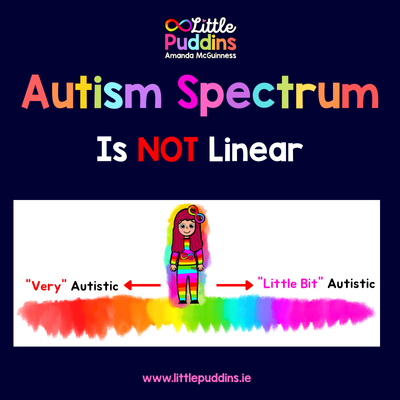
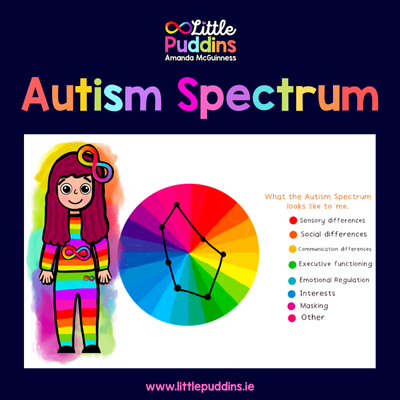
The Autism spectrum is not a line or ladder. It is a multidimensional, relational profile that reflects how an Autistic person senses, processes, interacts, and moves through the world. Each Autistic person has a unique pattern of sensory experiences, interests, communication preferences, emotional expression, and support needs. These patterns shift with context, stress, predictability, and access to co regulation.
Autism is part of natural human variation. It is not something that can be removed, cured, or trained away. Autistic people do not experience Autism as something separate from themselves. It is woven through perception, embodiment, and identity.
It is important to recognise that Autistic people frequently carry experiences of trauma that arise from chronic misunderstanding, social exclusion, inaccessible environments, masking, and the pressure to perform in neuronormative ways. Understanding Autism therefore means understanding context, safety, and relational connection.
A Relational and Neuroaffirmative Perspective
Autistic wellbeing begins with relational connection, autonomy, and safety. The focus is not on managing behaviour. The focus is on understanding the experiences, building trust, reducing pressure, and honouring communication. When environments support these needs, Autistic identity can flourish.
Challenges commonly attributed to Autism are often consequences of unmet sensory, communication needs, lack of predictability, unrelenting demands, or relational disconnection. The responsibility lies with systems and environments, not with the Autistic person.
Language that Respects Autistic Identity
Language must reflect dignity, agency, and truth. It must avoid pathologising interpretations and instead recognise Autistic humanity and culture.
Preferred
Identity first language. Autistic person.
Autistic community, Autistic culture, Autistic ways of being.
Non speaking or minimally speaking. These recognise diverse communication rather than absence of ability.
Support needs or access needs rather than functioning labels.
Co regulation, relational safety, sensory wellbeing.
Autonomy respecting language, for example, invites choice, collaboration, and partnership.
Language to Avoid
Identity first language. Autistic person.
High functioning or low functioning. These overlook distress, minimise needs, and flatten identity
Suffers from Autism or afflicted by Autism. Autism is not an affliction.
Behavioural terms that imply deliberate defiance such as non compliant or resistant. These ignore nervous system overwhelm.
Labels that frame social communication as broken such as social deficits or poor social skills. Autistic communication is valid.
Descriptions that treat interests as problems such as restricted or obsessive. Autistic interests hold meaning, comfort, and expertise.
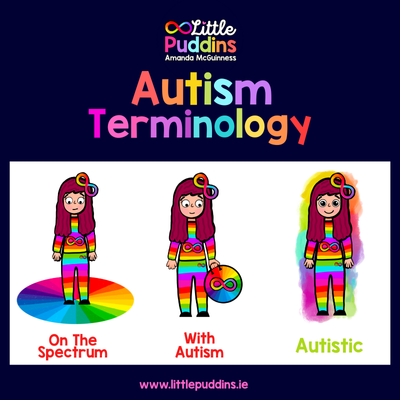
Why Language Matters
Language is not neutral. It shapes how society treats Autistic people and how Autistic people learn to understand themselves. When language positions Autism as a problem, children internalise shame. When language affirms identity, values authenticity, and recognises the influence of environment and trauma, children feel seen and understood.
The profound relief many Autistic individuals feel when they are finally understood without judgement, is available to read all across the online world. Families who use affirming language help create this sense of safety.
What Families Can Do
Centre relational safety
Connection comes before compliance. Autistic children thrive when adults focus on trust, compassion, predictability, and attuning to the child’s needs.Honour sensory and emotional truths
Sensory experiences are not preferences. They are real, embodied realities. When families respond with acceptance rather than correction, children feel validated.Reduce demands and pressure
High demand contexts can activate the nervous system. Offering choice, slowing the pace, and reducing social and verbal expectations can support regulation.Welcome Autistic communication
Autistic communication may be detailed, movement based, visual, direct, or rhythmic. It is meaningful. Families can support communication by giving time, reducing verbal volume, using visual supports, and respecting AAC.Support Autistic authenticity
Masking is often a survival strategy and is linked with trauma. Families can encourage authenticity by accepting stimming, supporting Autistic play, and creating environments where children do not feel judged.Reframe challenges through a compassionate lens
Instead of interpreting distress as misbehaviour, view it as communication of need. This reframing aligns with the trauma aware work of Dr Amy Pearson and Kieran Rose.
Understanding the Autism spectrum through a neuroaffirmative and trauma aware lens offers families a compassionate roadmap.
Autism is not a puzzle to solve. It is a meaningful identity shaped by sensory experience, cognition, embodiment, and connection.
When families use affirming language, reduce pressure, and create conditions of safety, Autistic children gain space to flourish as their authentic selves.
