Understanding Intellectual Disability Language
Intellectual Disability Language
Language shapes how children and teens are understood, supported, and valued. When families encounter the term Intellectual Disability, it is often accompanied by unfamiliar language such as mild, moderate, or severe. These terms are frequently misunderstood and can feel confronting or limiting when they are not explained clearly or used thoughtfully.
This post aims to clarify what Intellectual Disability language means, how children meet criteria for this classification, and why these terms exist within health and education systems, all through a neuroaffirmative, non-ableist lens.
What does “Intellectual Disability” mean?
Intellectual Disability is a neurodevelopmental classification used to describe a pattern of learning and support needs that emerge during childhood. It reflects differences in how a person learns, processes information, and manages daily life within their environments.
Importantly, Intellectual Disability is not a judgement of worth, intelligence, or potential. It does not describe personality, character, capacity for relationships, or ability to experience joy and belonging. It is a descriptor, used to guide understanding and support.
Contemporary frameworks emphasise that people with Intellectual Disabilities continue to learn and grow across the lifespan, particularly when environments are responsive, accessible, and inclusive.
How is Intellectual Disability identified?
Identification is carried out through a comprehensive psychological assessment by a Chartered Clinical Psychologist or Chartered Educational Psychologist with specialist training in child development.
A child is considered to meet criteria for Intellectual Disability when three proponents are present, according to internationally recognised diagnostic frameworks:
Differences in intellectual or cognitive capacity
This refers to how a child reasons, learns, problem-solves, and understands information. Assessment may involve standardised tools, but results are always interpreted cautiously and within context.Differences in adaptive or daily living skills
This includes how a child communicates, manages self-care, navigates social situations, and participates in everyday activities. Adaptive functioning is central to identification and is prioritised over test scores alone.Onset during the developmental period
These differences emerge during childhood or adolescence, rather than being acquired later in life.
Crucially, no child is identified on the basis of a single score or test. The process brings together observation, developmental history, adaptive functioning, and insight from parents and educational settings. The goal is understanding support needs, not predicting limits.
Why are “levels” used?
You may hear terms such as mild, moderate, severe, or profound used alongside Intellectual Disability. These are often referred to as “levels”, but this language can be misleading.
These descriptors do not describe the child. They describe the intensity of support a person may need within current systems.
Contemporary diagnostic guidance is explicit that these categories are:
Administrative and descriptive, not defining
Based on adaptive functioning and support needs, not intelligence alone
Intended to support planning, funding, and service provision
They exist because systems require shared language to allocate resources and supports. They are not measures of value, importance, or future quality of life.
What do the levels actually refer to?
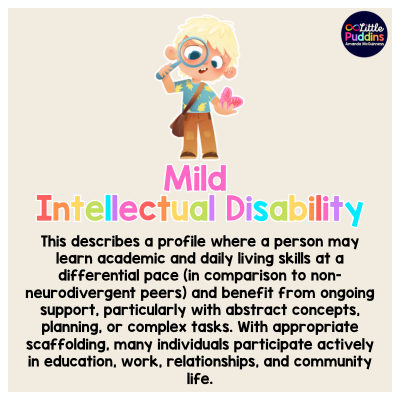
Mild Intellectual Disability
This describes a profile where a person may learn academic and daily living skills at a slower pace and benefit from ongoing support, particularly with abstract concepts, planning, or complex tasks. With appropriate scaffolding, many individuals participate actively in education, work, relationships, and community life.
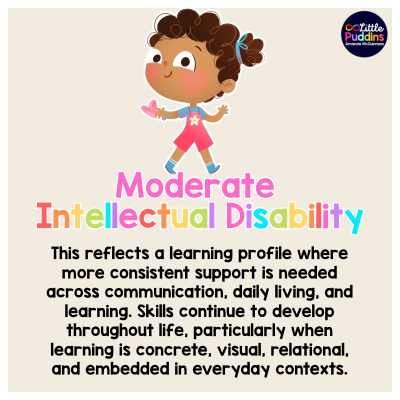
Moderate Intellectual Disability
This reflects a learning profile where more consistent support is needed across communication, daily living, and learning. Skills continue to develop throughout life, particularly when learning is concrete, visual, relational, and embedded in everyday contexts.
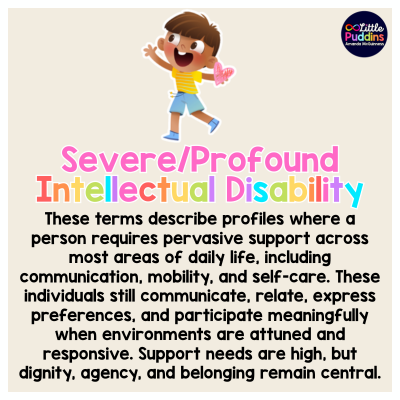
Severe and Profound Intellectual Disability
These terms describe profiles where a person requires pervasive support across most areas of daily life, including communication, mobility, and self-care. These individuals still communicate, relate, express preferences, and participate meaningfully when environments are attuned and responsive. Support needs are high, but dignity, agency, and belonging remain central.
Across all levels, learning is lifelong, and quality of life is shaped far more by relationships, inclusion, and environmental accessibility than by classification.
Why these labels must be used carefully
One of the greatest risks with Intellectual Disability language is when it is used to:
Lower expectations unfairly
Limit access to opportunity
Justify exclusion
Replace curiosity with assumption
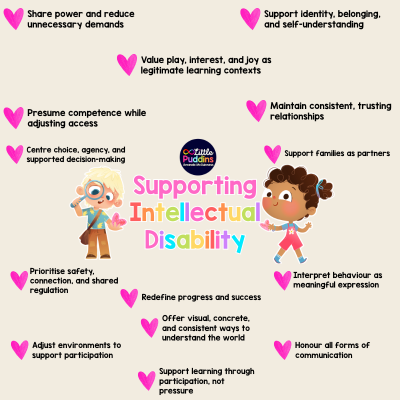
A neuroaffirmative approach recognises that support needs are contextual and fluid. A child may require significant support in one environment and far less in another. Needs also change across time as environments adapt and relationships deepen.
Labels should never be used to define a child’s identity or forecast their future.
Intellectual Disability language should never be used to shrink a child or teen’s world. When understood correctly, it provides a shared framework for recognising how a child learns and what supports allow them to participate fully.
