
Supporting Intellectual Disability

Supporting Autistic Children with an Intellectual Disability
Supporting Autistic children who have an Intellectual Disability requires moving away from deficit-based interpretations of learning, behaviour, and development. A neuroaffirmative approach recognises that difference does not indicate lack, and that support is about creating environments where children can participate, communicate, and belong in ways that are meaningful to them.
The following approaches centre dignity, relational safety, and environmental responsiveness.
1. Prioritise safety, connection, and shared regulation
Learning and participation are most accessible when a child feels emotionally and physically safe. Regulation is not an individual task that a child must master alone. It is a relational process that is supported through calm, attuned adults, predictable interactions, and respectful pacing.
When adults offer steadiness, emotional availability, and consistency, children are supported to remain engaged with their surroundings and with others. This relational regulation supports communication, exploration, and learning without requiring a child to suppress distress or meet external expectations.
2. Interpret behaviour as meaningful expression
All behaviour is a form of expression. It reflects a child’s attempt to communicate needs, preferences, boundaries, or internal states within the limits of the environment and available supports.
Rather than viewing behaviour as something to be managed or reduced, a neuroaffirmative approach focuses on understanding what the behaviour is communicating. This may include experiences of sensory dysphoria, confusion, fatigue, discomfort, desire for connection, or a need for predictability (this list is non-exhaustive).
Support is most effective when it responds to the meaning of the behaviour, rather than attempting to change how the behaviour looks from the outside. Consider may the person be trying to “show you” through their behaviour; are they distressed, ask yourself why.
3. Offer visual, concrete, and consistent ways to understand the world
Many Autistic children with an Intellectual Disability benefit from information that is presented in ways that reduce reliance on memory, language processing, or rapid interpretation. Visual and concrete supports allow children to access information at their own pace and in ways that feel manageable.
Predictable routines, clear visual cues, and consistent formats support understanding and reduce uncertainty. These supports are not compensatory tools. They are valid and respectful ways of sharing information that honour different cognitive and sensory processing styles.
4. Support learning through participation, not pressure
Learning is most meaningful when it is connected to real experiences, relationships, and everyday activities. Breaking activities into smaller steps, modelling actions, and repeating experiences in familiar ways allows children to engage without being overwhelmed.
Support does not need to be withdrawn in order for learning to be considered successful. Participation with support is still participation. Progress can be seen in comfort, confidence, willingness to engage, and shared enjoyment, rather than in speed or independence.
5. Honour all forms of communication
Communication is not limited to spoken language. Autistic children with an Intellectual Disability may communicate through gesture, movement, facial expression, behaviour, vocalisation, AAC, objects, or routines.
A neuroaffirmative approach assumes that all communication is intentional and meaningful. Responding respectfully to these forms of communication builds trust and supports further interaction. Communication support focuses on access and understanding, not on normalising how communication looks.
6. Adjust environments to support participation
Difficulties often arise not because of a child’s needs, but because environments are demanding, unpredictable, or inaccessible. Adjusting environments can significantly increase a child’s ability to participate.
This may include reducing sensory load, slowing the pace of interactions, offering choices, providing visual structure, or creating predictable transitions. These adjustments support inclusion without requiring the child to change who they are.
7. Redefine progress and success
Progress does not need to follow dominant developmental timelines to be meaningful. Learning includes connection, communication, comfort, curiosity, shared activity, and participation in daily life.
Success can be understood through quality of life, relational wellbeing, agency, and belonging. These outcomes are no less valuable than academic or independence-based goals and are often more closely aligned with a child’s lived experience.
8. Support families as partners
Families hold deep knowledge of their child and play a central role in their wellbeing. Supporting families means offering respect, collaboration, and space for complex emotions without judgement.
Acceptance does not mean lowering expectations or withdrawing hope. It means letting go of harmful comparisons and advocating for environments where children are valued as they are. Families should not be expected to carry this work alone.
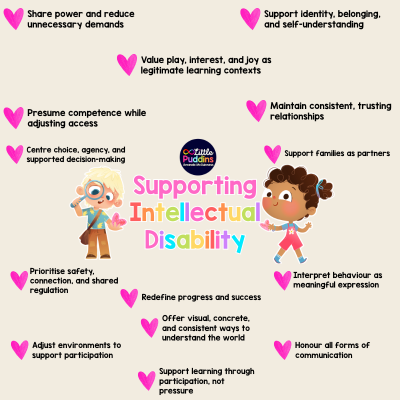
9. Centre choice, agency, and supported decision-making
Autistic children with an Intellectual Disability benefit when their preferences, refusals, and interests are taken seriously, even when these are expressed non-verbally or inconsistently. Agency does not require independence. It requires opportunity.
Supported decision-making involves offering meaningful choices, slowing interactions, and recognising that communication of preference may look different from dominant expectations. This can include choosing between activities, indicating readiness, opting out, or expressing discomfort.
Honouring choice supports trust, reduces distress, and reinforces the child’s sense of self as an active participant in their own life, rather than a passive recipient of care or intervention.
10. Value play, interest, and joy as legitimate learning contexts
Play, repetition, and interest-based engagement are not distractions from learning. They are powerful contexts through which learning, regulation, and connection occur.
Autistic children with an Intellectual Disability often engage deeply through familiar routines, sensory exploration, creative expression, or repeated activities. These forms of engagement support understanding, emotional regulation, and relational connection.
When adults join a child’s play or interests without directing or reshaping them, they communicate respect. Learning that emerges through joy, curiosity, and shared attention is meaningful, even when it does not resemble traditional instructional outcomes.
11. Protect rest, recovery, and pacing as essential supports
Fatigue, cognitive load, and sensory dysphoria are often overlooked contributors to distress and disengagement. Neuroaffirmative support recognises that rest and reduced demand are not rewards or regressions, but essential components of wellbeing.
Children benefit when expectations are paced, transitions are slowed, and rest is embedded into the day without justification. This may include quiet time, sensory breaks, reduced verbal input, or fewer demands during periods of overwhelm.
Supporting rest respects the child’s nervous system and capacity in the moment. It communicates that wellbeing matters more than productivity and that participation should never come at the cost of safety or comfort.
12. Presume competence while adjusting access
Presuming competence means approaching a child as someone who is capable of understanding, learning, and communicating, even when those processes look different from dominant expectations. It does not mean assuming skills that are not present. It means avoiding assumptions of incapacity based on appearance, speech, or pace.
Access is supported by adjusting how information is shared. This may include simplifying language without diminishing meaning, offering additional processing time, using visual or embodied supports, and checking for understanding through shared activity rather than verbal questioning.
Presuming competence protects a child’s dignity and ensures that support opens doors rather than quietly closing them.
13. Maintain consistent, trusting relationships
Predictable, trusting relationships are a powerful form of support. Autistic children with an Intellectual Disability often experience frequent changes in adults, expectations, and environments, which can disrupt safety and engagement.
Where possible, maintaining consistent adults, routines, and relational approaches helps children feel secure. Trust grows when adults respond in familiar ways, honour communication attempts, and follow through consistently.
Relational continuity supports regulation, participation, and confidence. It allows children to engage without needing to constantly assess whether an environment or interaction is safe.
14. Share power and reduce unnecessary demands
Many everyday demands are shaped by adult convenience rather than child need. A neuroaffirmative approach involves examining which demands are essential and which can be softened, delayed, or removed.
Reducing unnecessary demands lowers stress and preserves energy for meaningful engagement. This may include flexible timelines, fewer verbal instructions, alternative ways of participating, or allowing tasks to be unfinished without consequence.
Sharing power does not mean removing structure. It means creating space for collaboration, negotiation, and autonomy in ways that respect the child’s nervous system and capacity.
15. Support identity, belonging, and self-understanding
Children benefit from growing up with language and experiences that affirm who they are. This includes access to respectful explanations about difference, representation of disability as a valid way of being, and opportunities to see themselves reflected positively in their environments.
Supporting identity may involve inclusive books, conversations about difference that are grounded in respect, and adults modelling acceptance. It also includes protecting children from deficit-based narratives and ensuring they are not spoken about as problems or burdens.
Autistic children with an Intellectual Disability do not need to be reshaped to fit existing systems. They need systems that are flexible enough to include them.
When support is grounded in understanding, accessibility, and respect, children are able to participate in ways that reflect who they are. Belonging does not require conformity. It requires recognition.
