
Why Use Visual Supports
Why Visual Supports Matter in Autism Support
(Free resource included to accompany this post)
Visual supports are one of the most effective and evidence-informed ways to support Autistic children and young people across home, school, and community environments. They provide clarity, reduce uncertainty, and support understanding in ways that spoken language alone often cannot.
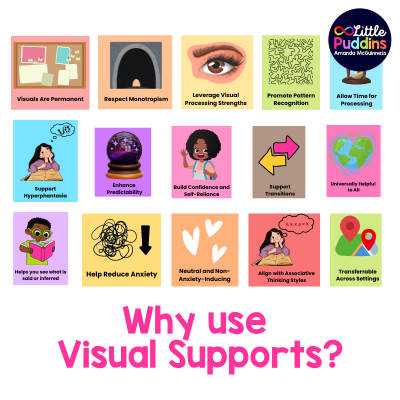
This blog post is accompanied by a free visual resource titled “Why Use Visual Supports?”, which expands on the principles discussed here and can be used as a reference tool for parents, educators, and professionals supporting Autistic learners.
Why visual supports are so effective for Autistic learners
Many Autistic individuals process information visually and benefit from information that is concrete, predictable, and permanently available. Unlike spoken language, which disappears once it is said, visual supports remain present. This allows time for processing, revisiting information, and reducing pressure to respond immediately.
Visual supports align with well-established Autistic cognitive strengths and needs, including:
Strong visual processing and pattern recognition
A preference for predictability and structure
Monotropic attention, where focus is directed toward fewer things at once
Associative thinking styles
A need for reduced cognitive and sensory load
When information is visual, it becomes more accessible, less overwhelming, and easier to integrate.
Reducing anxiety and supporting regulation
Anxiety in Autistic children and teens is often linked to uncertainty, unclear expectations, and rapid verbal demands. Visual supports directly address these stressors by making routines, transitions, and expectations visible and predictable.
Visual schedules, task breakdowns, and visual cues help reduce anxiety by:
Showing what is happening now and what comes next
Supporting smoother transitions
Removing the need for repeated verbal prompting
Offering neutral, non-emotive information
This neutrality is particularly important, as visual supports do not carry tone, urgency, or emotional charge.
Supporting independence without pressure
Visual supports are not about compliance or behaviour control. Used neuroaffirmatively, they support autonomy by giving Autistic children and teens access to information in a format that works for them.
They can support independence by:
Breaking tasks into manageable steps
Allowing individuals to work at their own pace
Supporting confidence and self-reliance
Being transferable across settings such as home, school, and community spaces
Independence here is understood as supported access, not doing things alone.
A resource to support understanding and practice
The free “Why Use Visual Supports?” resource that accompanies this post brings these concepts together in a clear, accessible visual format. It outlines key reasons visual supports are so effective, including predictability, reduced anxiety, support for processing time, and transferability across settings.
The resource can be used:
As a reference for parents and caregivers
In staff training or professional development
As a shared discussion tool within schools or services
To support consistent, neuroaffirmative practice
Visual supports as an environmental adjustment
Visual supports are not an add-on. They are an environmental adjustment that makes everyday life more accessible for Autistic people. When environments change, expectations become clearer and stress reduces.
This post and the accompanying free resource are intended to support a shift away from expecting Autistic children to adapt, and towards creating environments that are clear, predictable, and supportive.
The free “Why Use Visual Supports?” resource is available alongside this post and can be downloaded to support understanding, reflection, and practice across home and school contexts
