
Strewing and PDA Guide

A Neuroaffirmative Approach to Supporting Demand Avoidance
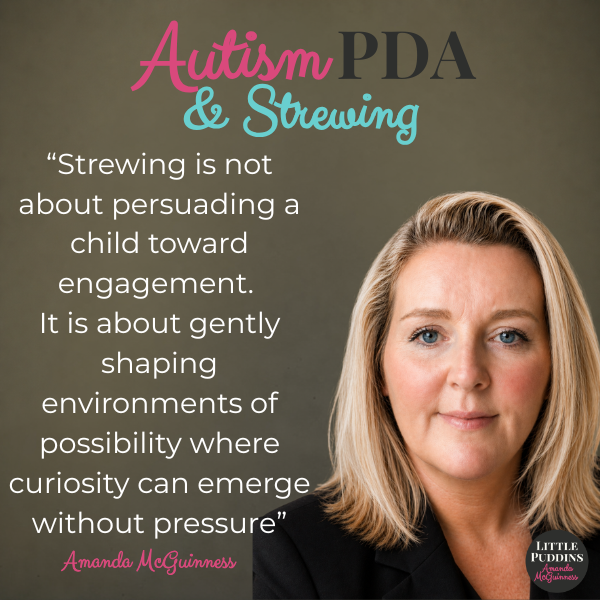
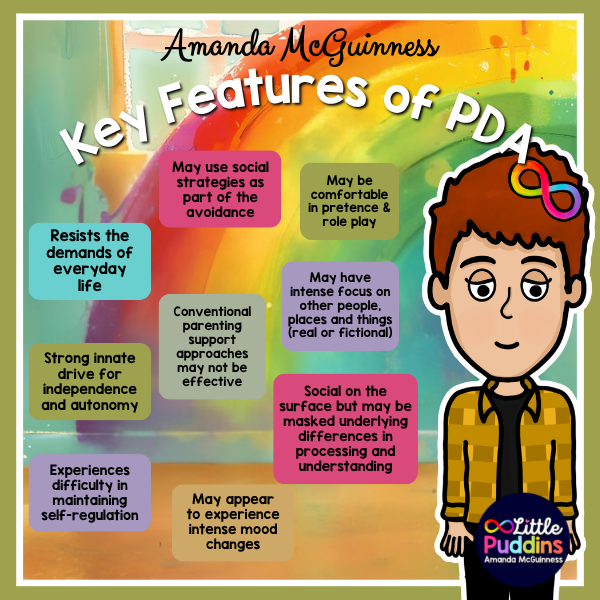
For PDAers with demand avoidant profile, everyday life can be experienced through a lens of heightened threat perception. Demands are not limited to instructions or expectations. They can be direct, subtle, relational, environmental, or even internally generated. This means that engagement, participation, and daily functioning are deeply influenced by how safe and autonomous the nervous system feels in any given moment.
PDA and Strewing
Within this context, strewing offers a practical, neuroaffirmative way of supporting engagement without increasing pressure.
Originally described by Sandra Dodd within unschooling, strewing has been meaningfully reconceptualised within PDA-informed practice as a way of reducing demand perception while still offering opportunities for connection, learning, and participation.
What Is Strewing in a PDA Context?
Within a demand avoidance framework, strewing can be defined as:
The intentional offering of sensory, environmental, or relational cues that a PDA individual can engage with or not, without expectation, instruction, or pressure.
The critical distinction is this:
The adult is not trying to get the child to do something.
The adult is creating conditions where engagement can happen safely.
Strewing as a Neuroaffirmative PDA Approach
For individuals with a PDA profile, the nervous system may interpret many everyday interactions as threats to autonomy.
This includes:
Direct instructions
Questions
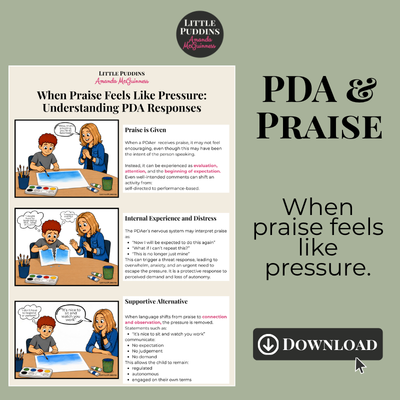
Praise
Suggestions
Planned activities
Transitions
Even perceived expectations
When this happens, the brain shifts into a protective state. Engagement is not accessible in the same way, regardless of interest or ability.
Strewing works because it:
Removes direct demand
Preserves autonomy
Reduces relational pressure
Allows the individual to remain in a regulated, thinking state
Creates space for curiosity to emerge
It aligns with the understanding that:
Engagement is not a skill deficit. It is a state-dependent capacity.
The Nervous System Perspective
Strewing is effective because it supports a shift away from survival responses and towards regulation.
When pressure is reduced:
The nervous system experiences greater safety
The thinking brain becomes more accessible
Flexibility increases
Curiosity can re-emerge
Engagement becomes possible
This reflects key principles from:
Polyvagal-informed understanding of safety and connection
Autonomy-based models of human motivation
Trauma-informed approaches to learning and support

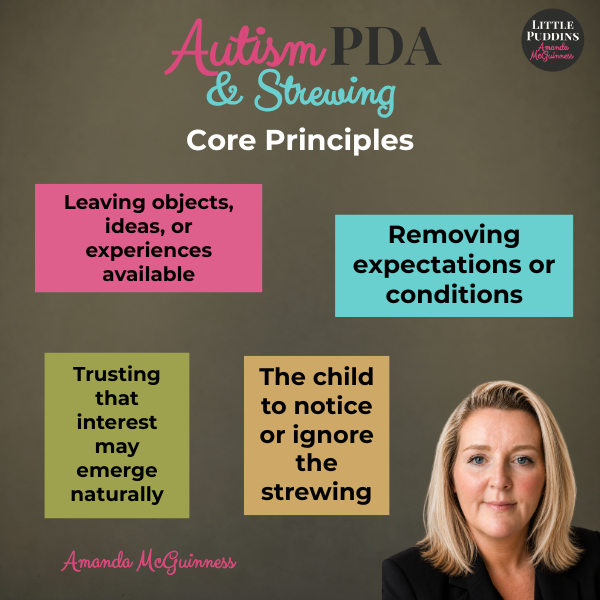
Core Principles of PDA Strewing
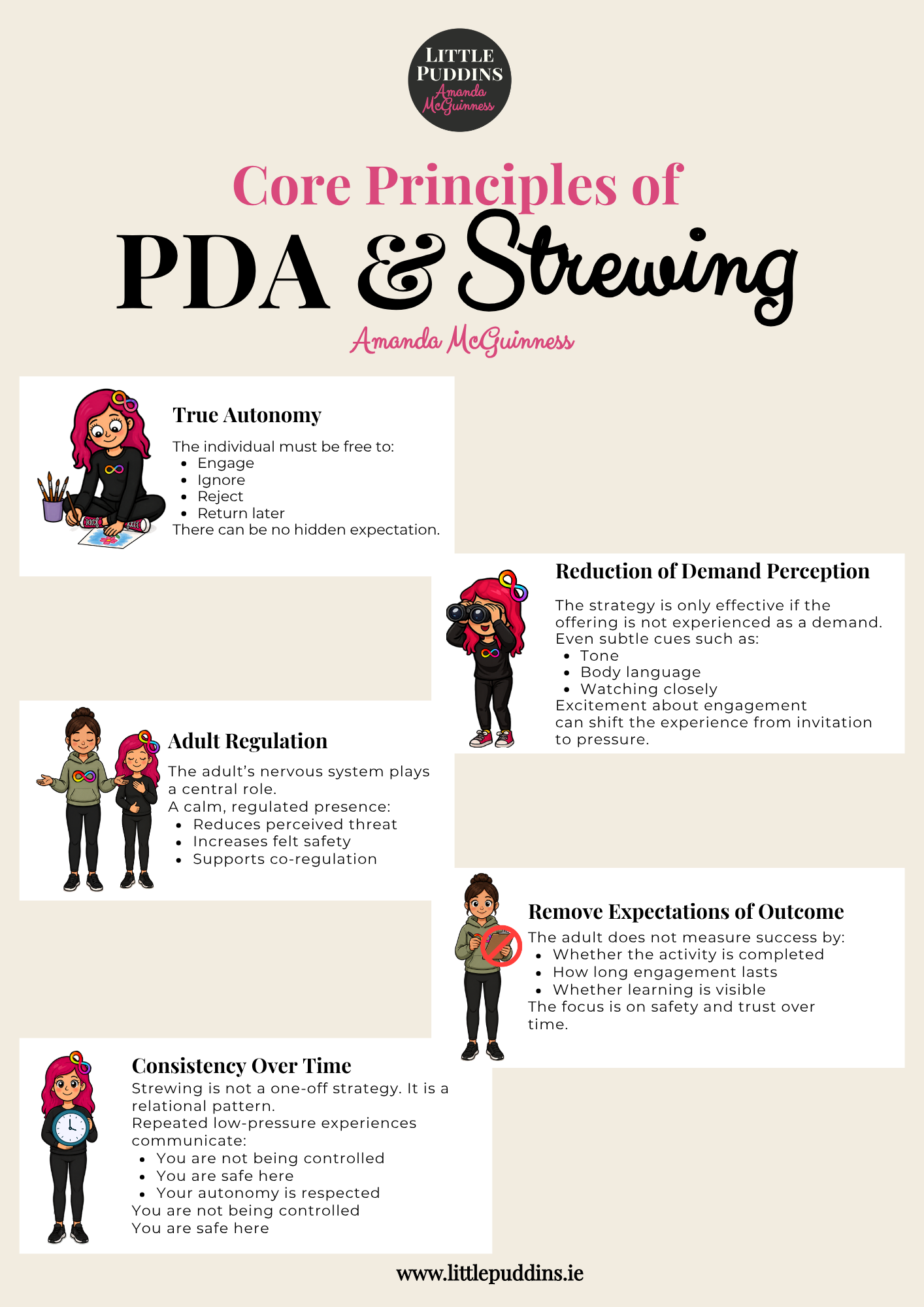
The core principles of strewing provide a contemporary neuroaffirmative framework for supporting individuals with a Persistent Drive for Autonomy (PDA) profile. Designed for parents, educators and professionals, the framework focuses on creating environments that strengthen meaningful influence, support autonomy, and enhance felt safety. By reducing pressure, prioritising collaboration, supporting adult regulation and removing predetermined expectations of outcome, strewing helps create the conditions in which participation becomes more accessible. Rather than seeking behavioural compliance, it supports engagement, learning and connection through relationship-centred, autonomy-supportive practice.
1. True Autonomy
The individual must be free to:
Engage
Ignore
Reject
Return later
There can be no hidden expectation.
2. Non-Attachment to Outcome
The adult does not measure success by:
Whether the activity is completed
How long engagement lasts
Whether learning is visible
The focus is on safety and trust over time.
3. Reduction of Demand Perception
The strategy is only effective if the offering is not experienced as a demand.
Even subtle cues such as:
Tone
Body language
Watching closely
Excitement about engagement
can shift the experience from invitation to pressure.
4. Consistency Over Time
Strewing is not a one-off strategy. It is a relational pattern.
Repeated low-pressure experiences communicate:
You are not being controlled
You are safe here
Your autonomy is respected
5. Adult Regulation
The adult’s nervous system plays a central role.
A calm, regulated presence:
Reduces perceived threat
Increases felt safety
Supports co-regulation
Types of Strewing in PDA Practice
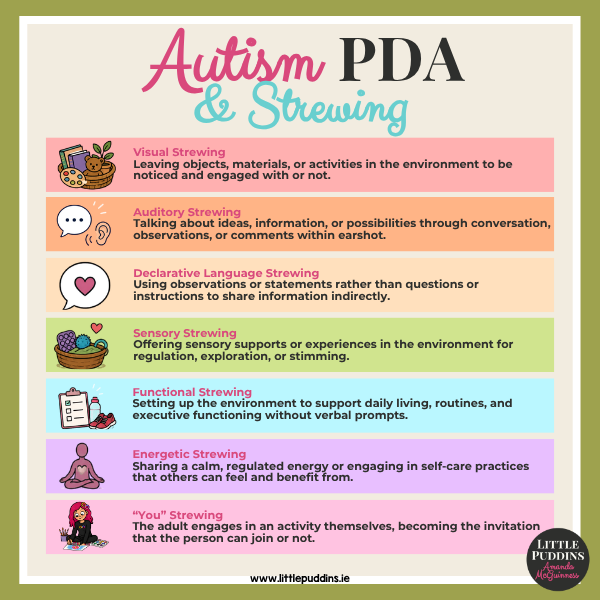
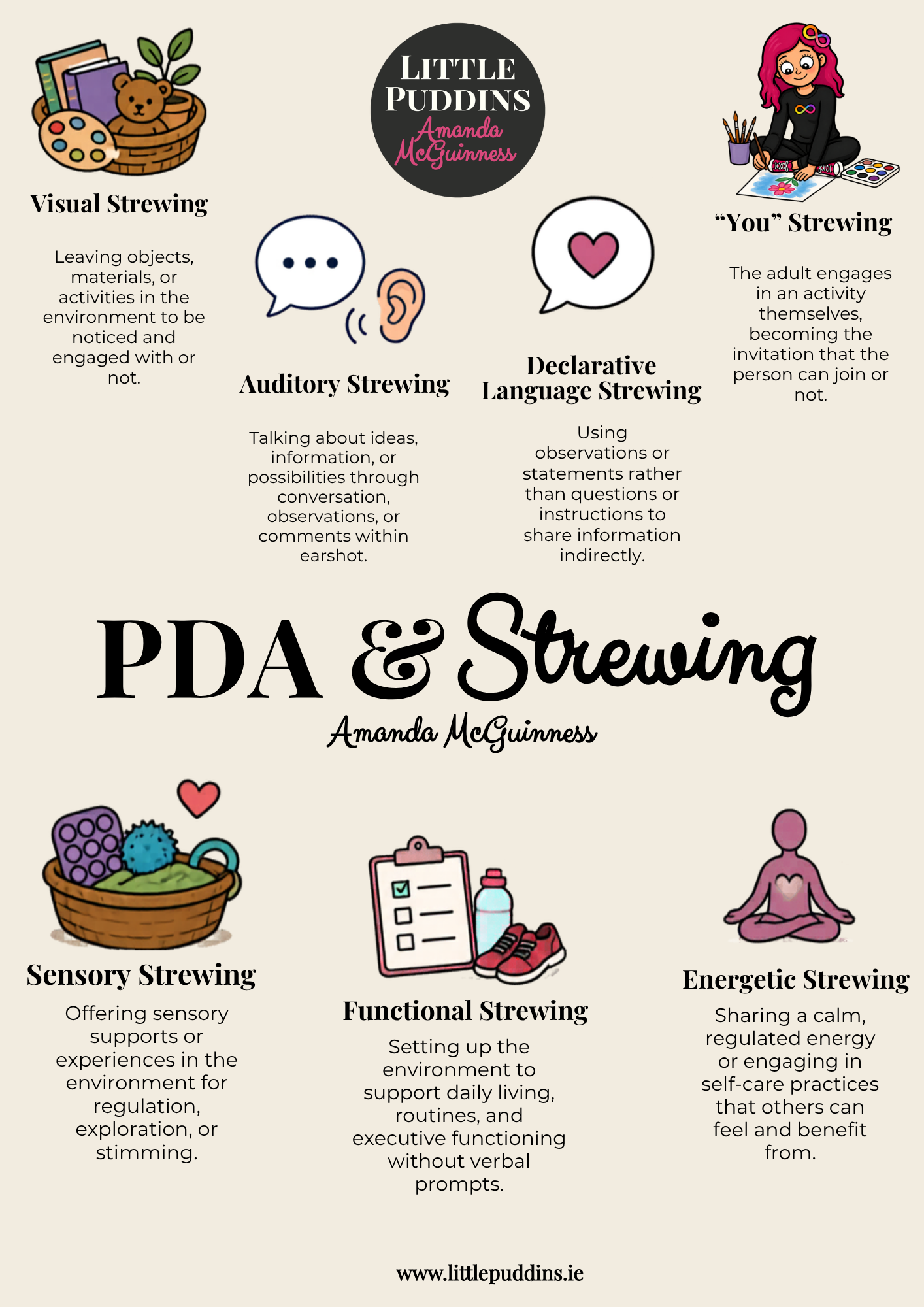
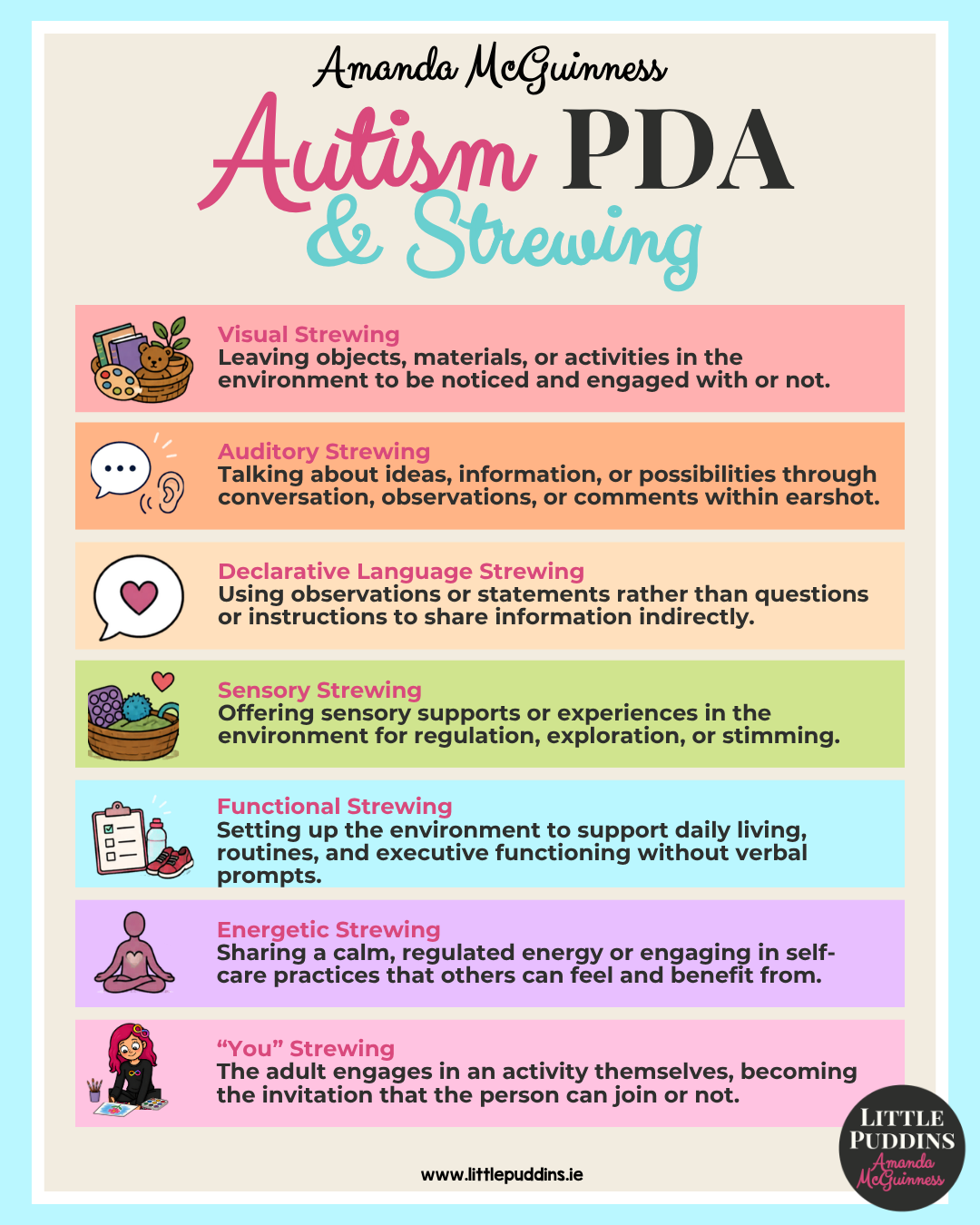
Visual Strewing
Objects or activities are placed in the environment.
Examples:
Art materials left on a table
A favourite book open on the sofa
Baking ingredients visible in the kitchen
A puzzle set up but incomplete
The individual can approach or not.
Auditory Strewing
Ideas are introduced indirectly, without requiring response.
Examples:
“I noticed the swimming pool is open today.”
“It looks like the park has a new playground.”
Conversations within earshot
This avoids triggering automatic refusal linked to direct questioning.
“You” Strewing
The adult engages in an activity themselves, without inviting participation.
Examples:
Painting
Baking
Building something
Reading nearby
This can feel safer because the individual is not being asked to perform or respond.
Declarative Language
Statements are used instead of questions or instructions.
Examples:
“That was a loud noise.”
“This task has lots of steps.”
“My body feels calmer when it’s quiet.”
This introduces information without creating demand.

Sensory Strewing
Regulation supports are made available.
Examples:
A basket of fidgets or textures
Soft lighting
Movement tools
Weighted items
This supports nervous system regulation without requiring the individual to ask.
Functional Strewing
The environment supports daily life tasks.
Examples:
Shoes placed near the door
A water bottle beside a preferred space
A school bag left open
Materials visible but not mentioned
This reduces executive functioning demands without verbal prompting.

Everyday Applications
Supporting Learning
Rather than structured teaching:
Materials are made available
Interests are followed
Learning emerges through engagement
Supporting Transitions
Instead of direct instructions:
Environmental cues signal upcoming changes
Options are visible rather than imposed
Supporting Regulation
Sensory supports are accessible without negotiation or request.
Supporting Daily Living
Tasks become more approachable when:
Pressure is reduced
Autonomy is preserved
The environment does some of the work
Common Misunderstandings
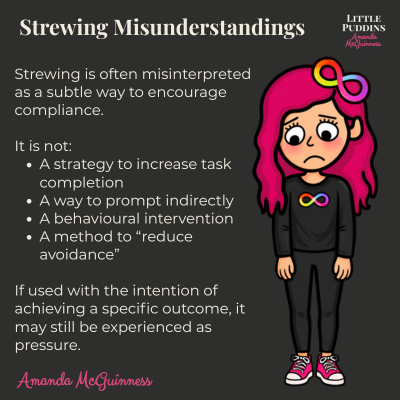
Strewing is often misinterpreted as a subtle way to encourage compliance.
It is not:
A strategy to increase task completion
A way to prompt indirectly
A behavioural intervention
A method to “reduce avoidance”
If used with the intention of achieving a specific outcome, it may still be experienced as pressure.
What to Avoid
Presenting too many options at once
Drawing attention to the activity
Praising in a way that creates expectation
Turning engagement into a task
Following up with demands
Using strewing only during moments of resistance
What Changes Over Time
When strewing is used consistently and authentically, families can often begin to notice:
Increased spontaneous engagement
Reduced intensity of demand-related distress
More flexible participation
Greater sense of autonomy
Improved relational trust
Moments of unexpected connection
These changes are gradual and cumulative.
Continue Exploring PDA
Understanding pressure is one part of the wider picture.
You may also find these Little Puddins guides helpful:
What is PDA? Learn about the characteristics of a Persistent Drive for Autonomy and why it is understood differently from traditional behaviour-based models.
PDA Parenting Guide Explore practical, neuroaffirmative approaches to supporting everyday life at home.
Declarative Language Discover how communication styles can influence autonomy, regulation and connection.
PDA and School Understand how classroom environments, expectations and relationships shape participation.
Autistic Burnout and Regulation Learn how accumulated stress can affect capacity across home, school and community.
References:
Pathological Demand Avoidance (PDA) and the Nervous System:
1. Foundational Understanding of PDA:
Newson, E., Le Maréchal, K. and David, C. (2003) ‘Pathological demand avoidance syndrome: a necessary distinction within the pervasive developmental disorders’, Archives of Disease in Childhood, 88(7), pp. 595–600. Available at: https://adc.bmj.com/content/88/7/595 (Accessed: 1 February 2025).
Johnson, M. and Saunderson, H. (2023) ‘Examining the relationship between anxiety and pathological demand avoidance in adults: A mixed methods approach’, Frontiers in Education, 8, Article 1179015. Available at: https://www.frontiersin.org/articles/10.3389/feduc.2023.1179015/full (Accessed: 2 February 2025).
O’Nions, E., Happé, F., Viding, E. and Noens, I. (2021) ‘Extreme demand avoidance in children with autism spectrum disorder: Refinement of a caregiver-report measure’, Advances in Neurodevelopmental Disorders, 5(3), pp. 1–13. Available at: https://link.springer.com/article/10.1007/s41252-021-00203-z (Accessed: 1 February 2025).
O’Nions, E., Christie, P., Gould, J., Viding, E. and Happé, F. (2014) ‘Development of the “Extreme Demand Avoidance Questionnaire” (EDA-Q): Preliminary observations on a trait measure for pathological demand avoidance’, Journal of Child Psychology and Psychiatry, 55(7), pp. 758–768. Available at: https://acamh.onlinelibrary.wiley.com/doi/10.1111/jcpp.12149 (Accessed: 2 February 2025).
2. Neurophysiological Perspectives:
Porges, S.W. (2011) The Polyvagal Theory: Neurophysiological Foundations of Emotions, Attachment, Communication, and Self-Regulation. New York: W.W. Norton & Company.
Porges, S.W. (2001) ‘The polyvagal theory: phylogenetic substrates of a social nervous system’, International Journal of Psychophysiology, 42(2), pp. 123–146.
3. Insights for PDA Practitioners:
O’Nions, E., Happé, F., Viding, E. and Noens, I. (2021) ‘Extreme demand avoidance in children with autism spectrum disorder: Refinement of a caregiver-report measure’, Advances in Neurodevelopmental Disorders, 5(3), pp. 1–13. Available at: https://link.springer.com/article/10.1007/s41252-021-00203-z (Accessed: 1 February 2025)
Haire, L., Symonds, J., Senior, J. and D’Urso, G. (2024) ‘Methods of studying pathological demand avoidance in children and adolescents: A scoping review’, Frontiers in Education, 9, Article 1230011. Available at: https://www.frontiersin.org/articles/10.3389/feduc.2024.1230011/full (Accessed: 1 February 2025).
4. Neuroscience and Trauma-Informed Perspectives:
Porges, S.W. (2009) ‘Reciprocal influences between body and brain in the perception and expression of affect: A polyvagal perspective’, The Healing Power of Emotion: Affective Neuroscience, Development & Clinical Practice, pp. 27–54.
5. Real-World Lived Experience and Clinical Application:
Christie, P. (2018) ‘PDA… the story so far’, PDA Society Resources. Available at: https://www.pdasociety.org.uk/resources/phil-christie-pda-the-story-so-far/ (Accessed: 1 February 2025).
