
What is Strewing?

Understanding What Is Strewing
The Origins of Strewing
The concept of strewing originates within the unschooling movement and is widely attributed to unschooling advocate Sandra Dodd. It emerged in the 1990s through home-schooling communities and was later developed through her writing and practical guidance for families engaging in self-directed education.
Within its original context, strewing was not designed as a strategy for demand avoidance. Instead, it formed part of a broader philosophy of natural, interest-led learning, where children are supported to engage with the world in ways that feel meaningful and self-directed.
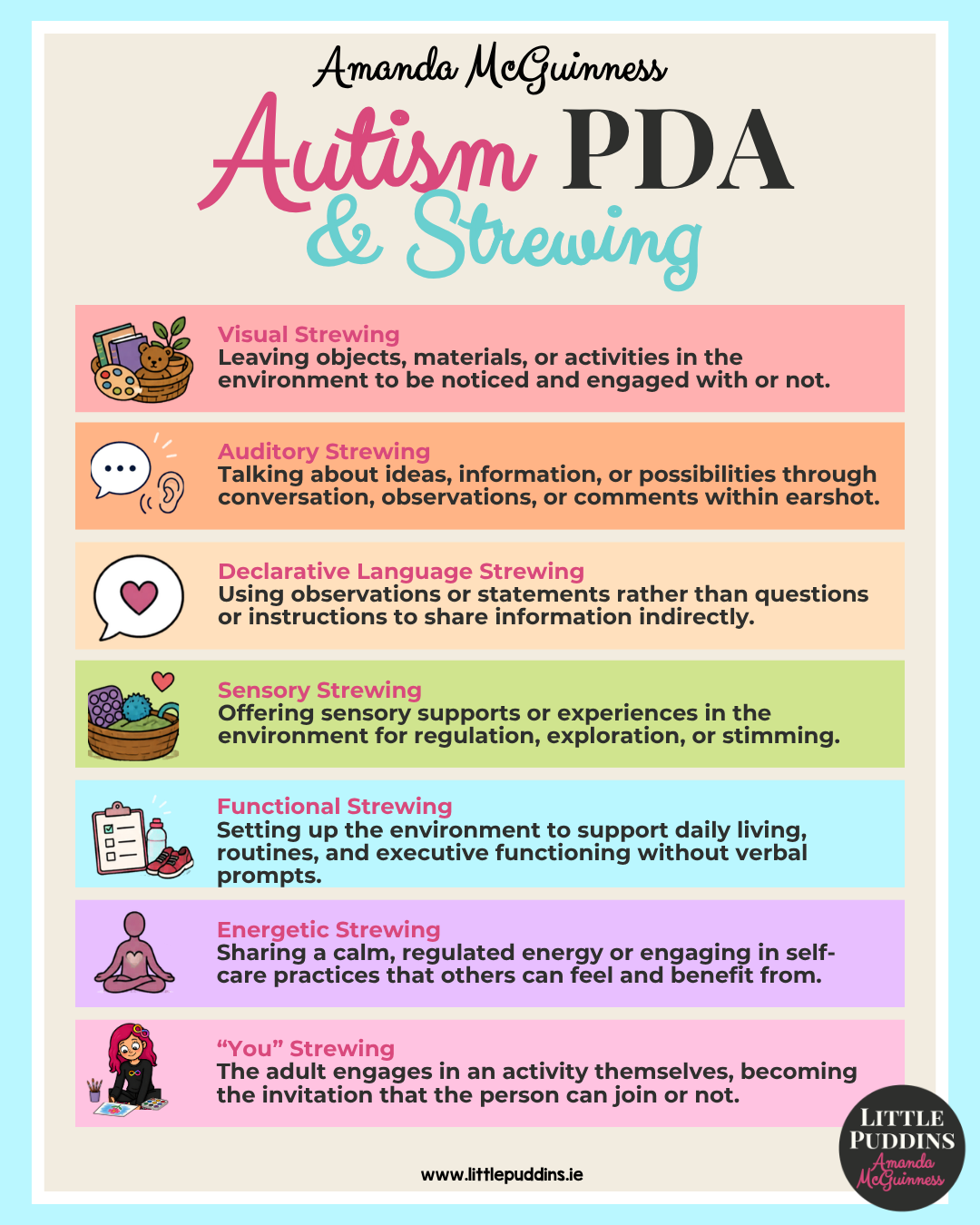
Sandra Dodd described strewing as a way of enriching a child’s environment by bringing interesting things into their path, without requiring interaction or turning those offerings into structured lessons.
Core Principles of Strewing
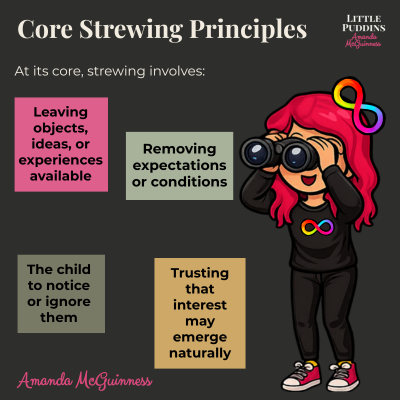
At its core, strewing involves:
Leaving objects, ideas, or experiences available
Allowing the child to notice or ignore them
Removing expectations or conditions
Trusting that interest may emerge naturally
Importantly, strewing is grounded in a non-directive approach. This means that the adult does not attach any expectation that the child must engage, learn, or respond in a particular way.

What Does Strewing Look Like in Practice?
In everyday life, strewing can look like:
Placing a book, puzzle, or object in a shared space
Bringing home something interesting discovered during the day
Introducing ideas through everyday conversation
Creating an environment rich in possibilities rather than instructions
Over time, Sandra Dodd emphasised that strewing becomes less of a deliberate technique and more of a way of living, where the environment is continuously shaped to support curiosity and exploration.
Strewing Within Unschooling Philosophy
Strewing sits within the wider framework of unschooling, which is based on the understanding that learning is:
Naturally occurring
Interest-driven
Embedded in everyday life
Not dependent on formal instruction or curriculum
Within this model, the role of the adult is not to direct learning, but to:
Create access to experiences
Expand opportunities
Support exploration
Trust the child’s internal motivation
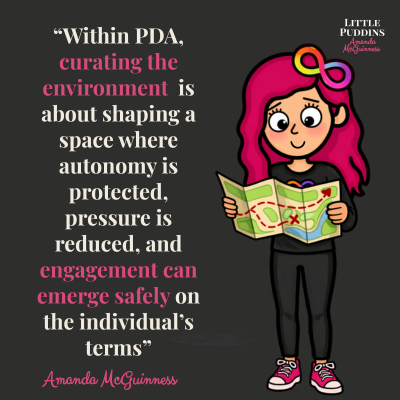
Rather than asking, prompting, or structuring learning, the adult curates the environment.
An Important Distinction for PDA Practice
While strewing is now widely used within PDA (Persistent Demand Avoidance) and demand avoidance support, it is important to be clear:
Strewing was not originally developed as a PDA strategy.
However, its core principles align closely with what we now understand about:
Autonomy and control
Nervous system safety
Demand perception
Relational dynamics

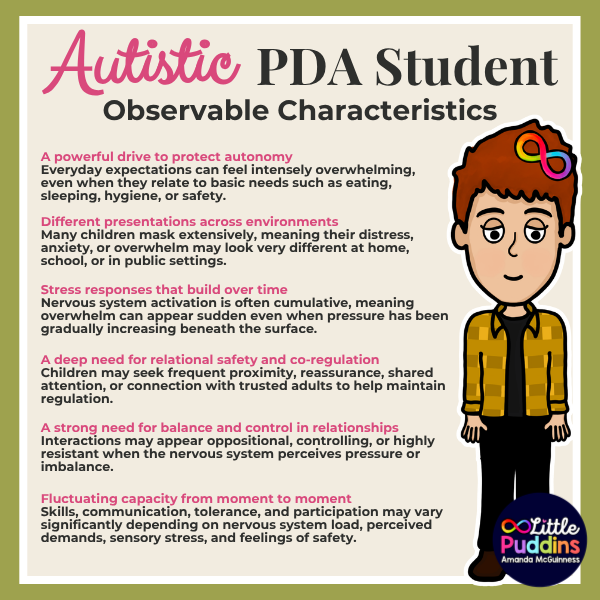
For Autistic individuals with a PDA profile, where even subtle expectations can activate a threat response, strewing offers a powerful way of:
Removing interpersonal pressure
Preserving autonomy
Allowing engagement to emerge without demand
This makes it a highly compatible and effective approach when used within a neuroaffirmative framework.
Strewing for PDA
In PDA-informed practice, strewing has evolved from an educational concept into a relational and regulatory support strategy.
The key shift is this:
From:
Creating opportunities for learning
To:
Reducing demand and supporting safe engagement
While the method may appear similar, the intention is fundamentally different.
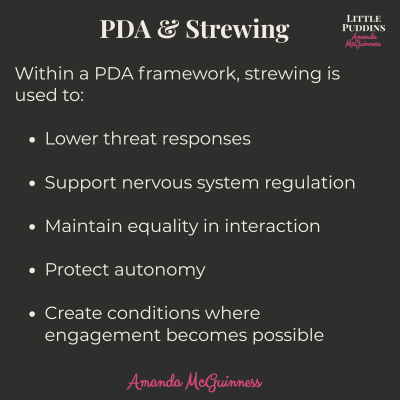
Within a PDA framework, strewing is used to:
Lower threat responses
Support nervous system regulation
Maintain equality in interaction
Protect autonomy
Create conditions where engagement becomes possible

The Origins of Strewing
Understanding where strewing comes from is essential for using it with integrity.
Without this context, strewing can easily be misunderstood as:
A subtle way to prompt behaviour
A strategy to increase participation
A tool to achieve specific outcomes
This shifts it back into a demand-based interaction, which is not supportive for PDA.
Returning to its origins reminds us that strewing is fundamentally about:
Offering, not directing
Trusting, not controlling
Inviting, not expecting
Continue Exploring PDA
Understanding pressure is one part of the wider picture.
You may also find these Little Puddins guides helpful:
What is PDA? Learn about the characteristics of a Persistent Drive for Autonomy and why it is understood differently from traditional behaviour-based models.
PDA Parenting Guide Explore practical, neuroaffirmative approaches to supporting everyday life at home.
Declarative Language Discover how communication styles can influence autonomy, regulation and connection.
PDA and School Understand how classroom environments, expectations and relationships shape participation.
Autistic Burnout and Regulation Learn how accumulated stress can affect capacity across home, school and community.

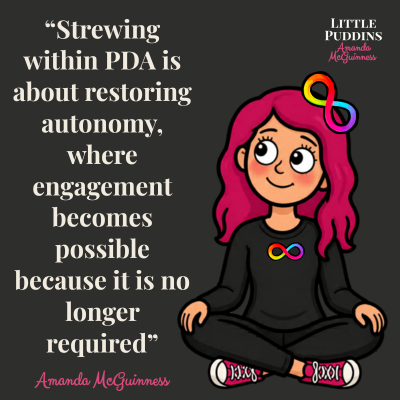
“When adapted thoughtfully, strewing becomes a powerful strategy to support Autistic individuals whose engagement is shaped by demand sensitivity and nervous system safety” Amanda McGuinness

PDA References
Supporting Autistic PDA Students References:
Christie, P., Duncan, M., Fidler, R. and Healy, Z. (2012). Understanding Pathological Demand Avoidance Syndrome in Children: A Guide for Parents, Teachers and Other Professionals. London: Jessica Kingsley Publishers.
Fidler, R. and Christie, P. (2019). Collaborative Approaches to Learning for Pupils with PDA: Strategies for Education Professionals. London: Jessica Kingsley Publishers.
Truman, C. (2021). The Teacher’s Introduction to Pathological Demand Avoidance: Essential Strategies for the Classroom. London: Jessica Kingsley Publishers.
Fricker, E. (2021). The Family Experience of PDA: An Illustrated Guide to Pathological Demand Avoidance. London: Jessica Kingsley Publishers.
Cat, S. (2018). Pathological Demand Avoidance Explained. London: Jessica Kingsley Publishers.
Eaton, J. (2017). A Guide to Mental Health Issues in Girls and Young Women on the Autism Spectrum: Diagnosis, Intervention and Family Support. London: Jessica Kingsley Publishers.
Newson, E. (2003). Pathological Demand Avoidance Syndrome: A Necessary Distinction within the Pervasive Developmental Disorders. Archives of Disease in Childhood, 88(7), pp. 595–600.
Get in Touch: Contact Amanda
Follow for Insights: Instagram @littlepuddins.ie
