PDA Assessment in Autism: EDA-Q and EDA-8 Explained
PDA EDA-Q and EDA-8 Explained
If you have been searching for information on PDA assessment, you may have come across terms such as the EDA-Q (Extreme Demand Avoidance Questionnaire) and the EDA-8. These tools are often referenced when discussing demand avoidance, yet there can be confusion around what they are, how they are used, and whether they provide a diagnosis.
This blog provides a clear, neuroaffirmative explanation of:
The role of the EDA-Q and EDA-8 questionnaires
What these tools can and cannot tell us
How they relate to the lived experience of demand avoidance

What Is the EDA-Q (Extreme Demand Avoidance Questionnaire)?
The EDA-Q is a research-based questionnaire developed by Dr. Elizabeth O’Nions and colleagues in 2013. It was created to help identify behaviours associated with extreme demand avoidance in children.
The questionnaire:
Is typically completed by parents or caregivers
Includes a series of statements about behaviour
Uses a rating scale to indicate how often behaviours occur
It was designed to measure patterns such as:
Resistance to everyday demands
Strong need for control and autonomy
Use of strategies to avoid expectations
Emotional responses linked to perceived pressure
You can explore the original EDA-Q here.
What Is the EDA-8?
The EDA-8 is a shorter, refined version of the EDA-Q, developed through further research.
It:
Includes 8 key items
Focuses on the most consistent indicators of demand avoidance
May be easier to use in both research and practice contexts
You can access the EDA-8 here.
EDA-Q and EDA-8 are screening and research tools
A key point for anyone exploring PDA assessment is that:
The EDA-Q and EDA-8 are screening and research tools
They do not diagnose PDA or Autism
They are used to identify patterns and traits, not provide clinical conclusions
They are most useful when:
Used alongside professional assessment
Interpreted within the child’s broader context
Considered as part of a holistic understanding
What Do These Questionnaires Tell Us About PDA?
The EDA-Q and EDA-8 highlight an important shift in understanding behaviour.
Rather than viewing behaviour as:
Refusal
Non-compliance
Opposition
They support understanding behaviour as a response to:
Perceived demand
Threat to autonomy
Nervous system activation
For many Autistic individuals with a demand avoidant profile:
Everyday expectations can feel overwhelming
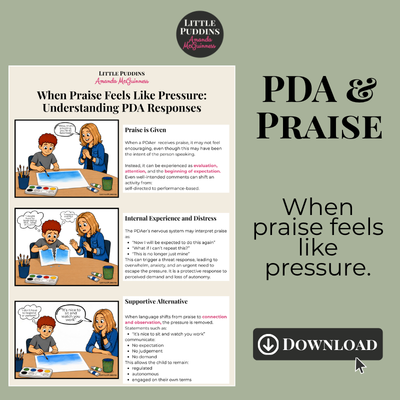
Even positive interactions, such as praise, can be experienced as pressure
Avoidance strategies are often protective, not intentional

Disclaimer
This post is for informational and educational purposes only. The EDA-Q and EDA-8 are research-based tools and not diagnostic instruments. Every individual is unique, and interpretation should always be considered within the context of the person’s lived experience.
References:
Pathological Demand Avoidance (PDA) and the Nervous System:
1. Foundational Understanding of PDA:
Newson, E., Le Maréchal, K. and David, C. (2003) ‘Pathological demand avoidance syndrome: a necessary distinction within the pervasive developmental disorders’, Archives of Disease in Childhood, 88(7), pp. 595–600. Available at: https://adc.bmj.com/content/88/7/595 (Accessed: 1 February 2025).
Johnson, M. and Saunderson, H. (2023) ‘Examining the relationship between anxiety and pathological demand avoidance in adults: A mixed methods approach’, Frontiers in Education, 8, Article 1179015. Available at: https://www.frontiersin.org/articles/10.3389/feduc.2023.1179015/full (Accessed: 2 February 2025).
O’Nions, E., Happé, F., Viding, E. and Noens, I. (2021) ‘Extreme demand avoidance in children with autism spectrum disorder: Refinement of a caregiver-report measure’, Advances in Neurodevelopmental Disorders, 5(3), pp. 1–13. Available at: https://link.springer.com/article/10.1007/s41252-021-00203-z (Accessed: 1 February 2025).
O’Nions, E., Christie, P., Gould, J., Viding, E. and Happé, F. (2014) ‘Development of the “Extreme Demand Avoidance Questionnaire” (EDA-Q): Preliminary observations on a trait measure for pathological demand avoidance’, Journal of Child Psychology and Psychiatry, 55(7), pp. 758–768. Available at: https://acamh.onlinelibrary.wiley.com/doi/10.1111/jcpp.12149 (Accessed: 2 February 2025).
2. Neurophysiological Perspectives:
Porges, S.W. (2011) The Polyvagal Theory: Neurophysiological Foundations of Emotions, Attachment, Communication, and Self-Regulation. New York: W.W. Norton & Company.
Porges, S.W. (2001) ‘The polyvagal theory: phylogenetic substrates of a social nervous system’, International Journal of Psychophysiology, 42(2), pp. 123–146.
3. Insights for PDA Practitioners:
O’Nions, E., Happé, F., Viding, E. and Noens, I. (2021) ‘Extreme demand avoidance in children with autism spectrum disorder: Refinement of a caregiver-report measure’, Advances in Neurodevelopmental Disorders, 5(3), pp. 1–13. Available at: https://link.springer.com/article/10.1007/s41252-021-00203-z (Accessed: 1 February 2025)
Haire, L., Symonds, J., Senior, J. and D’Urso, G. (2024) ‘Methods of studying pathological demand avoidance in children and adolescents: A scoping review’, Frontiers in Education, 9, Article 1230011. Available at: https://www.frontiersin.org/articles/10.3389/feduc.2024.1230011/full (Accessed: 1 February 2025).
4. Neuroscience and Trauma-Informed Perspectives:
Porges, S.W. (2009) ‘Reciprocal influences between body and brain in the perception and expression of affect: A polyvagal perspective’, The Healing Power of Emotion: Affective Neuroscience, Development & Clinical Practice, pp. 27–54.
5. Real-World Lived Experience and Clinical Application:
Christie, P. (2018) ‘PDA… the story so far’, PDA Society Resources. Available at: https://www.pdasociety.org.uk/resources/phil-christie-pda-the-story-so-far/ (Accessed: 1 February 2025).