Autism Level Up!
Why the Autism Level UP! Energy Framework Is Transforming How We Understand Regulation

Over the years, I have explored countless resources relating to regulation, emotional wellbeing, and support for Autistic individuals. Very few have had the lasting impact of the Autism Level UP Energy Framework developed by developmental psychologists Dr. Amy Laurent and Dr. Jacquelyn Fede.
Recently, I had the privilege of welcoming both Amy and Jacquelyn onto The Unfiltered Autistic Podcast, where we explored the origins of the framework, the thinking behind it, and why it has become such a powerful tool for families, educators, therapists, and Autistic individuals around the world. The conversation reinforced something I have often observed in my own professional practice: many Autistic people do not struggle because they lack motivation, willingness, or capability. Rather, they are often navigating environments that do not align with the way their nervous systems experience and manage energy.
The Energy Framework - Autism Level Up!
One of the most significant contributions of the Energy Framework is its challenge to the long-standing assumption that regulation is synonymous with being calm. Across schools, workplaces, and even many therapeutic settings, calmness is frequently presented as the desired endpoint. The Energy Framework offers a different perspective. Regulation is not about achieving a particular emotional state. Instead, it is about having the energy needed for the demands of the moment. A person can be energetic, excited, moving constantly, and still be well regulated if that energy matches the activity they are engaged in. Equally, a person may appear calm on the surface while experiencing significant internal strain, overwhelm, or exhaustion. This shift from judging energy levels to understanding their context is one of the reasons the framework resonates so strongly with so many people.
During our discussion, Jacquelyn spoke candidly about her own experience of Autistic burnout and how that experience ultimately contributed to the development of the framework. She described how traditional conversations about emotions often felt inaccessible and disconnected from her lived experience. Energy, however, felt concrete. It was something she could observe, notice, and understand within her body. Rather than asking herself whether she felt anxious, frustrated, or overwhelmed, she could identify whether her energy felt depleted, scattered, heightened, or focused. This distinction proved transformative. Amy explained that while emotional regulation has long been central to developmental psychology, physiological arousal and energy are already recognised as foundational components of emotional experiences. By focusing on energy first, the framework creates a more accessible entry point for many individuals, particularly those who find emotional language abstract or difficult to interpret.
What makes the framework particularly powerful is its simplicity. At its core, it asks two questions. Where is my energy right now? Where does my energy need to be for what I am trying to do? When there is a match between those two states, regulation is generally supported. When there is a mismatch, challenges often emerge. Importantly, the framework does not place responsibility solely on the individual to adapt. Instead, it recognises that environments, expectations, sensory demands, and activities all play a role in creating either alignment or mismatch. This perspective moves us away from deficit-based interpretations and towards a more contextual understanding of human functioning.
“The Only Norm Is Difference” - Dr Jacquelyn Fede
One of the concepts that resonated most strongly with me was Jac's statement that "the only norm is difference." It is a deceptively simple idea with far-reaching implications. Imagine classrooms where all students are encouraged to understand how they learn best, what helps them concentrate, what drains their energy, and what supports their participation. Not because they have a diagnosis or additional support needs, but because every human being is unique. This approach supports variation rather than positioning difference as something that requires explanation or justification. It creates cultures where understanding oneself becomes a shared expectation rather than a specialised intervention.
The framework also offers a powerful pathway towards self-awareness and self-advocacy. As a parent, this is one of the aspects I value most. When young people begin to recognise their own energy patterns, they gain insight into what helps them learn, participate, connect, and recover. Over time, this knowledge allows them to communicate their needs more effectively and advocate for the supports that genuinely matter. Rather than relying on others to interpret their experiences, they develop a language for understanding themselves. This capacity becomes increasingly important during adolescence and adulthood, where independence, decision-making, and self-determination play a central role in wellbeing and participation.
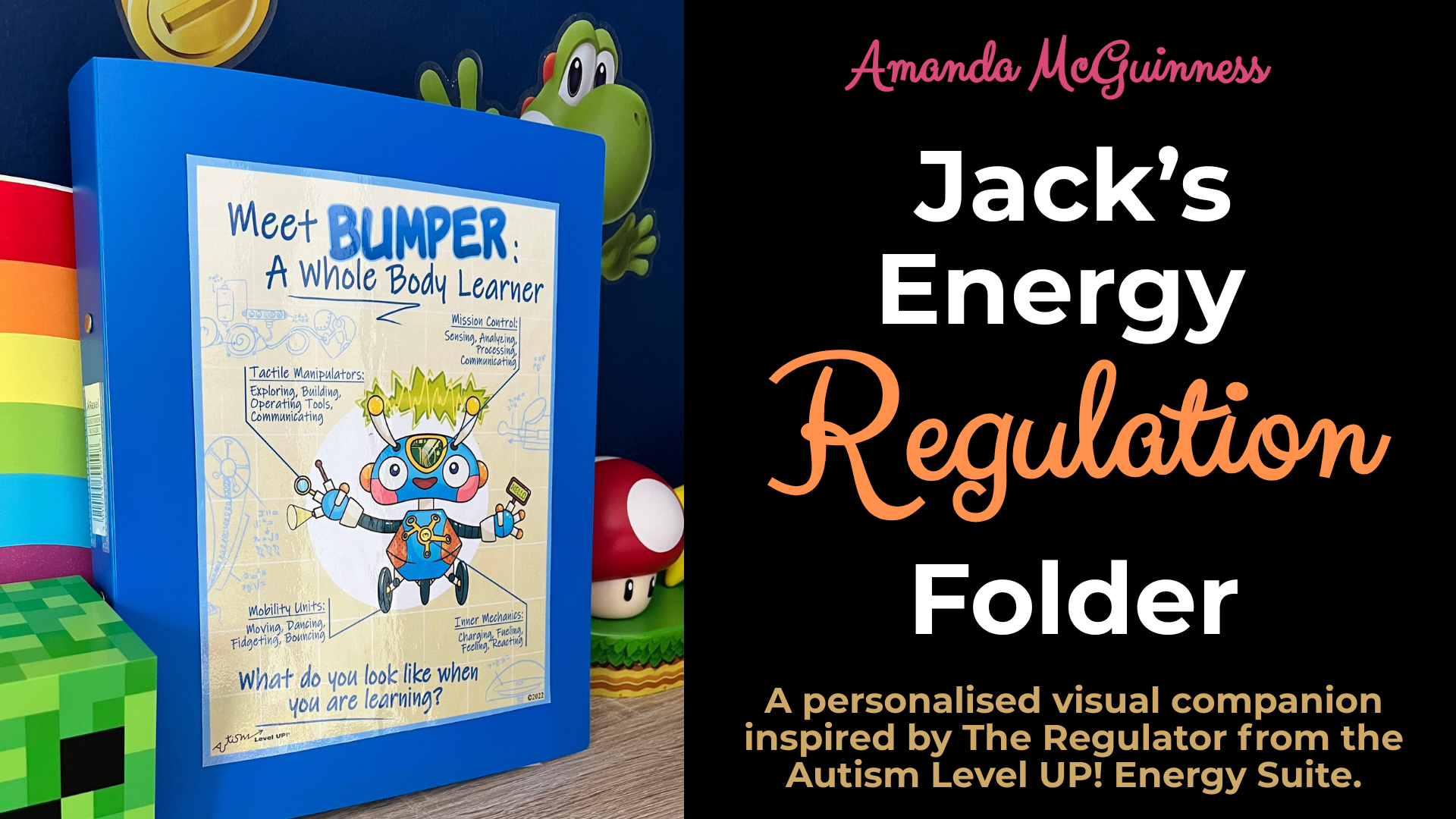
What struck me repeatedly throughout the conversation was the flexibility of the framework. There is no single correct way to use it. Some individuals may use visual supports, others may use written reflections, AAC systems, digital tools, playlists, symbols, objects, or personalised interests. The goal is not to fit the individual into the framework. The goal is to adapt the framework to fit the individual. This commitment to individualisation reflects a genuinely neuroaffirmative philosophy and explains why the framework has been successfully adopted across such diverse contexts, from family homes and mainstream classrooms to specialist educational settings and adult services.
The Autism Level UP Energy Framework has become one of the resources I recommend most frequently to families and professionals, because it fundamentally changes how we think about regulation. It shifts the conversation away from compliance, behaviour management, and towards curiosity, understanding, context, and self-awareness. It acknowledges that every person experiences the world differently and that regulation is not about changing who someone is. Rather, it is about understanding what they need in order to participate meaningfully and authentically in the environments that matter to them.
If there is one message I took away from my conversation with Amy and Jacquelyn, it is that regulation begins with understanding. When we understand our own energy, when we understand the environments we inhabit, and when we understand that difference is both expected and valued, we create the conditions for genuine wellbeing, participation, and belonging. That is why the Autism Level UP Energy Framework continues to have such a profound impact on individuals, families, schools, and communities around the world.
The Energy Framework - Discount Code
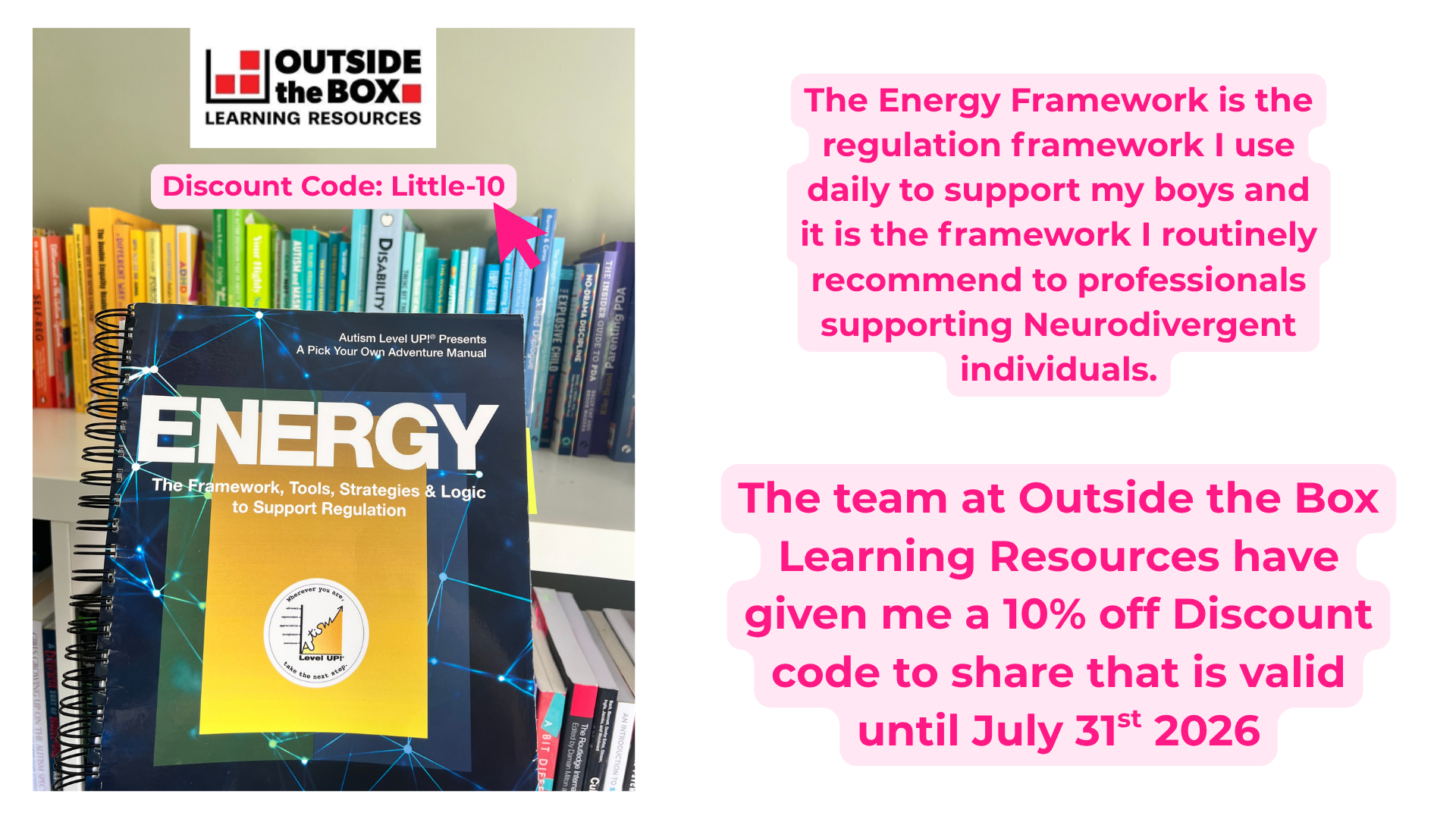
Where to Access the Autism Level UP Energy Framework
If you would like to explore the Autism Level UP Energy Framework further, the manual is available in Ireland through Outside the Box Learning Resources. Outside the Box Learning Resources is a leading provider of neuroaffirmative books, training materials, and educational resources used by families, schools, therapists, and professionals across Ireland.
As someone who uses the Energy Framework both professionally and personally, it is a resource I recommend regularly. It has supported me in understanding my own energy patterns, supporting my children, and helping Autistic individuals develop greater self-awareness, communication, and self-advocacy skills. The team at Outside the Box Learning Resources have kindly provided me with a 10% discount code for my community. Readers can use the code Little-10 when purchasing the Energy Framework manual. The discount is valid until 31 July 2026.