What is PDA?

Last reviewed and updated: July 2026
A Neuroaffirmative Guide to Persistent Drive for Autonomy
If you have been searching for information about PDA, you may have encountered a wide range of explanations. Some describe PDA as an extreme avoidance of everyday demands, while others focus on anxiety, behaviour, or oppositional presentations. For many families, professionals, and Autistic people themselves, these descriptions can feel incomplete.
Persistent Drive for Autonomy
Persistent Drive for Autonomy (PDA), historically referred to as Pathological Demand Avoidance, is increasingly understood through neuroaffirmative perspectives that recognise the importance of autonomy, agency, regulation, relationships, and lived experience. Rather than asking, "How can we reduce demand avoidance?", many practitioners and Autistic advocates are instead asking, "What is this person's nervous system communicating, and how can we create environments that support safety, autonomy and meaningful participation?"
This guide has been written to help answer the most common questions about PDA using current neuroaffirmative thinking alongside professional knowledge and lived experience. Throughout this page, you will also find links to more detailed guides, podcasts, visual supports and practical resources available across Little Puddins.
The understanding of PDA continues to evolve. Within this guide, I draw on current neuroaffirmative literature, professional practice, lived Autistic perspectives, and my own experience as an Audhd PDA adult, parent, educator and advocate. Where appropriate, I also introduce my own conceptual framework for understanding PDA through the interconnected lenses of regulation, autonomy, agency, and relational safety.
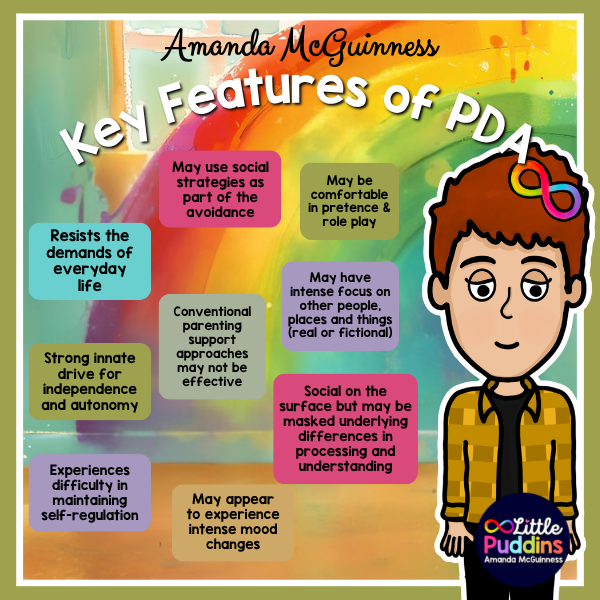
Understanding Persistent Drive for Autonomy
What is PDA?
Persistent Drive for Autonomy (PDA), historically known as Pathological Demand Avoidance, is a profile recognised by many clinicians, researchers, Autistic people and families as describing individuals for whom experiences of reduced autonomy, agency or felt safety may have particular significance for wellbeing.
Rather than viewing PDA simply as avoiding demands, many neuroaffirmative perspectives understand it as reflecting the interaction between an individual's nervous system, their environment, and experiences that may be perceived as reducing choice, control or self-determination.
For some Autistic people with a PDA profile, everyday requests, expectations, transitions, uncertainty, social demands or perceived pressure may contribute to heightened nervous system activation.
The responses that emerge are often best understood as adaptive attempts to restore regulation, preserve autonomy and maintain a sense of safety, rather than deliberate attempts to control other people or refuse for the sake of refusing.
Importantly, no two people with PDA are the same. Experiences vary across individuals, situations and stages of life, and support should always be individualised rather than based on assumptions.
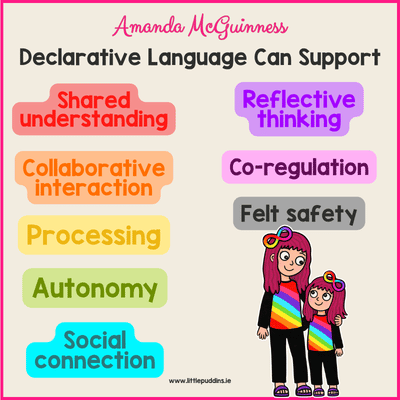
Is PDA part of Autism?
The relationship between Persistent Drive for Autonomy (PDA) and Autism continues to be an area of active discussion and debate. At present, there is no internationally agreed consensus on how PDA should be conceptualised.
Historically, PDA was described as a profile within Autism. Many clinicians, researchers, Autistic people and families continue to find this framework helpful in understanding experiences related to autonomy, regulation and everyday demands. However, others question whether PDA should be considered exclusively within Autism, suggesting that similar experiences may also be observed across a broader range of neurodevelopmental presentations.
Adding further complexity, PDA is not currently recognised as a distinct diagnostic category within major international diagnostic systems such as the DSM-5 or ICD-11. As a result, approaches to assessment, terminology and conceptualisation vary between countries, clinical services and professionals.
Rather than focusing solely on diagnostic classification, many neuroaffirmative practitioners prioritise understanding the individual's lived experience. From this perspective, the most important question is not whether someone perfectly fits a particular identification, but whether the framework helps explain their experiences and informs supports that promote regulation, autonomy, meaningful participation and wellbeing.
Throughout this guide, PDA is discussed as evolving conceptually rather than a settled diagnostic definition. Readers are encouraged to recognise that knowledge in this area continues to develop, and that respectful dialogue, ongoing research and lived experience all contribute to our understanding.

Why has the language changed from Pathological Demand Avoidance to Persistent Drive for Autonomy?
Language shapes understanding. Many Autistic people and professionals have raised concerns that the historical term "Pathological Demand Avoidance" places the emphasis on what a person appears to do rather than on the underlying experiences that may contribute to those responses.
The term "Persistent Drive for Autonomy" reflects a shift towards recognising the importance of autonomy, agency and self-determination in understanding this profile. While historical terminology continues to appear in research literature and clinical reports, many people now prefer language that avoids pathologising individuals and instead encourages curiosity about the interaction between the person, their nervous system and their environment.
Because both terms are currently used internationally, this guide uses "Persistent Drive for Autonomy (PDA)" while acknowledging the historical terminology to support readers searching for information using either phrase.
Why do some people with PDA find everyday demands difficult?
There is no single explanation for why everyday demands can become difficult. For different individuals, the reasons may vary and may change from one situation to another.
Many neuroaffirmative perspectives suggest that everyday demands should be understood within a broader context that includes sensory processing, executive functioning, uncertainty, previous experiences, social expectations, emotional significance, communication, physical wellbeing and nervous system regulation.
Within my own practice, I conceptualise PDA through the interconnected lenses of regulation, autonomy, agency, and relational safety. From this perspective, it is not the demand itself that is always significant, but how that demand is experienced by the individual in that particular moment.
Two requests that appear identical to others may be experienced very differently depending on factors such as trust, predictability, energy levels, sensory load, perceived choice and available support.
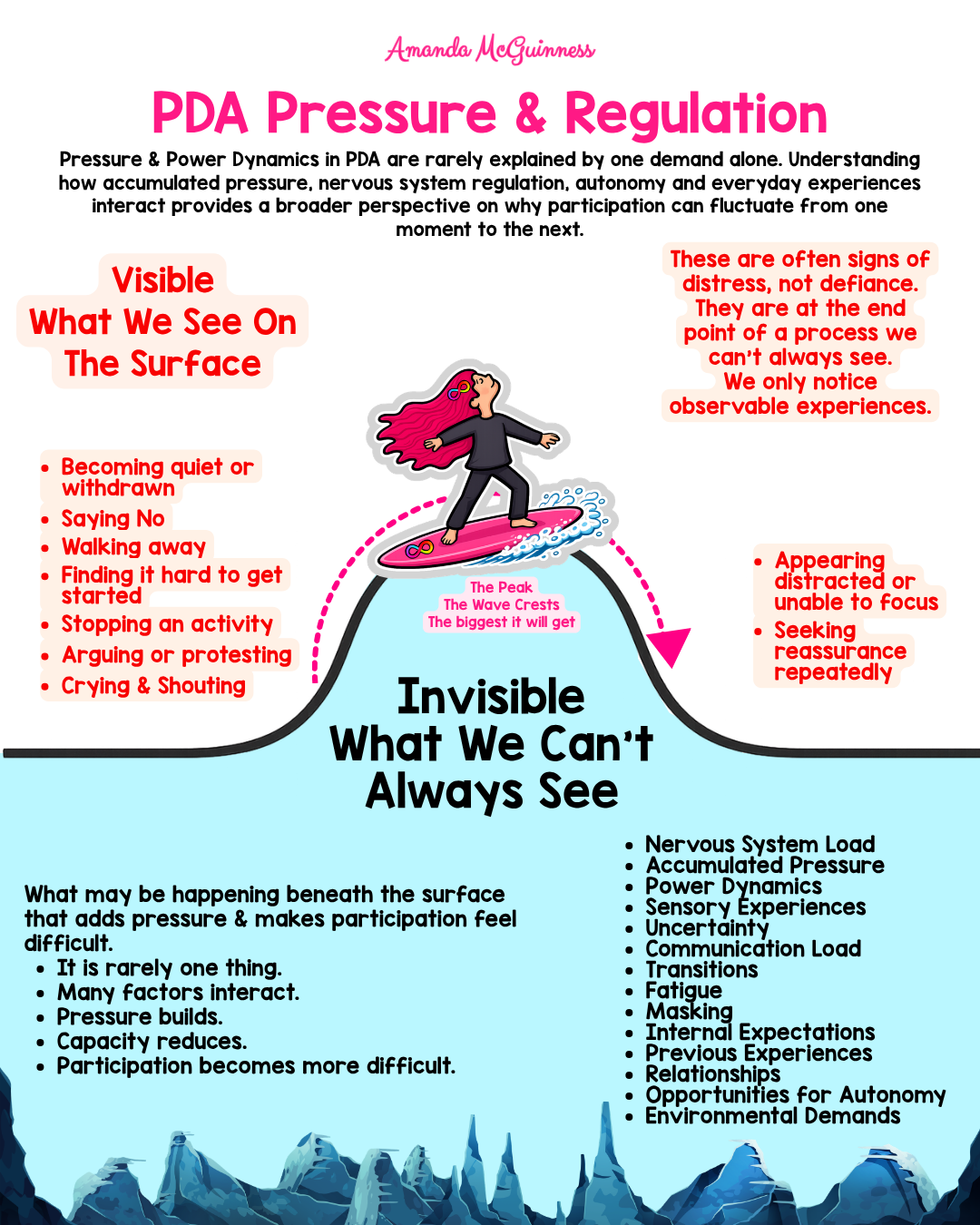
How might PDA be experienced?
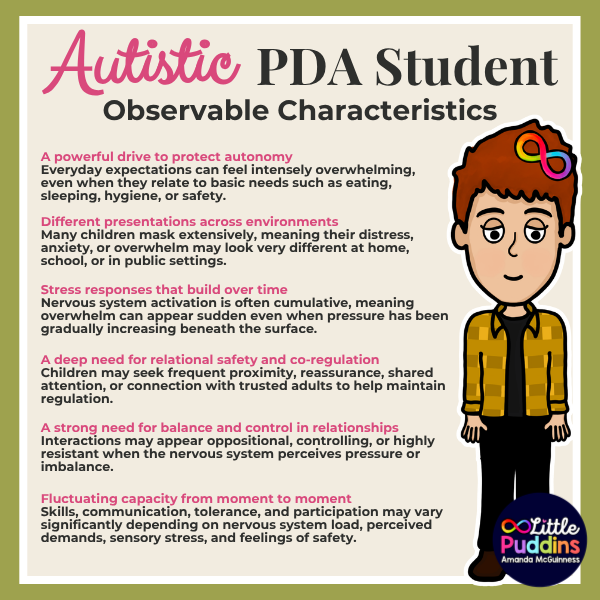
Persistent Drive for Autonomy (PDA) is highly individual. There is no single way that PDA is experienced, and no two people will respond in exactly the same way. Experiences may vary across different environments, relationships and stages of life, and can fluctuate depending on factors such as capacity, regulation, wellbeing, health, sensory experiences and available support.
Rather than viewing PDA as a collection of behaviours, many neuroaffirmative approaches encourage us to understand the underlying experiences that may contribute to how a person interacts with the world. These experiences are not separate from one another. Instead, they are interconnected and shaped by the interaction between the individual, their nervous system, their environment and the people around them.
Autonomy and Agency
Many people with a PDA profile describe autonomy, and agency, as being particularly important to their sense of wellbeing and safety. Situations that reduce opportunities for choice, collaboration or self-determination may be experienced differently from one person to another and can contribute to increased stress or reduced capacity.
Regulation
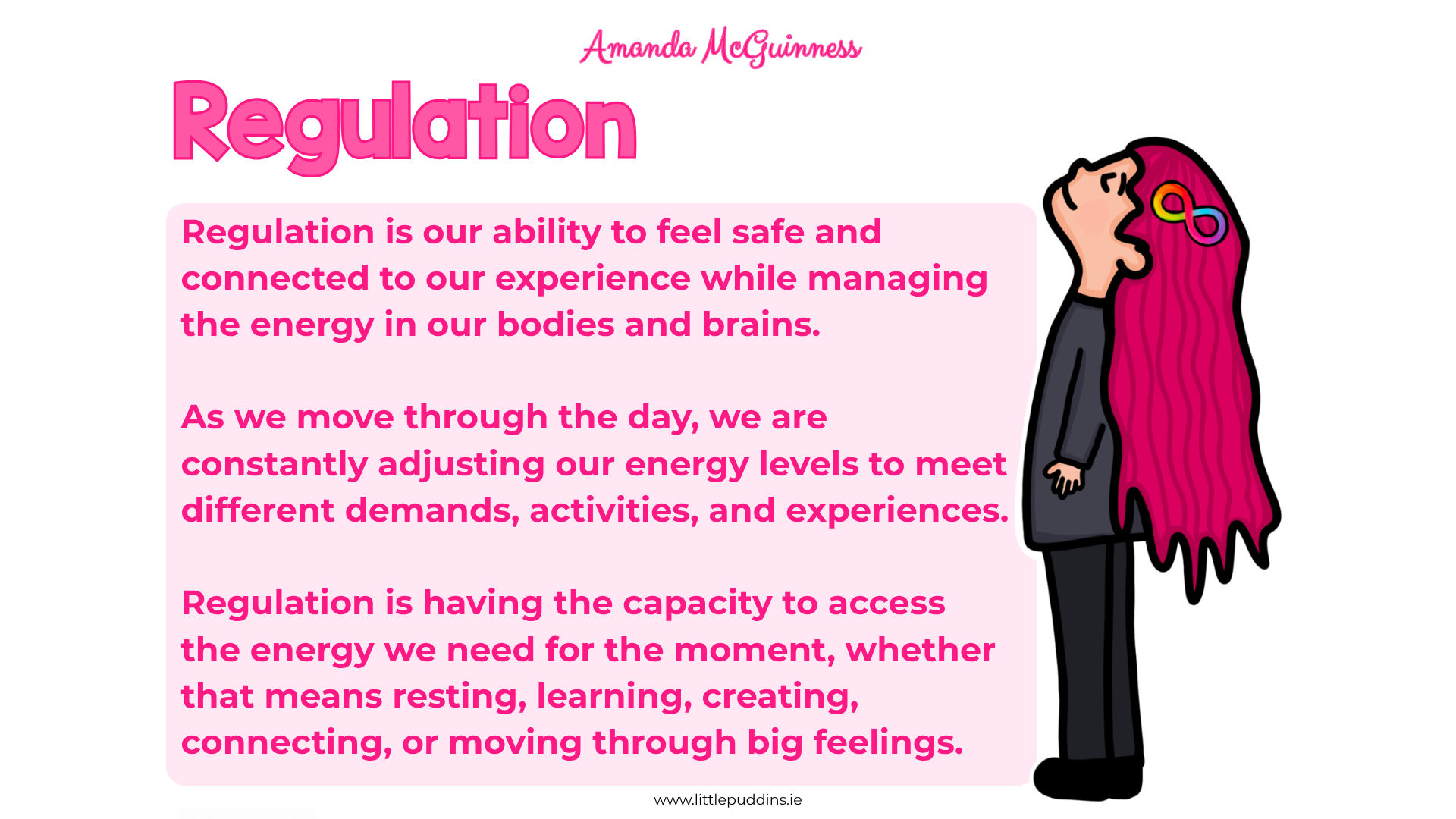
Capacity is not fixed. Many people experience fluctuations in their ability to manage everyday expectations depending on sensory processing, emotional wellbeing, physical health, energy levels, predictability, uncertainty and the cumulative impact of stress throughout the day. What feels manageable in one moment may feel overwhelming in another.
Communication
The way information is communicated can significantly influence how it is experienced. Direct instructions, repeated reminders, perceived urgency or highly controlling language may increase nervous system activation for some individuals. In contrast, collaborative, transparent and autonomy-supportive communication may help reduce pressure and support participation.
Executive Functioning
Executive functioning differences may influence how a person plans, initiates, organises, prioritises, transitions between activities or manages multiple sources of information at once. These experiences often become more noticeable during periods of increased stress or reduced regulation and should not be mistaken for a lack of motivation or willingness.
Relationships
Relationships often play an important role in shaping experiences of safety, trust and participation. Feeling understood, respected and included in decision-making may support regulation and collaboration, while experiences of coercion, judgement or unequal power dynamics may contribute to increased distress or reduced capacity.
Sensory Processing
Sensory experiences can have a significant influence on nervous system regulation. Noise, lighting, touch, movement, smell, taste and internal bodily sensations may all affect a person's available capacity. Sensory differences are an important part of understanding the broader context in which everyday expectations are experienced.
Uncertainty and Predictability
Unexpected changes, unclear expectations or uncertainty about what will happen next may increase cognitive load and nervous system activation for some individuals. Accessible information, predictability and opportunities to prepare can help reduce uncertainty and support participation.
Protective Responses
When a person's capacity is exceeded or experiences of pressure become overwhelming, a wide range of protective responses may emerge. These responses are best understood as adaptive attempts to preserve regulation, autonomy, safety or equilibrium rather than intentional attempts to be difficult or oppositional. Protective responses differ considerably between individuals and across contexts and may change over time.
Understanding PDA through these interconnected domains shifts the focus towards understanding lived experience. Rather than asking, "What is this person doing?", a neuroaffirmative approach encourages us to ask, "What might this person be experiencing, and how can we create environments, relationships and communication that better support their wellbeing, autonomy, and agency?"

Understanding the PDA Experiences
Why is autonomy important for some people with a PDA Profile?
Autonomy is the ability to experience choice, agency and meaningful influence over one's own life. It is a fundamental human need that supports wellbeing, motivation and self-determination. While autonomy is important for everyone, many people who identify with a PDA profile describe experiences of reduced autonomy as having particular significance for their sense of safety and regulation.
Within my own practice, I conceptualise PDA through the interconnected lenses of regulation, autonomy, agency, and relational safety. From this perspective, it is not simply the presence of an expectation that influences how it is experienced, but whether the individual feels they have opportunities for collaboration, choice and authentic participation.
Autonomy should not be confused with independence or with always getting your own way. Rather, it reflects the experience of having autonomy in decisions that affect you, feeling heard and respected, and being able to influence how everyday life unfolds. When opportunities for autonomy are reduced, some people may experience increased stress, reduced capacity or a greater need to protect their sense of agency.

How does the nervous system influence experiences associated with PDA?
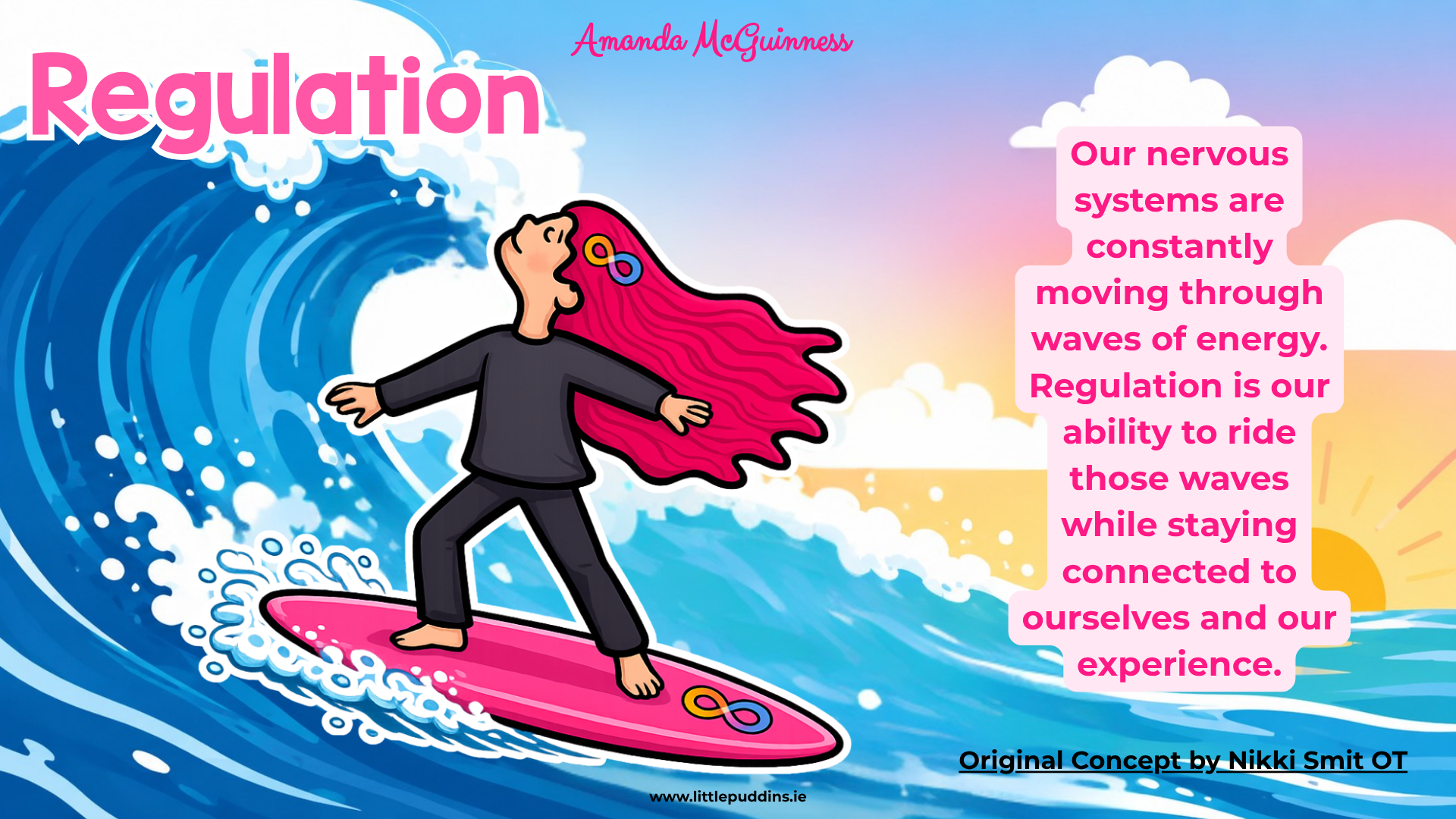
Everyday experiences are shaped not only by the expectations placed upon us but also by the current state of our nervous system.
The nervous system is constantly processing information from our bodies, our surroundings and our relationships, helping us determine whether situations feel manageable, uncertain or overwhelming. Factors such as sensory processing, physical health, emotional wellbeing, previous experiences, relationships, predictability and stress all influence how much capacity a person has available at any given moment.
When available capacity is reduced, activities that previously felt manageable may become significantly more challenging. This can influence communication, thinking, flexibility, emotional regulation and participation in everyday life.
Understanding the role of the nervous system encourages us to move beyond asking, "Why won't they do this?" and instead ask, "What factors might be influencing their capacity right now?"
Why can everyday expectations sometimes feel overwhelming?
Not all expectations are experienced in the same way, and the same expectation may feel very different from one day to the next.
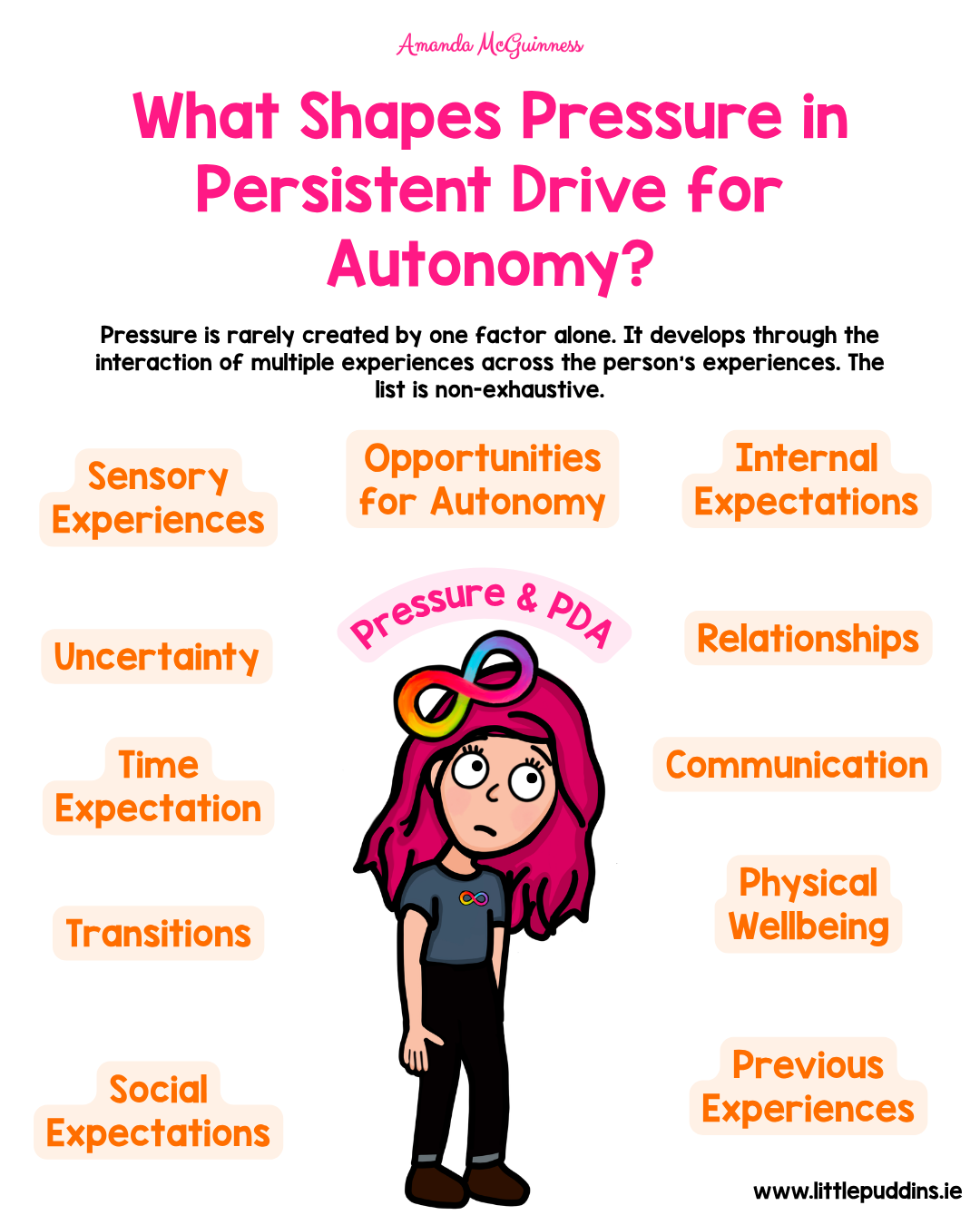
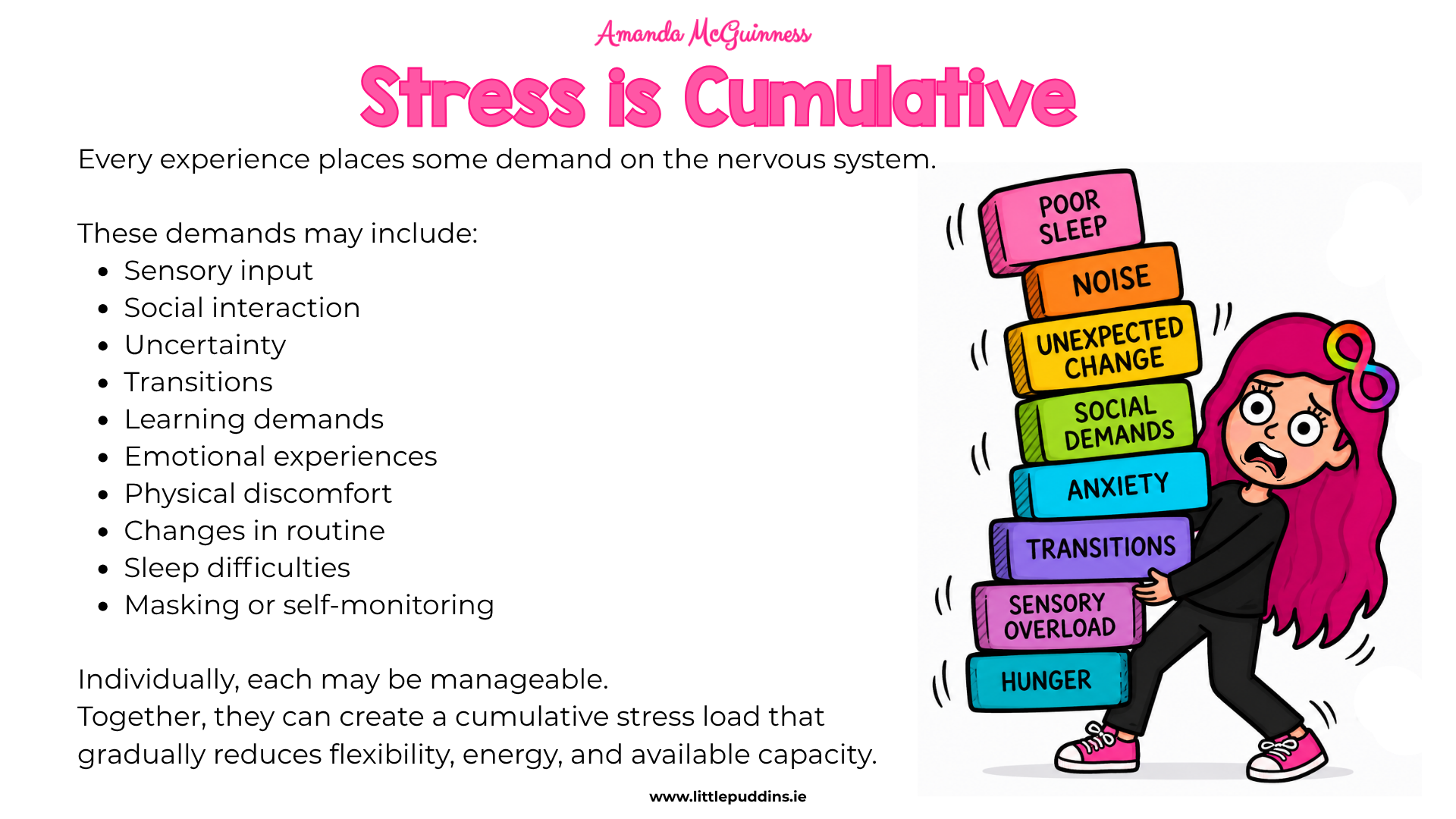
For many people, it is not a single request that becomes overwhelming, but the cumulative impact of multiple experiences occurring throughout the day. Sensory input, uncertainty, transitions, executive functioning demands, social interaction, communication, waiting, physical wellbeing and previous stress can all contribute to increasing cognitive load.
As these experiences accumulate, available capacity may gradually reduce until even relatively small expectations feel difficult to manage.
Understanding this cumulative process helps shift the focus away from individual demands and towards the broader context in which they occur. Rather than asking why one particular expectation became difficult, it can be more helpful to consider everything that may have impacted the person's available capacity before that moment.
What impact has sensory processing and executive functioning on PDA experiences?
Sensory processing and executive functioning are important aspects of understanding everyday experiences for many Autistic people, including those who identify with a PDA profile.
Sensory processing differences may influence how a person experiences sound, light, movement, touch, taste, smell or internal bodily sensations. When sensory input becomes overwhelming, it can reduce the energy available for communication, learning, decision making and participation.
Executive functioning differences may influence planning, organisation, working memory, flexible thinking, task initiation, transitions and managing multiple pieces of information at the same time. These experiences often become more noticeable during periods of increased stress or reduced regulation.
Recognising these influences encourages us to consider how environments can be made more accessible, rather than assuming that difficulties arise because someone lacks motivation or willingness.
Why can capacity fluctuate from day to day?
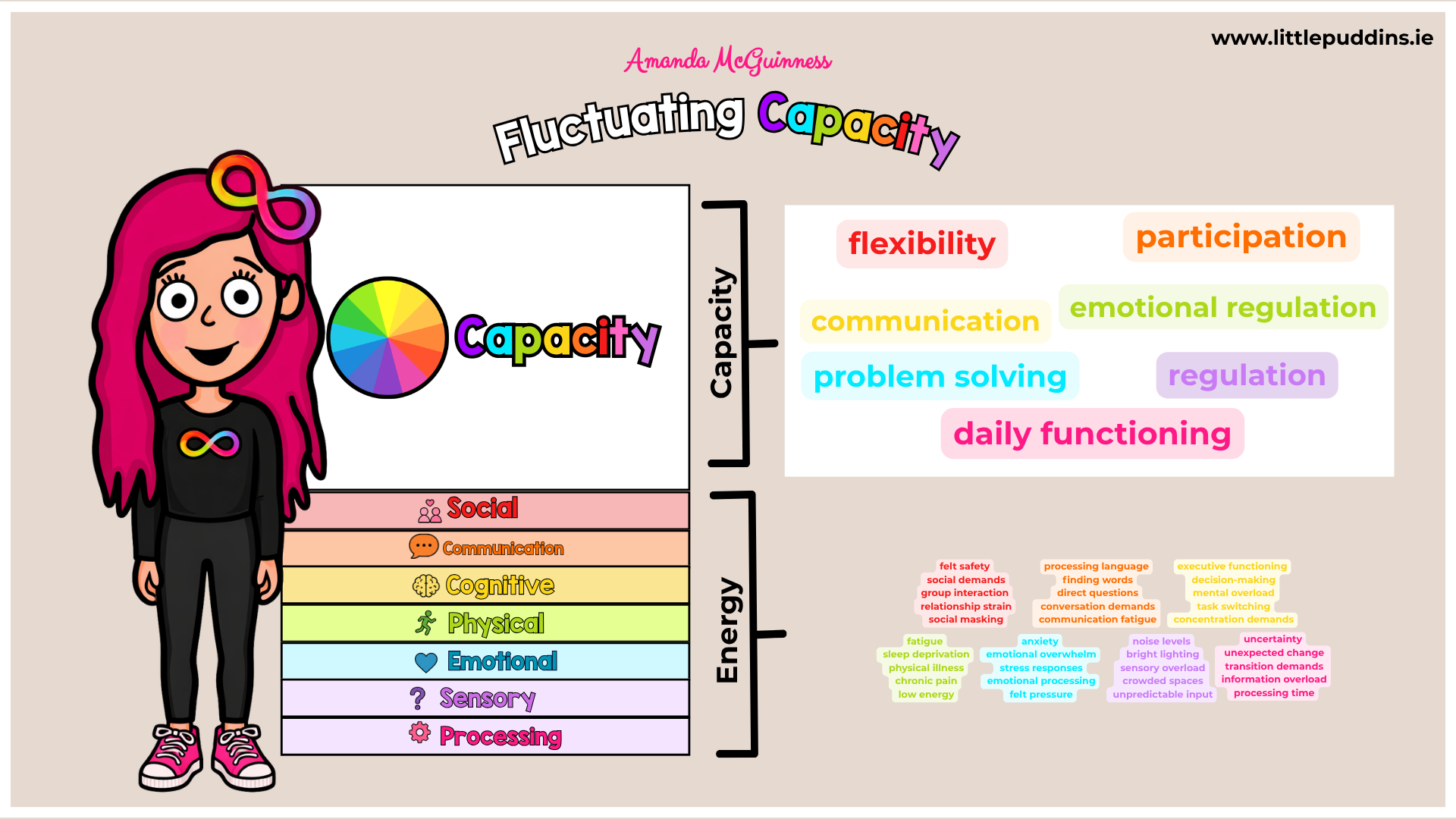
Capacity is dynamic rather than fixed.
Everyone experiences natural fluctuations in energy, attention and emotional wellbeing, but for many PDA Autistic people these changes may be more noticeable because of the interaction between sensory processing, executive functioning, health, relationships, stress and environmental demands.
A person may successfully participate in an activity one day but find the same activity significantly more difficult the next. This does not necessarily reflect inconsistency or unwillingness. Instead, it often reflects genuine differences in the amount of physical, cognitive and emotional capacity available at that time.
Recognising fluctuating capacity encourages flexibility, reduces unrealistic expectations and supports more responsive approaches to communication, learning and participation.
How might relationships affect experiences associated with PDA?
Relationships play an important role in shaping how everyday experiences are understood and responded to.
Feeling listened to, respected and understood can support trust, communication and collaboration. Equally, experiences of conflict, misunderstanding, repeated pressure or feeling unheard may increase stress and reduce available capacity.
This does not mean that strong relationships remove all challenges. Rather, supportive relationships can provide a foundation from which individuals feel safer to communicate their needs, solve problems collaboratively and participate in ways that respect both their autonomy and the realities of everyday life.
Building trusting relationships often involves curiosity, transparency, flexibility and a willingness to understand experiences from another person's perspective.
What is Autistic PDA burnout, and why is it important to understand?
Autistic burnout is increasingly recognised as a state of profound physical, emotional and cognitive exhaustion that can develop following prolonged periods of stress, masking, sensory overload, unmet needs or navigating environments that require sustained adaptation.
For some people who identify with a PDA profile, burnout may develop when the cumulative pressures of everyday life consistently exceed the person's available capacity over an extended period.
Burnout reflects the impact of sustained stress on the whole person and often requires time, understanding and appropriate environmental support to recover.
Recognising burnout reminds us of the importance of balancing expectations with wellbeing, creating accessible environments and supporting regulation over the long term.
Everyday Life
How can PDA affect family life?
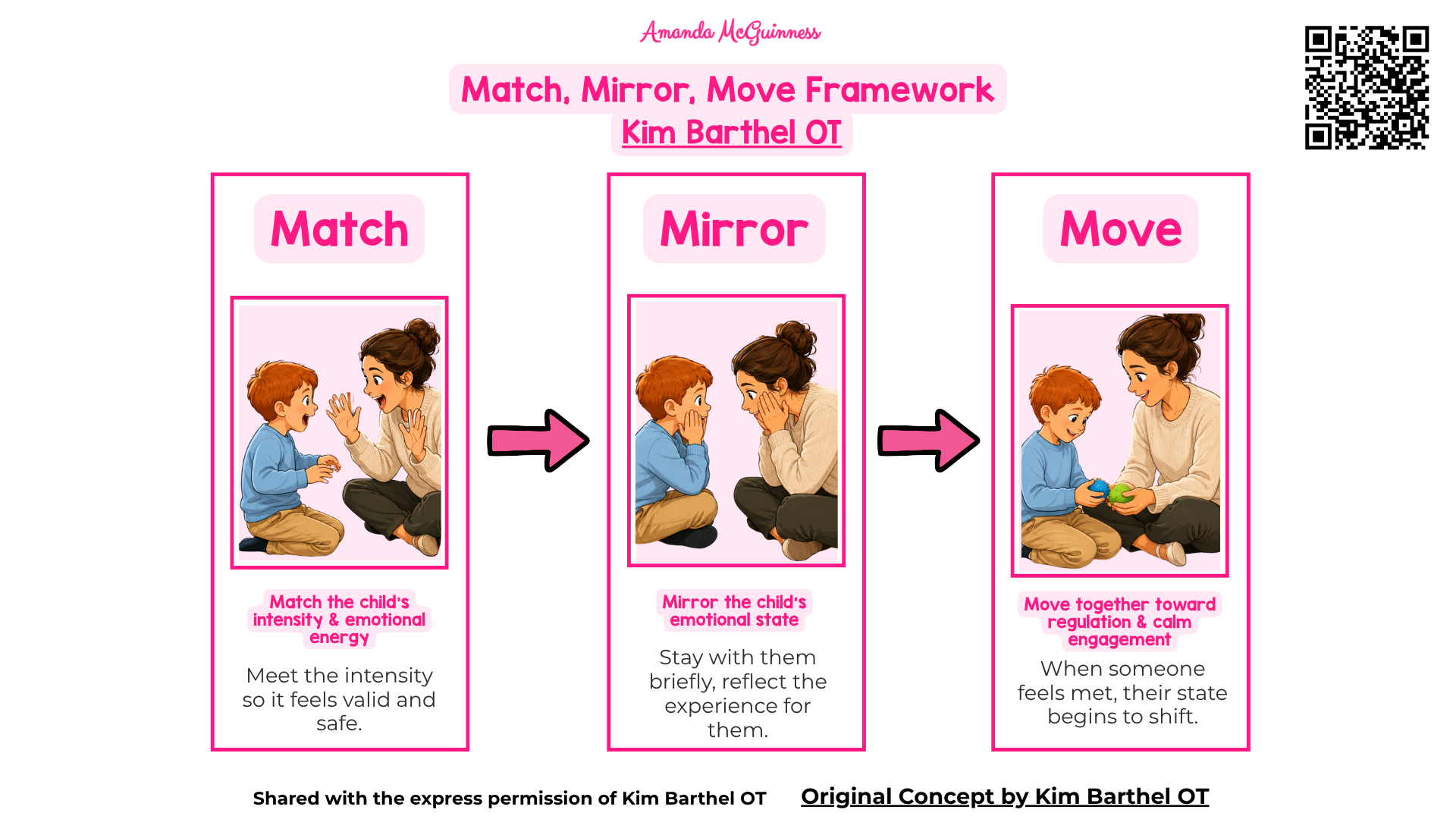
Family life is shaped by relationships, routines, responsibilities and the many expectations that naturally arise throughout the day. For some people who identify with a PDA profile, everyday family experiences such as getting ready in the morning, mealtimes, leaving the house, bedtime or changes to plans may require considerable energy and flexibility.
Families often describe good days and more challenging days, reflecting the natural fluctuations in capacity that can occur. What is manageable one day may feel overwhelming the next, even when routines remain the same.
Rather than viewing these experiences as deliberate non-compliance or a lack of motivation, many families find it more helpful to consider the interaction between regulation, communication, sensory processing, relationships and the environment. This perspective encourages collaborative problem-solving and a shared understanding of what may be contributing to challenges in the moment.
How can PDA affect school experiences?
Schools place many different expectations on children and young people beyond academic learning alone. Navigating transitions, managing sensory environments, participating in group activities, following routines, coping with uncertainty, organising materials and responding to frequent instructions can all contribute to cognitive and emotional load.
For some Autistic learners who identify with a PDA profile, educational success is often influenced not only by academic ability but also by how accessible, predictable and collaborative the learning environment feels.
Many schools are increasingly adopting neuroaffirmative approaches that focus on understanding individual needs, reducing unnecessary barriers to participation and creating environments that support regulation, communication and authentic engagement in learning.
How can PDA influence friendships and social relationships?
Friendships can be an important source of connection, belonging and enjoyment. Like all people, individuals who identify with a PDA profile have unique personalities, interests and ways of building relationships.
At times, social experiences may require significant cognitive effort. Navigating group dynamics, managing uncertainty, interpreting social expectations or balancing the needs of others alongside personal regulation can increase cognitive load for some individuals.
Supportive friendships are often built through shared interests, mutual respect, clear communication and environments where differences are understood and valued.
There is no single way that PDA influences friendships, and experiences vary considerably between individuals.
How can PDA influence adulthood?
PDA does not disappear when someone reaches adulthood. Many adults continue to describe experiences related to autonomy, regulation, sensory processing and fluctuating capacity throughout different stages of life.
Adult experiences may include navigating employment, higher education, relationships, parenting, healthcare, independent living and managing the cumulative demands of everyday responsibilities.
Many adults are identified later in life and describe finally having a framework that helps explain lifelong experiences. Understanding these experiences can support greater self-awareness, self-advocacy and access to more appropriate supports and accommodations.
Every adult's experience is unique, and there is no single pathway through adulthood.
Can PDA be experienced differently across the lifespan?
Yes. Experiences associated with PDA often change over time as people develop, encounter new environments and experience different life demands.
A young child, teenager and adult may all experience similar underlying challenges while expressing them in very different ways. Life transitions, changing responsibilities, health, relationships and access to appropriate support can all influence how experiences present.
For some individuals, increased self-understanding and more accessible environments lead to improved wellbeing and participation. Others may experience periods where increased demands exceed available capacity, highlighting the importance of responsive support throughout life.
Understanding PDA as a dynamic and evolving experience encourages us to move away from fixed assumptions and instead remain curious about each person's individual journey.
Can people with PDA experience periods of increased or reduced capacity?
Many people describe their experiences as fluctuating rather than consistent. Capacity may change throughout the day, from one environment to another or across different stages of life.
Sleep, illness, sensory experiences, emotional wellbeing, uncertainty, relationships, executive functioning demands and cumulative stress can all influence how much capacity is available at any given time.
Recognising fluctuating capacity helps explain why a person may participate successfully in an activity on one occasion but find the same activity much more difficult at another time. Rather than expecting consistency at all times, neuroaffirmative approaches encourage flexibility, accessible environments and responsive support that reflects changing needs.
What role do environments play in supporting people with PDA?
Environments can either increase or reduce the demands placed on an individual. Physical spaces, communication styles, routines, sensory experiences, relationships and organisational expectations all influence how accessible an environment feels.
Neuroaffirmative practice encourages us to consider not only how a person responds to their environment, but also how the environment responds to them.
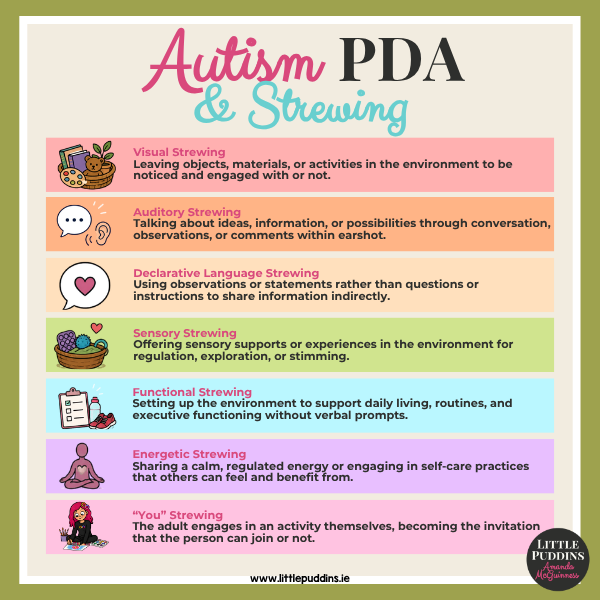
Small changes, such as improving predictability, providing accessible information, reducing unnecessary uncertainty, supporting communication and creating opportunities for collaboration, may have a significant impact on participation and wellbeing.
Rather than expecting people to adapt to environments that do not meet their needs, the goal is to create environments that are more accessible, inclusive and responsive for everyone.
Key Takeaways
Persistent Drive for Autonomy (PDA) is an evolving conceptual framework, and there is currently no international consensus regarding its definition or classification.
Neuroaffirmative perspectives encourage us to move beyond behaviours alone and consider the interaction between the individual, their nervous system, their environment and their lived experiences.
Every person's experiences are unique. There is no single way that PDA presents or is experienced.
Factors such as autonomy, regulation, sensory processing, executive functioning, relationships and environmental accessibility may all influence how everyday expectations are experienced.
Understanding should always come first. Curiosity, collaboration and accessible environments provide a stronger foundation for support than assumptions based on behaviour alone.

Frequently Asked Questions
Is PDA a diagnosis?
No. Persistent Drive for Autonomy (PDA) is not currently recognised as a distinct diagnostic category within the DSM-5 or ICD-11. However, many clinicians, researchers, Autistic people and families find the framework helpful for understanding particular patterns of lived experience.
Can adults experience PDA?
Yes. Many adults identify with a PDA profile, including those who were recognised in childhood and those who come to understand their experiences later in life. Experiences may change over time and vary across different environments and life stages.
Is everyone with PDA the same?
No. Every person is unique. Experiences associated with PDA differ between individuals and may also fluctuate depending on regulation, health, relationships, sensory experiences and environmental demands.
Is PDA caused by parenting?
No. There is no evidence that parenting causes PDA. Contemporary neuroaffirmative approaches encourage us to understand the interaction between the individual, their nervous system, their environment and their lived experiences rather than attributing responsibility to parenting approaches.
Can schools support learners with PDA?
Yes. Many schools are increasingly adopting neuroaffirmative approaches that prioritise accessibility, regulation, collaboration and inclusive learning environments. Understanding the individual learner and adapting the environment are often key aspects of effective support.
What approaches may support people who identify with a PDA profile?
Support should always be individualised and may include accessible communication, collaborative relationships, environmental adaptations, visual supports, predictability and opportunities for autonomy while recognising each person's unique strengths, needs and circumstances.
Where can I learn more about PDA?
Amanda’sPDA Hub includes in-depth articles, podcast episodes, practical resources and downloadable visual supports exploring communication, regulation, education, executive functioning and everyday life.
This article was reviewed and updated in July 2026 to reflect current neuroaffirmative perspectives and emerging discussions relating to PDA. As understanding continues to evolve, this guide will be reviewed and updated to reflect new evidence, professional dialogue and lived experience.
A Note About This Guide
Persistent Drive for Autonomy (PDA) is an evolving area of understanding, and there is currently no international consensus regarding its definition, classification or conceptualisation. Throughout this guide, I present an overview informed by contemporary neuroaffirmative literature, professional practice, lived Autistic perspectives and my own experience as an educator, advocate, as an Audhd PDA adult, and as a parent to two sons with a PDA profile.
Where I discuss established concepts, these are grounded in the current evidence base and wider professional discourse. Where I introduce broader interpretations or conceptual perspectives, these reflect my own personal and professional understanding and are offered as contributions to an ongoing conversation rather than definitive explanations.
The aim of this guide is to support understanding, encourage critical thinking and provide readers with a balanced, neuroaffirmative introduction to PDA while recognising that knowledge in this area continues to develop.