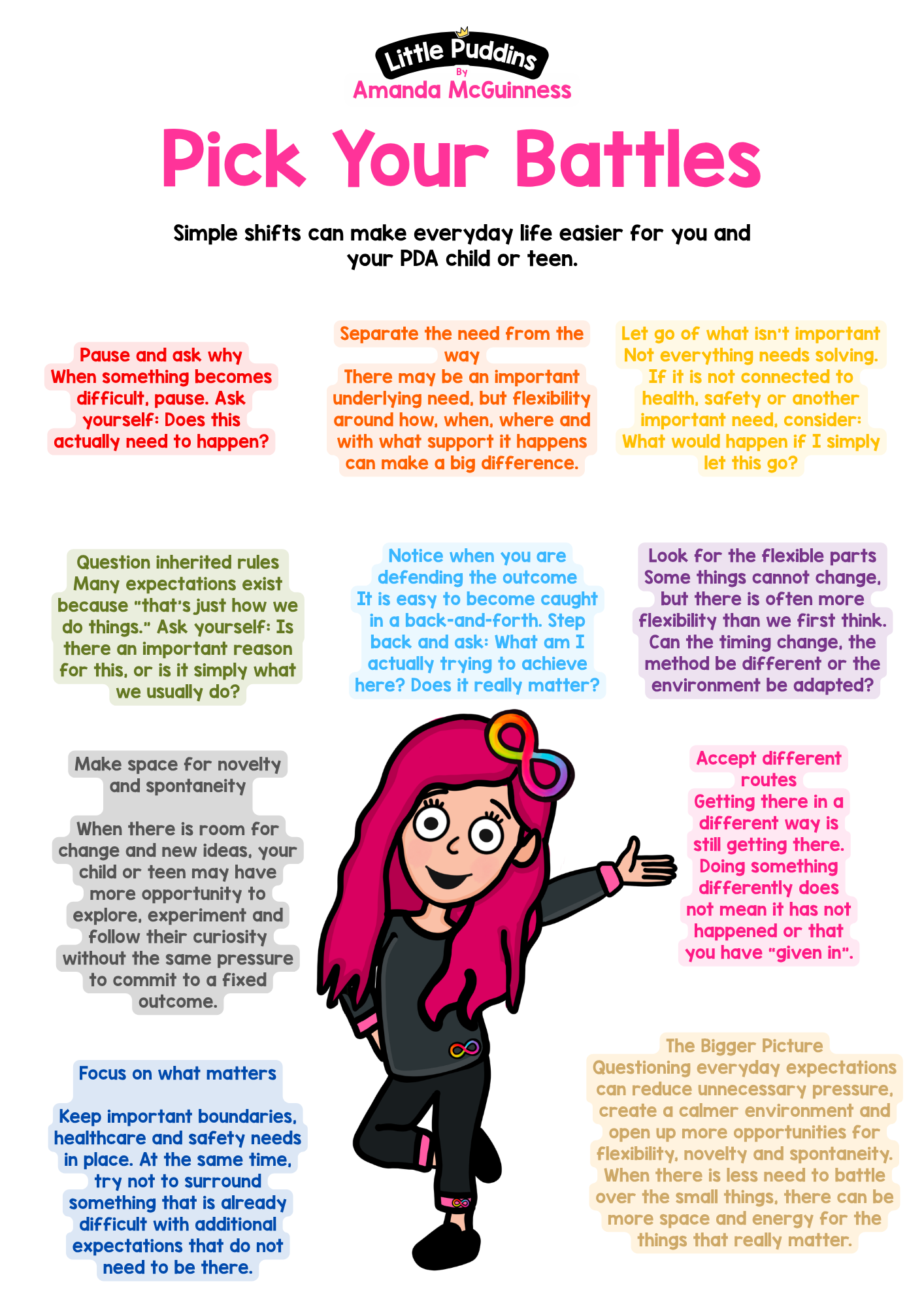
Pick Your Battles?

Rethinking everyday expectations when supporting a PDA child or teen
"Pick your battles" is advice many parents hear at some point. Usually, it means deciding which issues are important enough to hold firm on and which ones we can let go.
When supporting an Autistic child or teenager with a Persistent Drive for Autonomy (PDA) profile, I think there is another question worth asking: why does this need to become a battle at all?
Everyday family life contains hundreds of expectations. Get dressed. Come downstairs. Sit at the table. Put your shoes on. Brush your teeth. Say hello. Turn the screen off. Get into the car. Come with us. Go to bed. Some of these relate to important needs. Others are simply familiar ways of doing things that we may never have had a reason to question.
When an everyday expectation repeatedly becomes difficult, our instinct can be to search for a better way to achieve it. We might change our language, offer choices, explain why it matters, provide encouragement or try again later. Sometimes those things help. But before working out how to make something happen, there is another useful question: does it actually need to happen?
Separate the Need From the Way We Usually Meet It
Sometimes there is an important underlying need, but we have accidentally turned our preferred way of meeting that need into the requirement itself.
Perhaps everyone needs to leave the house. That may not be negotiable. Does the coat need to go on now? Does everything need to happen in the usual order?
Perhaps teeth need to be cared for, medication needs to be taken or an important appointment needs to be attended. The underlying need remains important, but there may still be considerable flexibility around how, where, when or with what support it happens.
Once we identify the essential part, we can often become much more flexible about everything surrounding it.
Question the Rules
Many expectations around children are inherited rather than consciously chosen. Children eat meals at the table. Pyjamas are worn to bed. Bedrooms should be tidy. Homework happens after school. People greet visitors when they arrive. Clothes should be appropriate for the occasion. Everyone attends the family event.
Sometimes there is a reason for an expectation. Sometimes there isn't.
If a child is more comfortable eating somewhere other than the table, what problem are we trying to solve by insisting they sit there? If a teenager does not want to greet a visitor immediately but comes down later when they are ready, what has actually been lost? If a child wants breakfast food in the evening, does the time of day matter? If clothes are safe and comfortable but do not match our expectations for the occasion, whose discomfort are we responding to?
Sometimes we are working very hard to solve something that does not actually need solving.
Look for Where Things Can Bend
Of course, some things matter. Children and teenagers need healthcare, safety boundaries exist, other family members have needs and sometimes we simply have to be somewhere at a particular time. PDA-informed parenting or support does not mean pretending those realities do not exist. But we can consider where we can “bend” the rules for the greater good.
An appointment may need to happen, but perhaps the waiting room can be avoided. The family may need to leave at a particular time, but perhaps getting ready does not need to look the way we expected. A safety boundary may remain firm while the child or teenager still has meaningful influence over what happens around it.
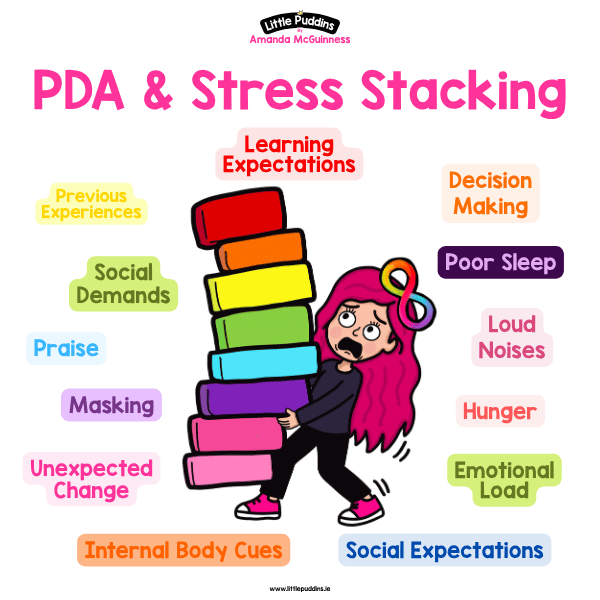
We can also be careful not to add unnecessary expectations around something that is already difficult. If getting to an appointment is taking everything the young person has available that day, perhaps that is not also the day to insist that their bedroom is tidied before leaving.
Sometimes we cannot remove the difficult thing. We can, however, avoid surrounding it with five other things that did not need to happen.
Notice When You Are Defending an Outcome
There are moments when adults can become caught in an interaction without realising it. We ask. The child says no. We explain. They suggest something different. We explain why our way would be easier. They negotiate. We offer another choice. Suddenly both people are deeply invested in an outcome that may not have been particularly important to begin with.
That can be a useful point to stop.
What am I actually trying to achieve here?
Perhaps the answer is safety, healthcare or something that cannot change. If so, knowing that helps us focus on where flexibility is still possible.
If the answer is: "Because that's what we normally do", "Because I already said it", "Because they should be able to", or "Because otherwise it feels like I'm giving in”, then there is room for flexibility.
Sometimes changing our mind is simply good problem-solving.
Doing Things Differently Is Still Doing Them
PDA children and teenagers may sometimes reach the same destination by a very different route from the one adults expected.
Eating in a comfortable space is still eating. Joining a family gathering for twenty minutes rather than three hours is still participating. Communicating through a message rather than speaking is still communicating. Completing something at a different time is still completing it.
When we become overly attached to how something should happen, we can miss the fact that the young person may already be showing us another way. That does not mean every alternative will always be possible. It means alternatives are worth noticing before we dismiss them simply because they are unconventional.
Making Space for Novelty, Flexibility and Spontaneity
Questioning unnecessary expectations can also create more room for novelty, flexibility and spontaneity. When a PDA child or teenager knows there is space to change their mind, approach something differently, suggest another idea or leave something that is not working, new experiences may feel more accessible. Flexibility can allow curiosity to emerge without the same sense that trying something new means becoming committed to it or losing influence over what happens next. A spontaneous change of plan, an unexpected activity or a new experience may be easier to explore when the young person knows they can shape their involvement, step back or find their own way of participating, or not even participate at all. Over time, creating this kind of space can support opportunities for exploration, experimentation and discovery, because the environment and the adults around them have become more flexible too.
Things to Think About
The next time an everyday situation begins turning into a battle, it may be worth pausing.
Ask yourself whether this actually needs to happen, and whether it needs to happen now. Consider whether the outcome matters more than the way it is achieved. Look for the parts that cannot change and separate them from the parts that can.
Notice the rules you have inherited without consciously choosing them. Ask yourself what would actually happen if this expectation disappeared. Consider whose need is being met and whether the child or teenager is offering an alternative that could work, even if it is not the way you would have chosen.
And perhaps one of the most useful questions of all is:
Am I trying to solve a problem, or am I trying to make something happen because I believe it should happen this way?
There will always be moments when adults need to hold boundaries, make decisions or support children and teenagers through things they would rather not do. The aim is not to remove every expectation from life. It is to make sure we are not creating unnecessary battles around things that could have been flexible. Sometimes the most useful thing you can do is question whether the expectation needed to be there in the first place.