Autism Puberty Book Recommendations
Autism Puberty Book Recommendations
Puberty education for Autistic children and teenagers needs to be clear, respectful, and grounded in reality. Many Autistic young people benefit from explicit, factual information that does not rely on inference, metaphor, or social guesswork. Books can play an important role in supporting this learning, particularly when they are written with Autism in mind and acknowledge sensory, emotional, and cognitive differences.
At Little Puddins, puberty resources are approached through a neuroaffirmative lens. This means prioritising understanding, autonomy, and emotional safety rather than compliance or social conformity. The following Autism puberty book recommendations are drawn from well-established texts that many families and professionals find helpful when supporting Autistic children and teens through bodily changes, relationships, and self-care.
Choosing puberty books for Autistic children and teens
No single book will suit every Autistic young person. Some children prefer detailed explanations, while others need information broken into smaller parts over time. Many of the books listed below use very direct language and vivid illustrations. This can be extremely helpful for clarity, but it also means that adults should review materials in advance and use their own discretion when deciding what is appropriate for their child at a given time.
These books are best used as part of an ongoing conversation rather than handed over without support.
Recommended Autism puberty books
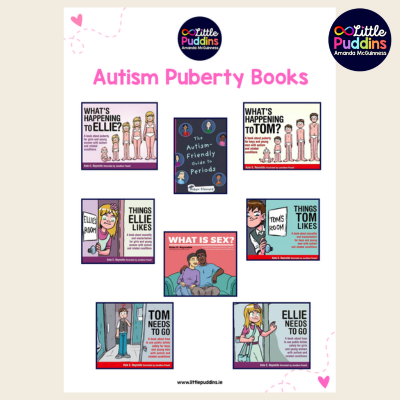
What’s Happening to Ellie? by Kate E. Reynolds
This book supports Autistic girls and young people through the physical and emotional changes associated with puberty. It uses clear illustrations and literal explanations to explore menstruation, body changes, and hygiene. The visual content is detailed, which can be reassuring for some readers and overwhelming for others, so adult guidance is recommended.
What’s Happening to Tom? by Kate E. Reynolds
A companion book designed for Autistic boys and young people, focusing on growth, body changes, erections, and emotional shifts during puberty. The strength of this book lies in its straightforward, non-judgemental explanations and predictable structure.
The Autism-Friendly Guide to Periods by Robyn Steward
Written from lived Autistic experience, this book explores menstruation through a sensory-aware and emotionally validating lens. It addresses periods, pain, mood changes, and product choices in a way that respects Autistic perspectives and bodily autonomy. This book is often particularly valued by teens who want honest information without minimising language.
Things Ellie Likes by Kate E. Reynolds
This book introduces topics around sexuality, masturbation, and privacy for Autistic girls and young people. It clearly distinguishes between private and public behaviour and uses visual storytelling to support understanding. Due to the explicit nature of the content and illustrations, adult discretion and shared reading are strongly advised.
Things Tom Likes by Kate E. Reynolds
A parallel resource for Autistic boys and young people, focusing on sexual feelings, boundaries, and appropriate contexts. The book is explicit and factual, which can reduce confusion but may require careful pacing depending on the teen’s emotional readiness.
What Is Sex? by Kate E. Reynolds
This book provides a clear explanation of sexual relationships, consent, and intimacy for Autistic teens and young adults. It avoids euphemisms and uses direct imagery. While this clarity is often helpful, families should consider timing and context carefully when introducing this material.
Ellie Needs to Go by Kate E. Reynolds
A practical book supporting Autistic girls and young people to use public toilets safely and confidently. It addresses privacy, safety, and social expectations in a structured, visual way, which can be particularly supportive during puberty when toileting needs may change.
Tom Needs to Go by Kate E. Reynolds
This book supports Autistic boys and young people with understanding public toileting, privacy, and safety. It complements broader puberty education by addressing real-life self-care situations that often become more complex during adolescence.
A note on parental discretion and pacing
Many Autism puberty books use explicit language and detailed illustrations intentionally, as this reduces ambiguity and misunderstanding. However, explicit does not mean universally appropriate at all stages. Parents and caregivers are encouraged to:
Read books in advance before sharing them
Introduce content gradually rather than all at once
Use shared reading where discussion and reassurance can happen
Pause or revisit topics based on the child’s emotional responses
There is no correct age or timeline. Readiness is individual and may change over time.
Using books as part of neuroaffirmative puberty support
Books are tools, not solutions. They work best when paired with open communication, visual supports, and an environment where questions are welcomed without judgement. Autistic children and teens deserve accurate information about their bodies and relationships, delivered in ways that respect their neurology and lived experience.
When chosen thoughtfully and used with care, puberty books can support understanding, reduce anxiety, and empower Autistic young people to navigate adolescence with greater confidence and self-advocacy.
These Autism puberty book recommendations offer a starting point for families and professionals seeking resources that prioritise clarity, dignity, and neuroaffirmative practice.