
Parenting A PDA Child

Rethinking Parenting Through a Low-Demand, Nervous System Aware Lens
This article forms part of the Little Puddins PDA Parenting series. If you're looking for practical guidance on supporting an Autistic child with a PDA profile across everyday family life, explore the PDA Parenting guide, where you'll find practical approaches, resources and links to more in-depth topics.
Parenting a PDA Child Often Changes the Parent Too
If you've spent time exploring PDA parenting, you've probably come across the term low demand parenting. For many families, discovering this approach feels like a breath of fresh air. It offers permission to step away from parenting based on compliance, repeated prompting and power dynamics, and instead prioritise regulation, connection and understanding.
For many parents, this shift can feel both liberating and unsettling.
Questions often begin to emerge.
Does low demand parenting mean removing all expectations?
How do I support autonomy while still meeting my child's everyday needs?
Is reducing demands enough?
How do I know what my child actually needs from me?
These are important questions, and they deserve thoughtful answers.
As an Autistic PDA adult, the parent of four Autistic children, two of whom have a PDA profile, and an Autism specialist, I have spent many years reflecting on these questions through both lived experience and professional practice.
Over time, my own thinking has evolved.
While I value many of the principles commonly associated with low demand parenting, I have come to believe that the conversation becomes even more helpful when we move beyond asking "How can I reduce demands?" and begin asking a different question.
What makes an experience feel pressurised in the first place?
For me, that question has fundamentally changed how I think about parenting.

Beyond Reducing Demands
When families first encounter low demand parenting, it is easy to assume that the goal is simply to reduce or remove demands.
In reality, parenting is rarely that straightforward.
Children need support with learning, self-care, boundaries, relationships, health, education and participating in family life. The question is not whether everyday life contains demands, pressures and power dynamics. It always will.
The more helpful question is how those experiences are understood, communicated, scaffolded, and supported.
Rather than thinking about parenting as a process of managing demands, I now think about shaping environments and relationships that support autonomy, relational safety and reduce power dynamics, recognising that when these foundations are present, engagement is more likely to emerge naturally.
I find myself curiously asking,
What might be making this difficult?
What is happening within my child's nervous system?
What environmental factors are contributing?
Does my child have the available capacity right now?
How can I increase understanding, predictability and reduce the perception of pressure?
How do I identify the power dynamics that be subtle and not obvious to me?
What would make this experience feel more manageable?
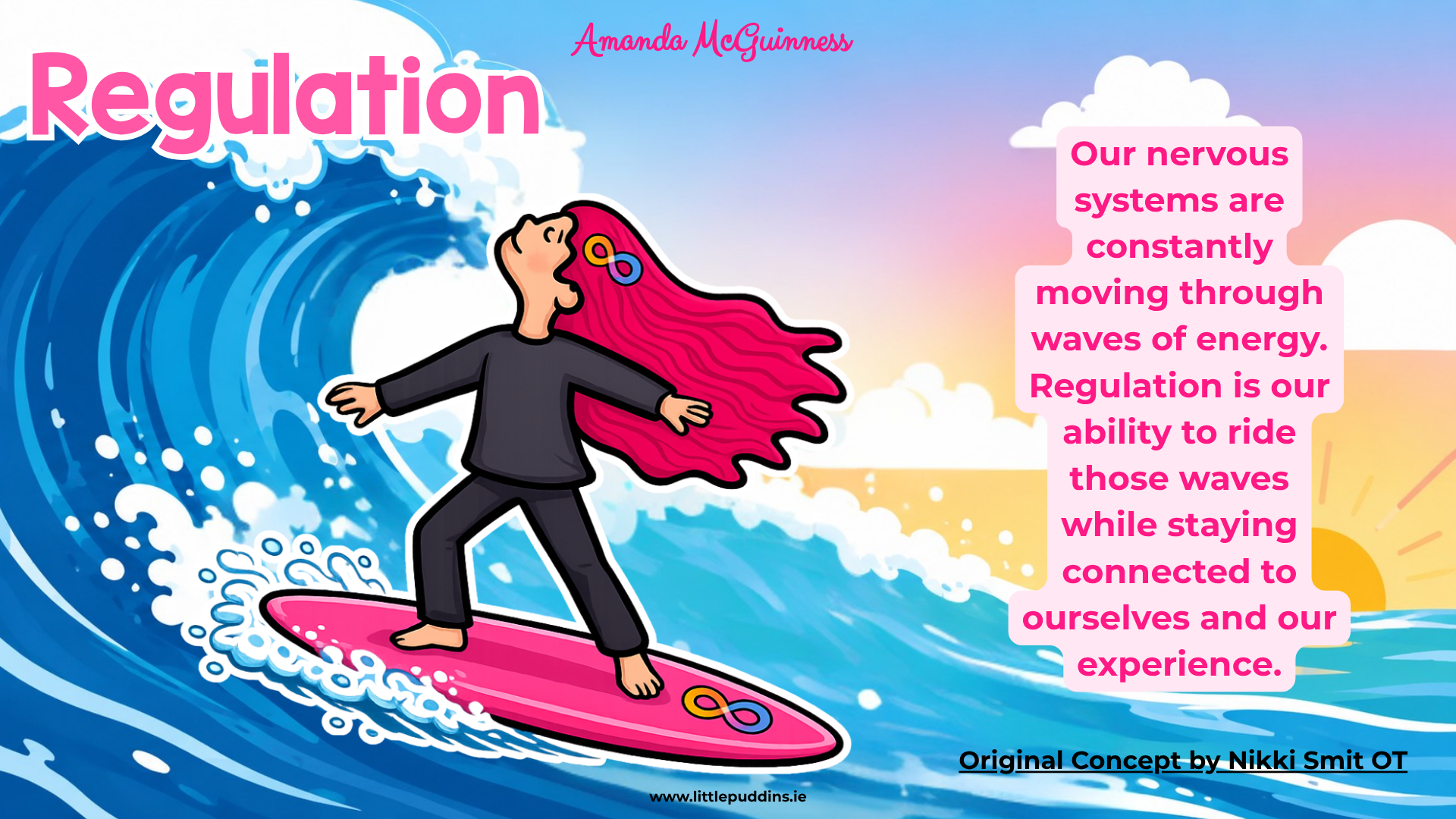
Understanding the Demand Landscape
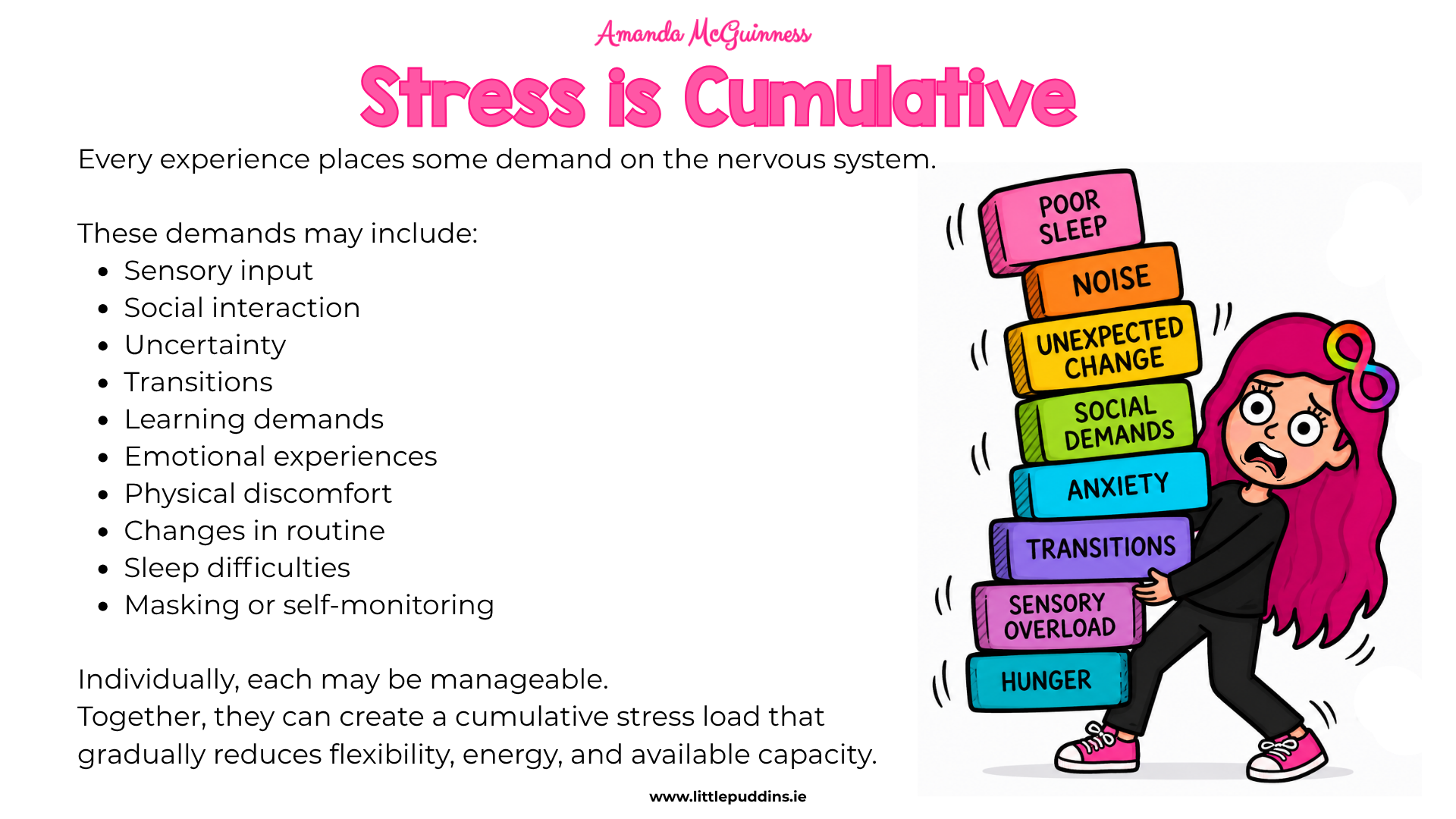
One of the biggest changes in my own thinking has been recognising that demands are rarely isolated events. I think of demands now as pressures, stresses that stack accumulatively.
What we often describe as "a demand" is usually the final visible moment within a much larger landscape of interacting stressor, pressurised experiences.
For example when we talk about getting dressed as a demand we may think its the simple task of putting on clothes but in terms of pressures, power dynamics and stress stacking we have to consider it accumulatively may also include:
transitioning away from a preferred activity
sensory discomfort from clothing
uncertainty about the day ahead
executive functioning demands
time pressure
communication demands
previous stressful experiences
emotional fatigue
masking
reduced available capacity after a difficult morning
From the outside, it can appear that getting dressed is the problem. From the PDA person’s perspective, it may be only one part of a much larger pressurised experience.
Looking at the whole demand landscape helps us move beyond asking whether a task is simply "too demanding" and towards understanding what is contributing to that experience.
This way of thinking encourages us to support participation rather than simply reducing demands.
Parenting Through Curiosity Rather Than Control
Traditional parenting often encourages us to respond by increasing structure, consistency or consequences when something isn't working.
My own experience has taught me that curiosity is often far more informative than control.
When participation becomes difficult, I try to understand before I intervene.
I don’t always get it right of course, but when I can I try to consider:
What is my child communicating?
What is happening in terms of stress stacking?
Have I considered their available capacity?
What has today already required of them?
Is uncertainty increasing distress?
What impact has the power dynamic on this experience for my child?
Is there another way we could approach this together?
In our home we have boundaries and we have expectations but they may not look like what you may consider to be “traditional parenting”. It changes how we arrive at them.
The Unlearning : Letting Go of Traditional Parenting
Parenting a PDA child requires deep unlearning. It’s more than abandoning outdated strategies, it’s unpacking the belief systems you inherited. The traditional model of control and compliance often fails to support Autistic neurobiology and autonomy. Letting go is painful, but it opens the door to connection-driven parenting.
Parenting Through Judgement: Standing Firm in Your Truth
Parenting a child with a PDA profile can be confronting in public spaces. Others may judge your parenting approach, but PDA parenting demands a focus on relationship and regulation, not performance. Anchor yourself in what your child needs, not what others expect.
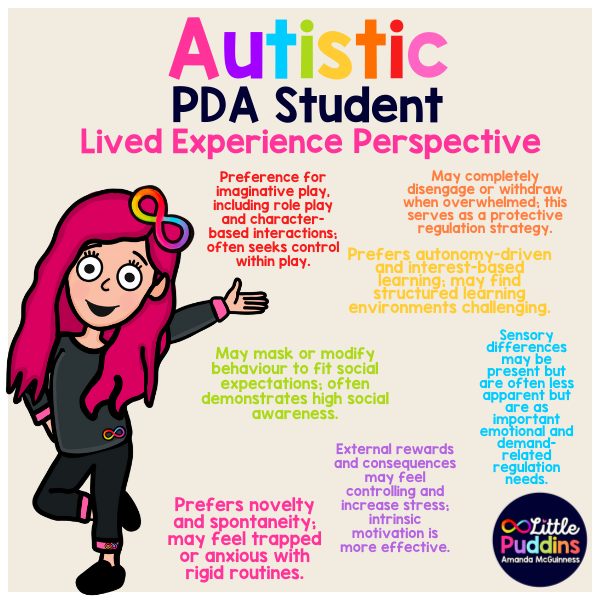
Low Demand Does Not Mean Low Expectations
One of the most common misunderstandings about low demand parenting is that it means removing all expectations or saying yes to everything. That has never reflected my own understanding. Supporting autonomy is not the same as abandoning guidance. Children still need support to learn, grow, develop independence and participate in everyday life.
The difference lies in recognising that participation cannot be separated from regulation, communication, sensory experiences, relationships, predictability, available capacity and environmental fit.
I try to remind myself to consider:
How can we create the environmental conditions that make participation feel more achievable while respecting autonomy and wellbeing?
It may mean changing how something is communicated.
It may require changing the timing.
It often can mean adapting the environment.
It may mean providing recovery before expecting participation.
Sometimes it means recognising that today simply requires a different approach.
At the centre of everything is my focus on the PDA child, their experiences and how I can support them to receive signals of safety from me and the environmental experience.

The Boundary Blueprint: Preserving Peace in a Neurodivergent Home
Boundaries become essential for PDA families. You’ll need to protect your energy from well-meaning but misinformed advice. Boundaries create space to honour your child’s nervous system and your own, allowing you to parent intuitively and protect the heart of your connection.
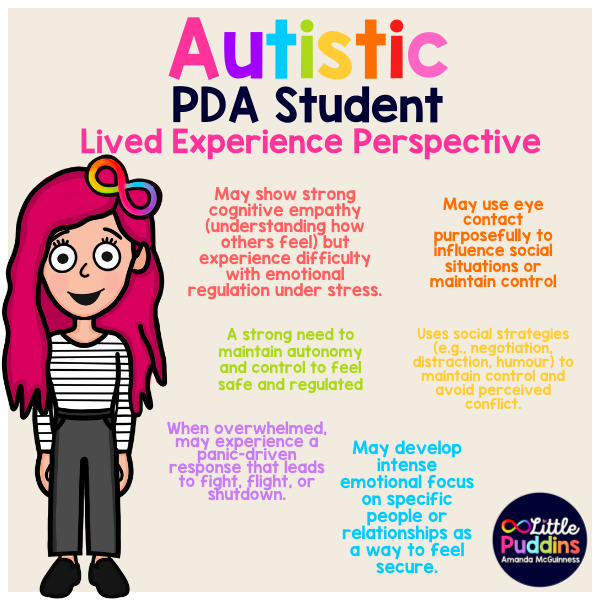
Parenting as a Collaborative Relationship
One of the greatest lessons my children have taught me is that parenting is not something we do to our children. It is something we build with them. The strongest relationships I have experienced have not grown from trying to increase compliance. They have grown from trust.
From repair after difficult moments.
From listening more carefully.
From recognising that my children experience the world differently from me.
From understanding that behaviour tells only part of the story.
Connection does not remove challenge. But it changes how challenge is experienced together.
Releasing Control: Parenting Without Power Struggles
In PDA parenting, control often leads to rupture. Instead of escalating demands, you learn to co-create safe environments that feel manageable for your child. You stop parenting from the outside in, and begin parenting from the inside out.
A Different Way of Measuring Progress
Parenting a child with a PDA profile has also changed how I think about success. Progress is not always visible.
Sometimes progress looks like:
recovering more quickly after overwhelm
asking for help instead of shutting down
feeling safe enough to communicate "no"
trusting that a difficult conversation can be repaired
participating in a way that wasn't possible six months ago
having one calmer morning this week than last
These moments, within many PDA families, they can represent enormous growth.
Beyond Behaviour: The Power of Accommodation
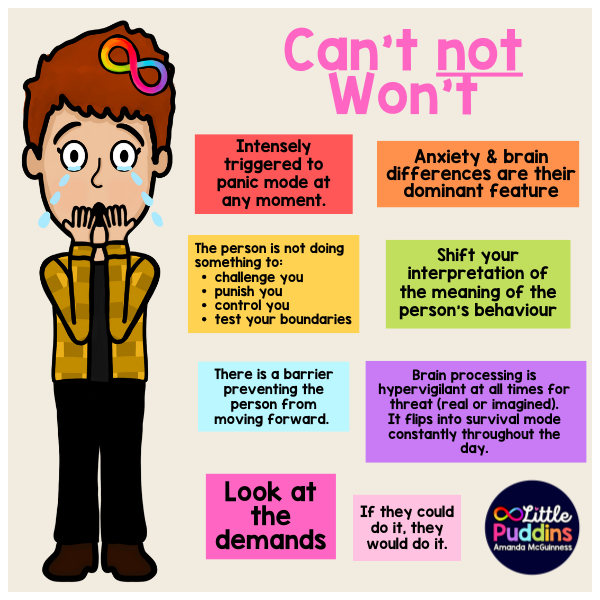
Accommodation isn’t giving in, it’s giving space. PDA children are not misbehaving; they are communicating. Adapting your parenting and reducing demands builds trust and co-regulation. Accommodation becomes the foundation for emotional safety and relationship.
The Parent Is Part of the Environment Too
One lesson I return to again and again is that parents are not standing outside the experience.
We are a central part of the environment our children are responding to.
Our regulation.
Our communication.
Our pacing.
Our expectations.
Our flexibility.
Our willingness to repair.
None of us gets this right all the time. I certainly don't. I make mistakes and have to repair with my child.
But recognising that we are part of the relationship gives us opportunities to make thoughtful changes without placing responsibility solely on our children.

Off-Road Parenting: Navigating the Unknown
There is no manual for PDA parenting that will work exactly right for your unique family. You are writing your own. It may feel lonely or unfamiliar, but it’s also empowering. This uncharted path is one of honesty, adaptability, and deep attunement.
My Perspective on PDA Parenting
For me, neuroaffirmative PDA parenting is defined by how deeply we seek to understand what makes everyday life feel overwhelming.
I try to remind myself that participation emerges through the interaction between the individual, their nervous system, their relationships and the environments they move through every day.
When I can perceive and understand those interactions more clearly, I am better equipped to make thoughtful decisions that support autonomy, strengthen connection and create conditions where participation feels safer and more achievable.
That is the lens through which I continue to parent my own children, support other families and develop the resources across Little Puddins.
Continue Exploring PDA Parenting
If this way of thinking resonates with you, you may also find these resources helpful:
PDA Parenting: Practical neuroaffirmative guidance for supporting everyday family life.
What is PDA?: Understanding the PDA profile, characteristics and current perspectives.
PDA and Regulation: Exploring regulation, capacity and participation.
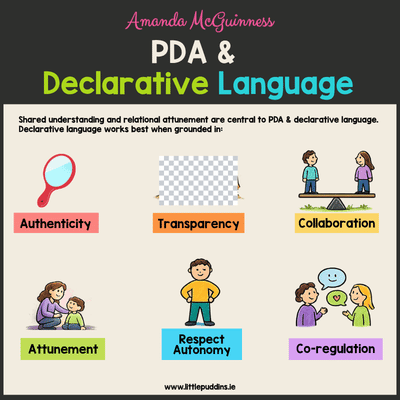
Declarative Language: Supporting communication while reducing unnecessary pressure.
PDA at School: Creating more accessible educational environments.
PDA Resources: Practical visual supports and downloadable tools for home and school.
No two Autistic children, and no two families, are the same. My hope is that Little Puddins helps you build understanding, develop confidence in your own decision making, and find approaches that support your family's unique journey while respecting your child's individuality, autonomy and wellbeing.

PDA References
Supporting Autistic PDA Students References:
Christie, P., Duncan, M., Fidler, R. and Healy, Z. (2012).Understanding Pathological Demand Avoidance Syndrome in Children: A Guide for Parents, Teachers and Other Professionals. London: Jessica Kingsley Publishers.
Fidler, R. and Christie, P. (2019).Collaborative Approaches to Learning for Pupils with PDA: Strategies for Education Professionals. London: Jessica Kingsley Publishers.
Truman, C. (2021).The Teacher’s Introduction to Pathological Demand Avoidance: Essential Strategies for the Classroom. London: Jessica Kingsley Publishers.
Fricker, E. (2021).The Family Experience of PDA: An Illustrated Guide to Pathological Demand Avoidance. London: Jessica Kingsley Publishers.
Cat, S. (2018).Pathological Demand Avoidance Explained. London: Jessica Kingsley Publishers.
Eaton, J. (2017).A Guide to Mental Health Issues in Girls and Young Women on the Autism Spectrum: Diagnosis, Intervention and Family Support. London: Jessica Kingsley Publishers.
Newson, E. (2003).Pathological Demand Avoidance Syndrome: A Necessary Distinction within the Pervasive Developmental Disorders. Archives of Disease in Childhood, 88(7), pp. 595–600.
Get in Touch:Contact Amanda
Follow for Insights:Instagram @littlepuddins.ie
