The Window of Tolerance

Understanding the Window of Tolerance in Autism & PDA
The Window of Tolerance is a concept increasingly used within neuroaffirmative Autism and PDA-informed practice to help parents, caregivers, educators, and professionals better understand nervous system regulation, emotional overwhelm, shutdown, and stress responses.
Originally described by Dr. Dan Siegel within the field of interpersonal neurobiology, the Window of Tolerance refers to the range in which a person’s nervous system feels regulated enough to think clearly, communicate, process information, learn, connect with others, and cope with everyday experiences.

For many Autistic individuals, particularly those with a PDA profile, the nervous system can move outside this regulation window more quickly due to demands, pressure, expectations, sensory overwhelm, uncertainty, emotional stress, social pressure, communication demands, fatigue, or perceived loss of autonomy.
Understanding the Window of Tolerance can help families and professionals move away from behaviour-based interpretations of distress and towards a more compassionate, nervous-system-informed understanding of regulation and support.
What is the Window of Tolerance?
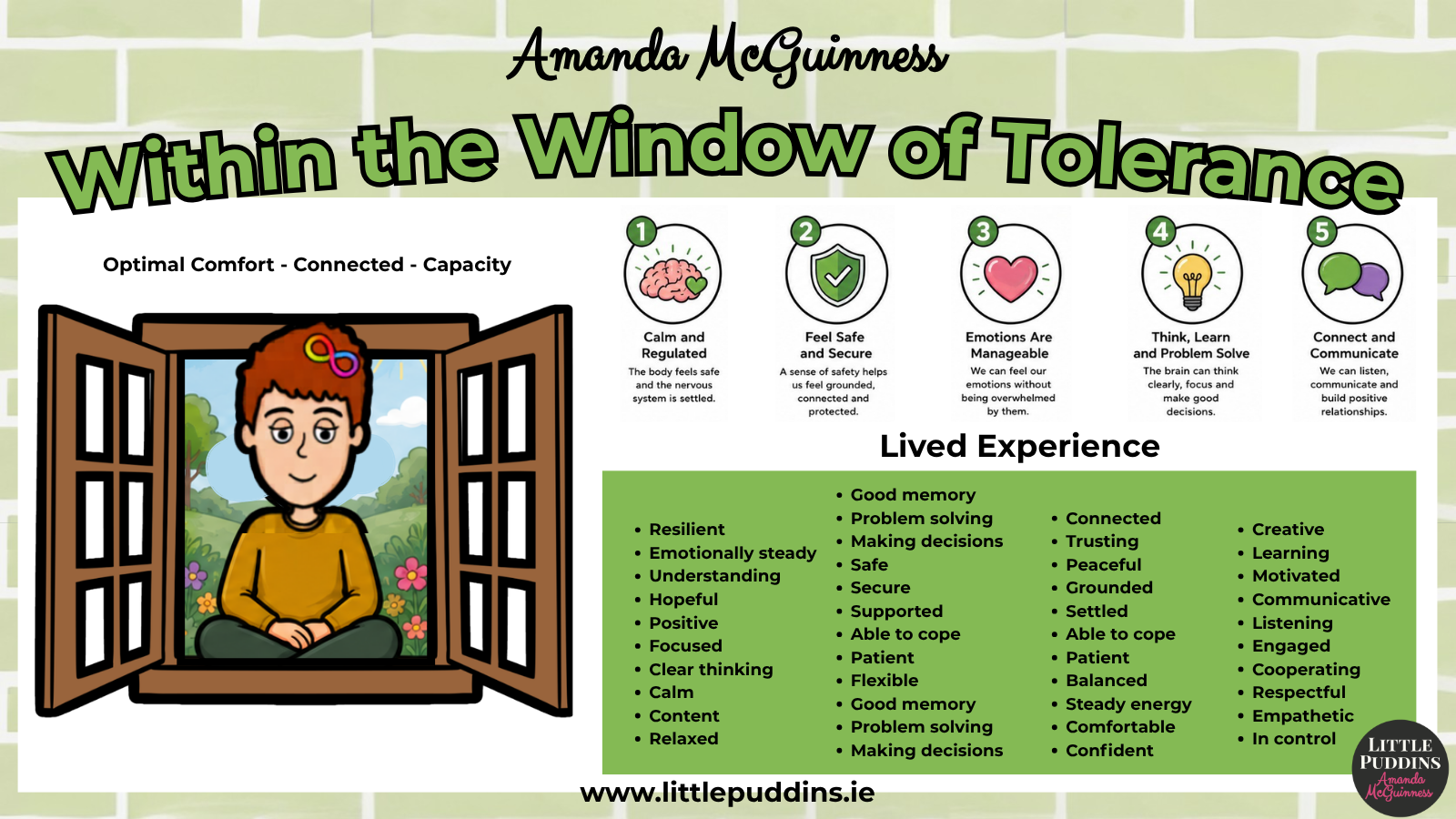
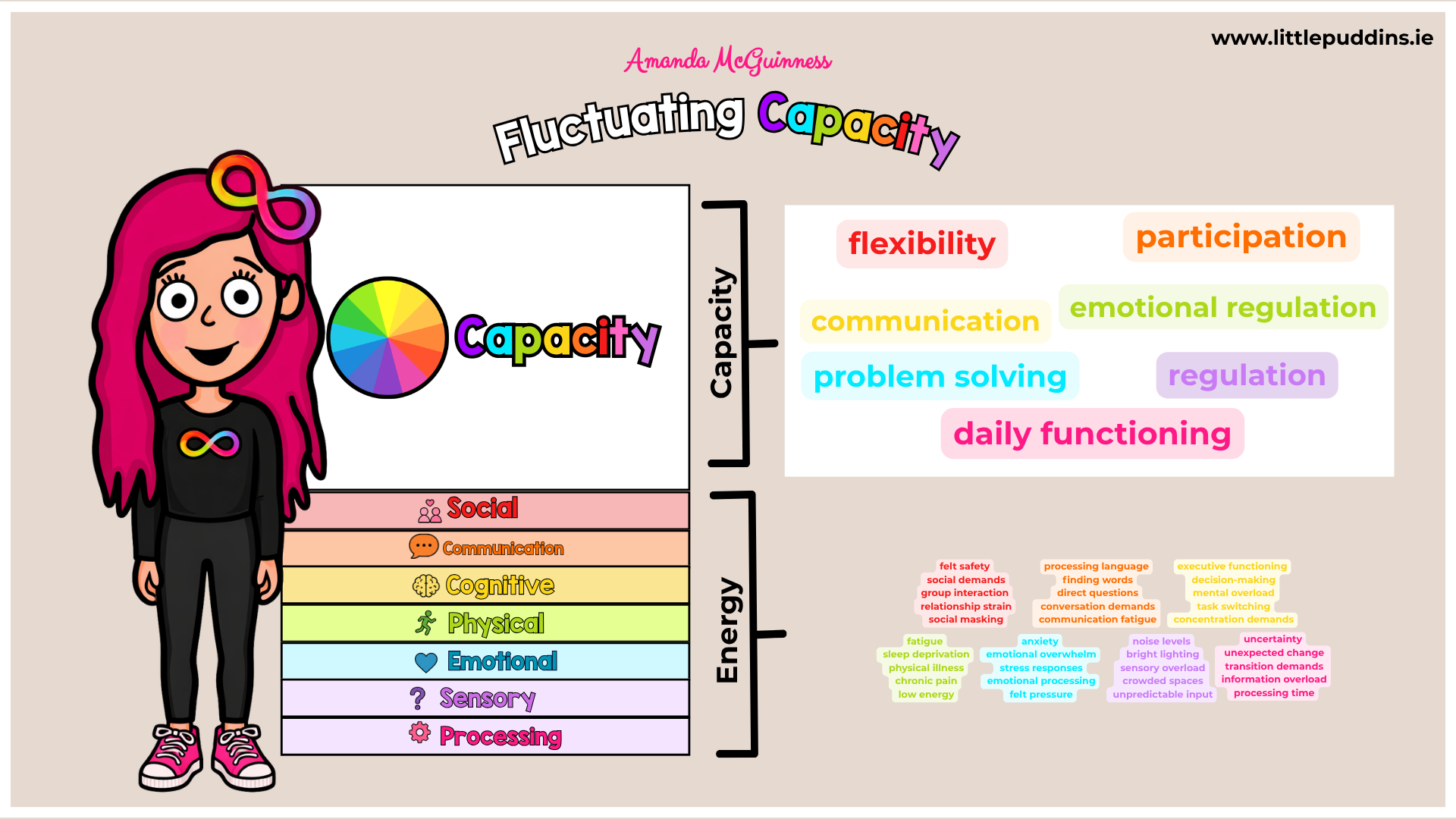
The Window of Tolerance describes the available capacity in which the brain and body are able to function in a more flexible and integrated way. When a person is within their regulation window, they are more likely to feel safe enough to:
communicate
learn
problem solve
engage socially
regulate emotions
recover from stress
process sensory information
cope with everyday demands
Being within the Window of Capacity does not mean a person is always calm or happy. Rather, it means the nervous system is functioning within a manageable range of activation where emotional experiences remain tolerable and flexible thinking remains accessible.

For Autistic individuals and PDAers, the size and flexibility of this regulation window can fluctuate significantly depending on factors such as:
sensory processing demands
masking and social exhaustion
environmental stress
uncertainty
transitions
sleep
emotional safety
interoception
cumulative stress load
communication demands
perceived pressure or loss of control
external expectations
external feedback

Hyperarousal in Autism & PDA
When a person moves above their Window of Tolerance, they may experience hyperarousal. Hyperarousal is associated with activation of the sympathetic nervous system and can involve fight, flight, panic, urgency, hypervigilance, sensory overwhelm, emotional flooding, and increased stress responses.
For PDA individuals, demands and expectations can trigger intense nervous system activation because the brain perceives pressure and loss of autonomy as a threat to safety. This is not intentional oppositional behaviour. Rather, it reflects a protective survival response within the nervous system.
Hyperarousal in Autism and PDA may include:
panic
irritability
racing thoughts
sensory overload
increased movement
emotional overwhelm
shouting or crying
difficulty processing language
heightened anxiety
meltdowns
urgent need to escape
defensive responses
hypervigilance
nervous system overload
During hyperarousal, the thinking parts of the brain become less accessible. A person may struggle to process verbal information, communicate effectively, or engage in flexible problem solving. In these moments, nervous system safety and co-regulation are often more important than verbal reasoning or behavioural correction.
Hypoarousal and Shutdown
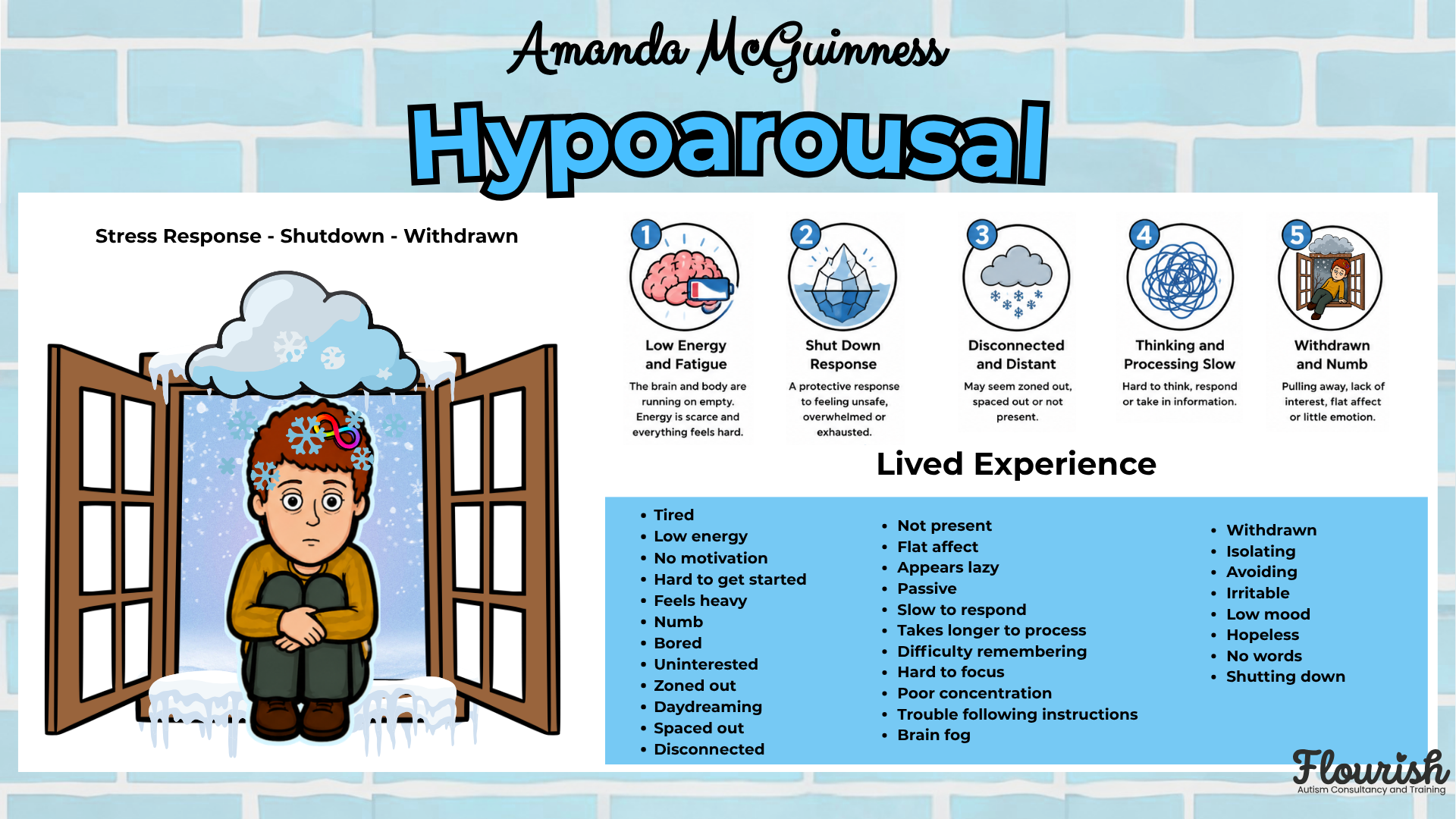
When a person moves below their Window of Tolerance, they may enter a state of hypoarousal. Hypoarousal is associated with shutdown, withdrawal, exhaustion, emotional numbness, and reduced responsiveness. The nervous system slows down in an attempt to conserve energy and protect itself from further overwhelm.
Hypoarousal is often misunderstood because it can appear quieter or less externally visible than hyperarousal. However, shutdown states can reflect significant nervous system distress and depletion.
Hypoarousal in Autism and PDA may include:
exhaustion
emotional numbness
low energy
withdrawal
disconnection
shutdown
brain fog
reduced communication
slow processing
difficulty initiating tasks
feeling “checked out”
zoning out
reduced responsiveness
low motivation
burnout
For many Autistic individuals, prolonged masking, chronic stress, sensory overload, anxiety, or cumulative nervous system strain can contribute to hypoarousal and Autistic burnout.
Supporting Regulation
Neuroaffirmative support focuses on increasing felt safety, reducing overwhelm, and supporting nervous system flexibility rather than attempting to control behaviour.
Research across interpersonal neurobiology, Polyvagal Theory, sensory processing, attachment, trauma-informed practice, and Autism research consistently highlights the importance of:
relational trust
emotional safety
predictability
co-regulation
sensory understanding
autonomy
compassionate communication
unconditional positive regard
reduced threat perception
Supportive approaches may include:
reducing unnecessary demands
using declarative language
increasing predictability
supporting sensory regulation
protecting recovery time
offering autonomy and flexibility
validating distress
supporting communication differences
reducing pressure
prioritising connection over control
For PDA individuals, low-demand, collaborative, and trust-based approaches are often more effective.

Understanding Regulation
The Window of Tolerance framework helps reframe distress with greater compassion and understanding. Instead of asking, “How do we stop this behaviour?”, families and professionals can begin asking:
What is the nervous system communicating right now?
What might feel unsafe, overwhelming, or unpredictable?
What support does this person need in this moment?
How can we reduce stress and increase safety?
This shift is particularly important within Autism and PDA support because nervous system responses are deeply connected to sensory processing, emotional safety, autonomy, communication, connection, and stress capacity.
The goal is not to force constant calmness or compliance.
Human nervous systems naturally fluctuate between states depending on stress, overwhelm, safety, support, and environmental demands. Understanding these nervous system states can help Autistic individuals feel more understood, validated, and supported rather than judged or misunderstood.
Continue Exploring PDA
Understanding pressure is one part of the wider picture.
You may also find these Little Puddins guides helpful:
What is PDA? Learn about the characteristics of a Persistent Drive for Autonomy and why it is understood differently from traditional behaviour-based models.
PDA Parenting Guide Explore practical, neuroaffirmative approaches to supporting everyday life at home.
Declarative Language Discover how communication styles can influence autonomy, regulation and connection.
PDA and School Understand how classroom environments, expectations and relationships shape participation.
Autistic Burnout and Regulation Learn how accumulated stress can affect capacity across home, school and community.

References
Dana, D. (2018) The Polyvagal Theory in Therapy: Engaging the Rhythm of Regulation. New York: W.W. Norton & Company.
Fidler, R. and Christie, P. (2019) Collaborative Approaches to Learning for Pupils with PDA: Strategies for Education Professionals. London: Jessica Kingsley Publishers.
Kapp, S.K., Steward, R., Crane, L., Elliott, D., Elphick, C., Pellicano, E. and Russell, G. (2019) ‘People should be allowed to do what they like’: Autistic adults’ views and experiences of stimming. Autism, 23(7), pp. 1782–1792.
Milton, D. (2012) ‘On the ontological status of Autism: The “double empathy problem”’, Disability & Society, 27(6), pp. 883–887.
Ogden, P., Minton, K. and Pain, C. (2006) Trauma and the Body: A Sensorimotor Approach to Psychotherapy. New York: W.W. Norton & Company.
Pellicano, E. and Burr, D. (2012) ‘When the world becomes “too real”: A Bayesian explanation of Autistic perception’, Trends in Cognitive Sciences, 16(10), pp. 504–510.
Porges, S.W. (2011) The Polyvagal Theory: Neurophysiological Foundations of Emotions, Attachment, Communication and Self-Regulation. New York: W.W. Norton & Company.
Schore, A.N. (2019) Right Brain Psychotherapy. New York: W.W. Norton & Company.
Siegel, D.J. (1999) The Developing Mind: Toward a Neurobiology of Interpersonal Experience. New York: Guilford Press.
van der Kolk, B. (2014) The Body Keeps the Score: Brain, Mind, and Body in the Healing of Trauma. New York: Viking.
Walker, N. (2021) Neuroqueer Heresies: Notes on the Neurodiversity Paradigm, Autistic Empowerment, and Postnormal Possibilities. Fort Worth, TX: Autonomous Press.