
The Waves of Regulation

The Waves of Regulation and the Window of Capacity:
Understanding Regulation with Nikki Smit OT
When we think about regulation, many of us picture calm.
We imagine someone sitting quietly, taking deep breaths, or appearing relaxed and in control. Yet regulation is so much more than this.
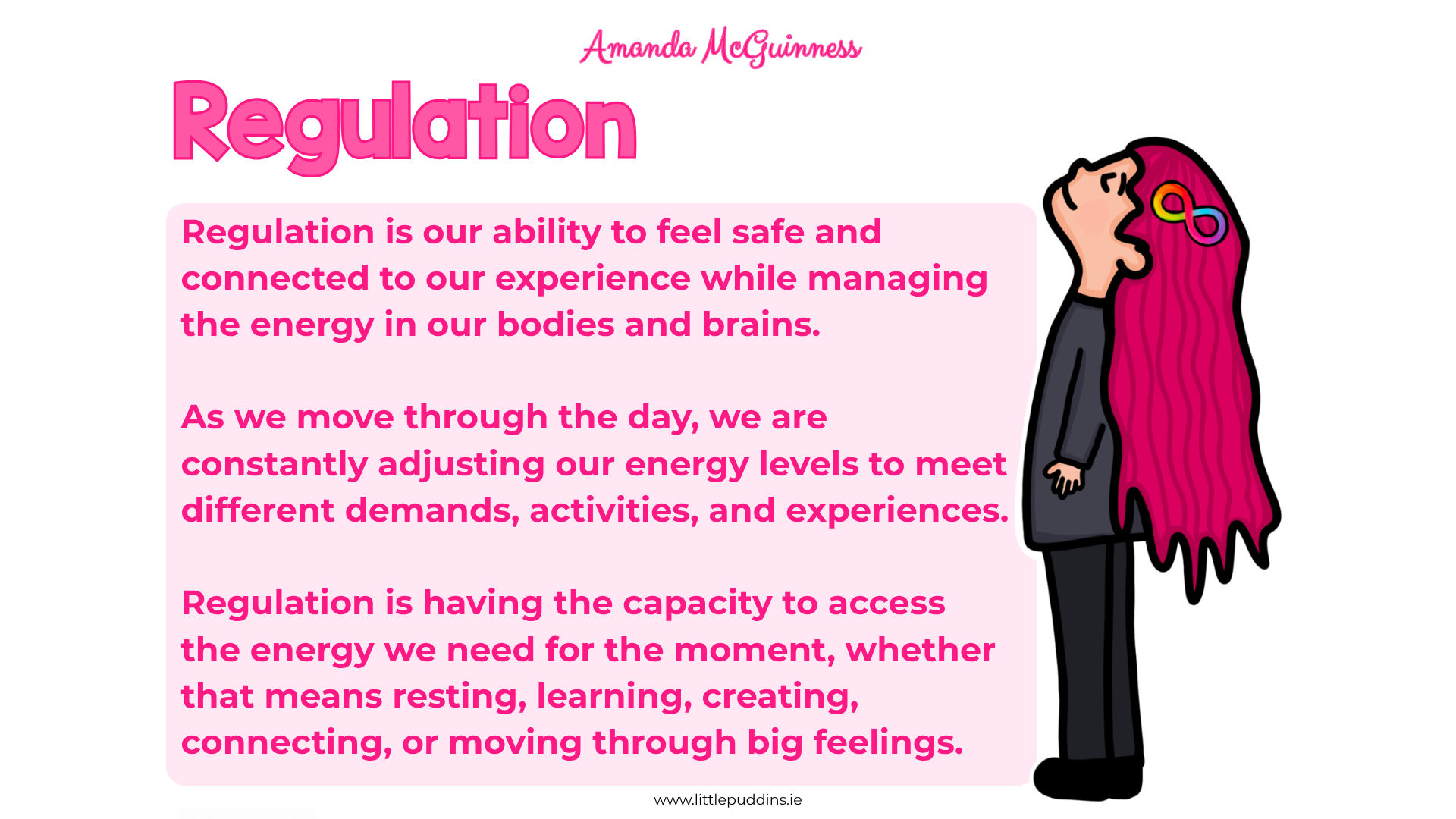
Regulation is not the absence of emotion, energy, or challenge. It is our nervous system's capacity to remain connected to ourselves and to others as we move through the natural ups and downs of everyday life.
In a recent episode of The Unfiltered Autistic Podcast, I was joined by neurodivergent Occupational Therapist, educator, and speaker Nikki Smit to explore her Waves of Regulation framework. Together, we discussed how understanding the nervous system can transform the way parents, educators, therapists, and helping professionals support Autistic and neurodivergent people.
If we shift our understanding of regulation away from calmness and towards capacity, connection, and felt safety, we begin to see behaviour, emotions, and nervous system responses in an entirely different light.
What Are the Waves of Regulation?
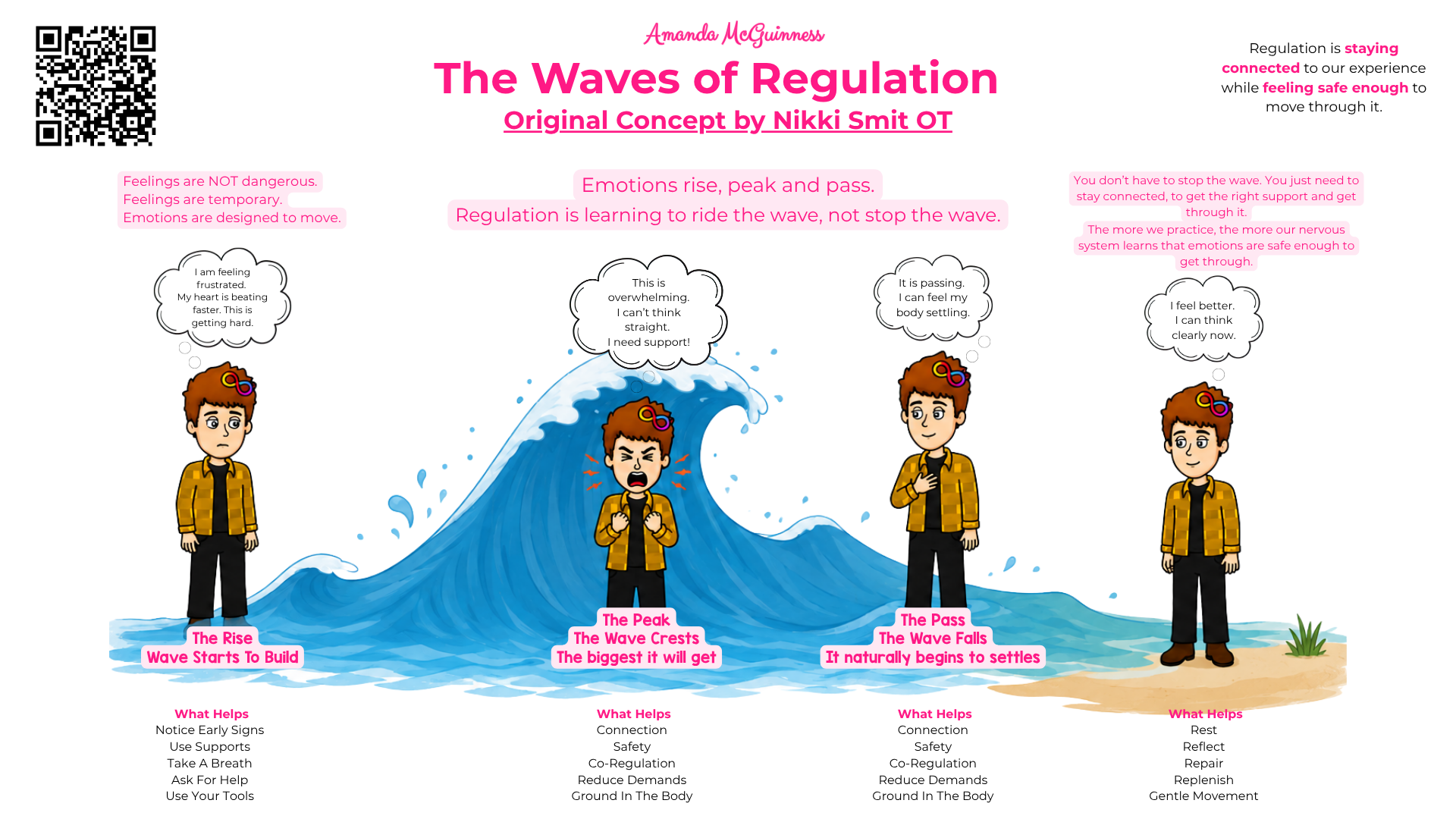
The Waves of Regulation is a compassionate framework developed by Nikki Smit OT that helps us understand regulation as something dynamic rather than static.
Life naturally moves in waves.
Some moments feel calm and predictable.
Others bring excitement, uncertainty, frustration, disappointment, grief, joy, curiosity, or overwhelm.
Healthy regulation does not mean preventing these waves from occurring.
Instead, regulation is our ability to remain connected to ourselves as those waves rise, peak, and eventually settle again.
This understanding is grounded in neuroscience.
Research demonstrates that emotions are designed to move through us. When we are supported to experience feelings safely, they naturally rise, peak, and begin to settle over time.
The goal is not to eliminate emotion.
The goal is to develop the capacity to experience it safely.
Understanding the Window of Capacity
At the heart of Nikki Smit's Waves of Regulation framework is the concept of the Window of Capacity.
This concept builds upon Dr. Dan Siegel's widely recognised Window of Tolerance, which describes the range within which our nervous system is able to remain flexible, connected, and responsive during everyday life. Within this window, we are generally able to think clearly, solve problems, learn, communicate, adapt, and remain connected to ourselves and to others.
Throughout our conversation, Nikki explains that she prefers the term Window of Capacity because it shifts the emphasis away from tolerating experiences and instead focuses on the available resources and flexibility within our nervous system. Rather than asking how much we can simply tolerate, the concept encourages us to consider how much capacity we currently have to meet the demands of a particular moment.
When we are within our Window of Capacity, we can experience a full range of emotions, including excitement, frustration, sadness, joy, disappointment, and uncertainty, while remaining connected to ourselves. We may not enjoy every feeling, but we have enough nervous system capacity to move through those experiences without becoming completely overwhelmed by them.
The Window of Capacity is not fixed.
It expands and contracts throughout our lives and even from one day to the next.
Sleep, sensory experiences, illness, relationships, emotional wellbeing, physical health, cumulative stress, and the accessibility of our environments all influence how much capacity our nervous system has available at any given time.
For many Autistic and otherwise neurodivergent people, everyday life may involve significantly greater sensory, cognitive, emotional, and social demands. Sensory processing differences, masking, uncertainty, communication demands, executive functioning, transitions, and inaccessible environments all require nervous system resources. This means that capacity is not simply about resilience or coping. It is shaped by the interaction between the individual and their environment.
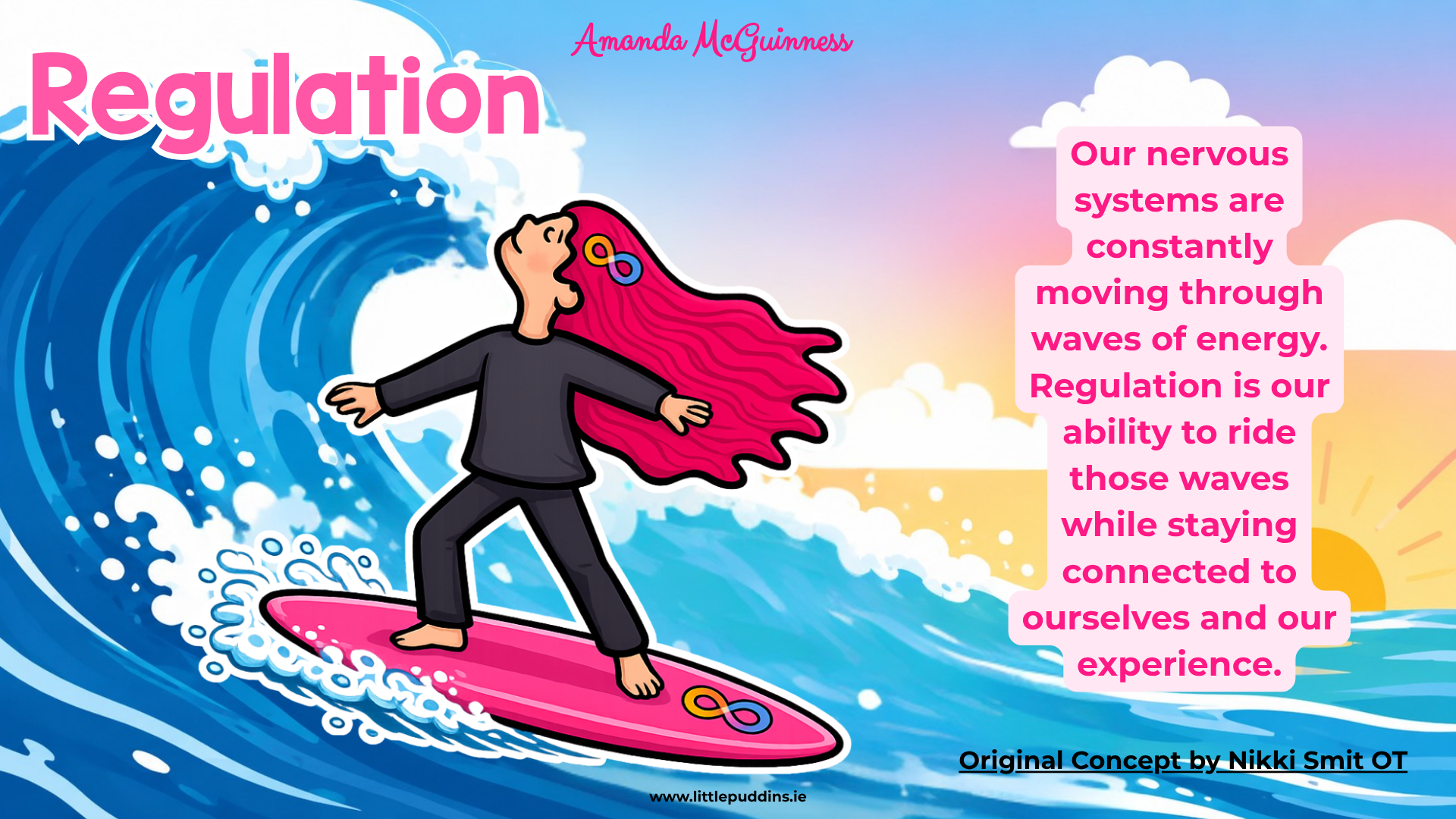
One of the most hopeful aspects of this framework is that capacity is not static. As Nikki explains, our Window of Capacity can grow over time through experiences of safety, connection, support, and authentic relationships. Growth does not occur because we force ourselves to tolerate increasingly overwhelming situations. Rather, it develops when challenge is balanced with sufficient support, allowing the nervous system to gradually develop greater flexibility while maintaining a sense of safety.
Understanding the Window of Capacity encourages us to move away from asking, "Why can't they cope?" and instead ask, "What is affecting this person's available capacity today?" That subtle shift invites curiosity, compassion, and a far more neuroaffirmative understanding of regulation.
What Happens Outside the Window of Capacity?
As the demands placed upon our nervous system begin to exceed our available capacity, we may move outside our Window of Capacity.
This is not a conscious decision, nor does it reflect poor coping, weakness, or a lack of resilience. Instead, it represents the nervous system doing exactly what it has evolved to do: protect us.
Our nervous system is constantly scanning both our internal experiences and the world around us for cues of safety and cues of potential threat. This process occurs automatically, often long before we become consciously aware of it. When the nervous system determines that the demands being placed upon us exceed the resources currently available, it begins to shift into protective states designed to help us cope.
For some people, this results in higher levels of activation.
The nervous system increases energy and alertness in preparation to respond to what it perceives as challenge or danger. This may be experienced as urgency, anxiety, panic, frustration, anger, restlessness, racing thoughts, heightened sensory sensitivity, impulsivity, or difficulty accessing logical thinking and communication.
For others, the nervous system responds by moving into lower levels of activation.
Rather than increasing energy, it begins conserving it. This may present as shutdown, withdrawal, emotional numbness, fatigue, brain fog, reduced communication, reduced movement, or feeling disconnected from people and the surrounding environment.
Neither response is inherently better than the other.
Neither is a sign that something has gone wrong.
Both represent adaptive, protective nervous system responses that have developed to support survival when our available capacity has been exceeded.
Importantly, these are not fixed states. Our nervous systems continually move between different levels of activation throughout the day as our environments, relationships, sensory experiences, physical health, emotions, and available resources change. It is entirely possible to move between higher and lower activation within a relatively short period of time, particularly when stress accumulates without opportunities for recovery.
For many Autistic people, everyday life may involve significantly greater sensory, cognitive, emotional, and social demands than those around them recognise. Sensory processing differences, uncertainty, masking, executive functioning demands, communication effort, transitions, and inaccessible environments all require nervous system resources. As a result, available capacity may become depleted more quickly, not because an Autistic nervous system is less capable, but because it is often required to process considerably more information while navigating environments that may not have been designed with neurodivergent people in mind.
Understanding what happens outside the Window of Capacity encourages us to replace judgement with curiosity.
Understanding how and why we move outside our Window of Capacity naturally leads us to another important concept explored by Nikki Smit: stress stacking. More often than not, it is not one significant event that overwhelms the nervous system, but the gradual accumulation of many seemingly small demands over time.
Stress Stacking
When someone becomes overwhelmed, our natural instinct is often to search for the immediate trigger.
"What happened just before?"
While understanding the immediate context can be helpful, nervous systems rarely work in such a simple or linear way.
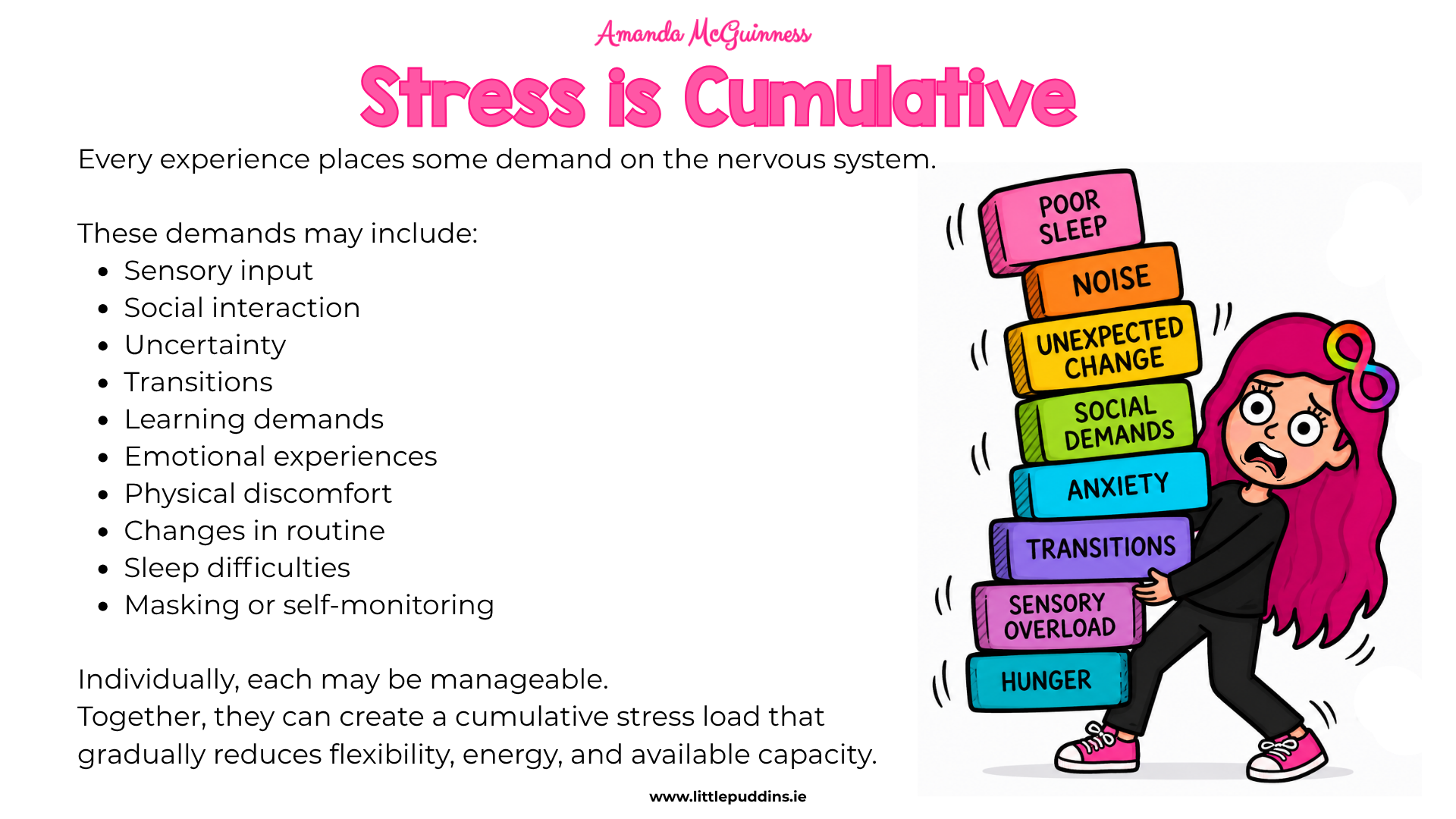
Stress is cumulative.
Throughout the day, our nervous system is constantly responding to sensory experiences, transitions, communication demands, social interactions, uncertainty, waiting, decision making, masking, unexpected changes, physical discomfort, and countless other demands. Each of these experiences may seem relatively small on its own, but together they gradually draw upon our available nervous system capacity.
Eventually, one additional demand may exceed that remaining capacity.
Importantly, this final event is often not the true cause of overwhelm. Instead, it may simply be the moment when the cumulative demands of the day become more than the nervous system can manage.
Another important consideration is that stress stacking often occurs outside of conscious awareness. Many people, particularly Autistic people who are navigating complex sensory, cognitive, and social demands, may not consciously recognise each individual stressor as it occurs. By the time overwhelm becomes visible, the nervous system may already have been managing an accumulation of demands for hours or even days.
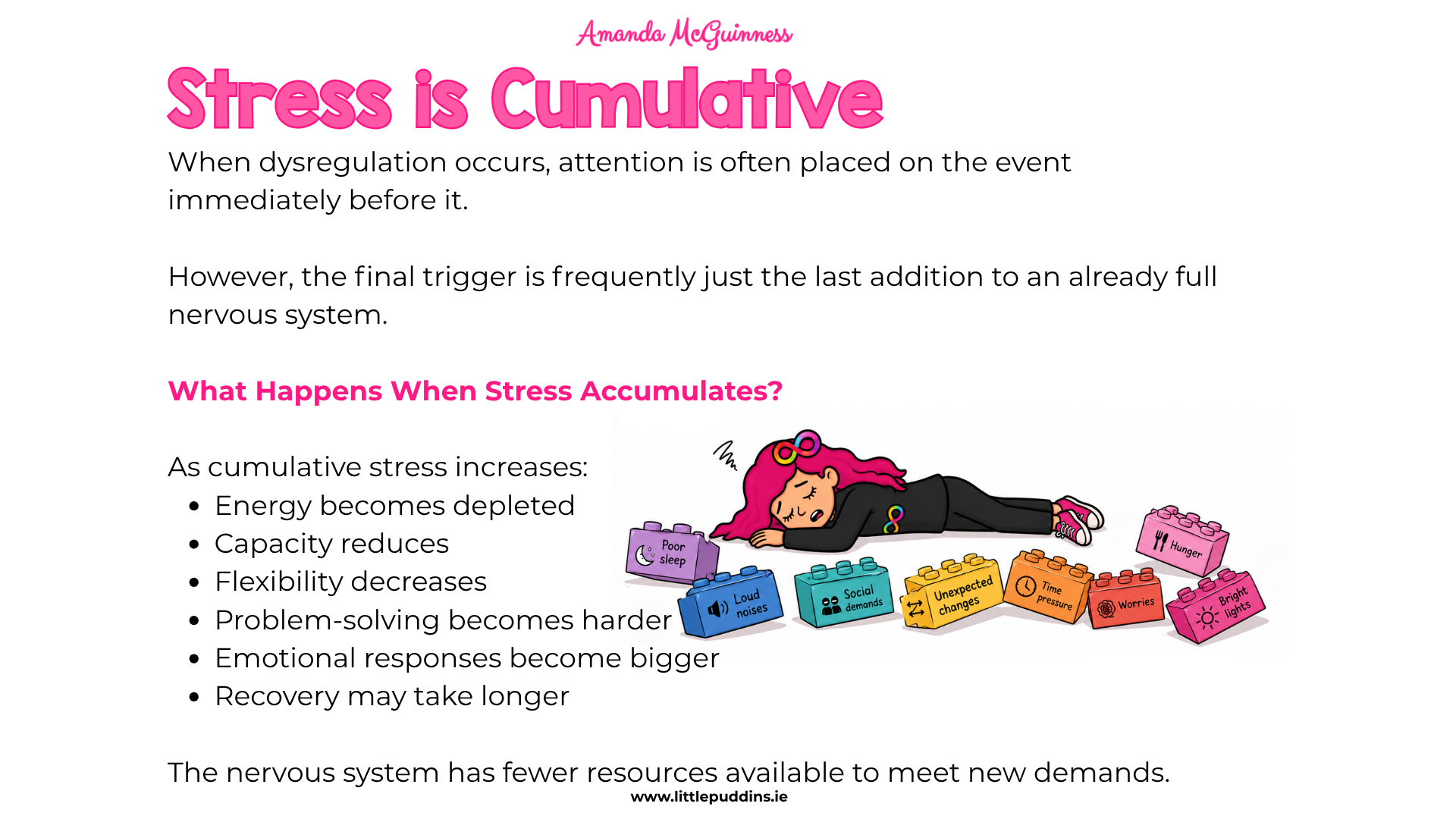
Understanding stress stacking encourages us to widen our perspective.
Rather than asking only,
"What happened just before?"
we might instead ask:
What sensory demands has this person been managing today?
How much uncertainty have they experienced?
How much communication effort has been required?
How many transitions have they navigated?
How much masking or social effort has been expected?
Have there been enough opportunities for rest, regulation, and recovery?
These questions shift our focus from finding a single cause towards understanding the broader context in which the nervous system is operating.
This perspective encourages greater curiosity, compassion, and understanding, while helping us identify opportunities to reduce cumulative stress before available capacity becomes exceeded.
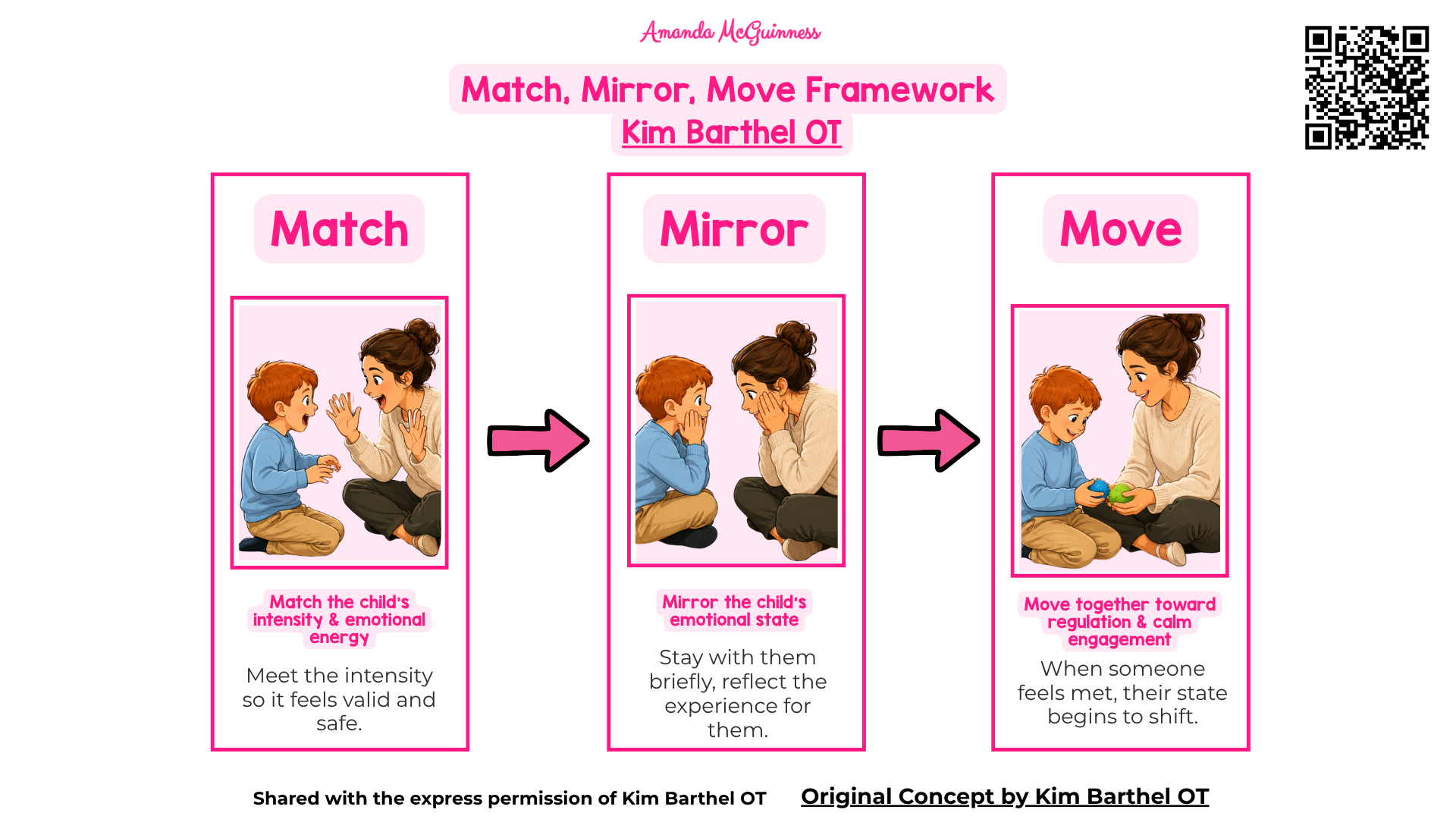
Match, Mirror, Move
During the podcast, Nikki Smit introduces Match, Mirror, Move, a relational framework developed by Occupational Therapist Kim Barthel for supporting co-regulation and authentic nervous system connection.
Nikki explains that many of us have been taught that co-regulation means remaining completely calm so that another person can "borrow our calm." While there are certainly times when a calm presence is helpful, she suggests that this can sometimes unintentionally communicate that the person's emotional experience is too much or that they simply need to calm down.
Instead, Match, Mirror, Move offers a different approach.
The first step is to match the person's nervous system. This does not mean copying their behaviour or becoming dysregulated alongside them. Rather, it means matching the intensity of their experience through our own body. Nikki describes this as communicating, through posture, facial expression, breathing, and energy, "I can see how big this feels for you." The goal is not to join the distress, but to acknowledge its magnitude.
The second step is to mirror. Here, we reflect back our understanding of the person's experience. Nikki explains that this is less about finding the perfect words and more about using our nervous system to communicate genuine understanding and validation. This is particularly important because when someone is outside their Window of Capacity, they may have reduced access to the parts of the brain responsible for language, reasoning, and problem solving. Our body often communicates more effectively than our words.
Only then do we begin to move.
Movement is never forced. It is an invitation rather than a demand. Once the person experiences that they have been seen, understood, and emotionally met where they are, the nervous system is often better able to shift naturally towards greater regulation.
Throughout our conversation, Nikki highlights that this process is deeply relational. Rather than trying to change another person's emotional state as quickly as possible, Match, Mirror, Move encourages us to first establish connection. It is through that authentic connection that co-regulation becomes possible.
For parents, educators, therapists, and helping professionals, this framework offers a powerful reminder that regulation is not something we do to another person. It is something that emerges within safe, trusting, and attuned relationships. As Nikki explains, when people feel genuinely seen in the size of their experience, they are often far more able to move towards regulation than if we immediately focus on calming, correcting, or solving the situation.

Find Out More About Nikki Smit OT
Nikki Smit is a neurodivergent occupational therapist, speaker, and educator with over fifteen years of clinical experience. Based in Singapore and working globally, her work sits at the intersection of nervous system regulation, sensory health, neurodiversity-affirming practice, and trauma-sensitive care.
She is interested in the capacity to stay present as experiences rise and fall, and in wellbeing as something dynamic and relational, grounded in dignity and curiosity rather than calm or compliance. Her work is shaped as much by her own lived experience as by relational neuroscience and sensory health, and she helps people make sense of why they respond the way they do, and what genuinely supports them.
She works with children, adults, and families, as well as the practitioners who support them, and speaks, writes, and mentors internationally.
Follow Nikki on Instagram here and sign up to her Newsletter here.
Continue the Conversation
If you would like to explore these ideas in greater depth, I encourage you to listen to my conversation with neurodivergent Occupational Therapist Nikki Smit on The Unfiltered Autistic Podcast. Throughout the episode, Nikki shares compassionate, practical insights into the Waves of Regulation, the Window of Capacity, co-regulation, stress stacking, Match, Mirror, Move, and what it truly means to support regulation through authentic connection rather than compliance.
Whether you are a parent, educator, therapist, helping professional, or an Autistic adult wanting to better understand your own nervous system, this episode offers thoughtful perspectives and practical strategies that can transform how you understand regulation and support others.
I also highly recommend exploring Nikki's work beyond the podcast. She regularly shares evidence-informed, neurodiversity-affirming insights on social media, publishes a free newsletter, and has developed the excellent Waves of Regulation resources that expand on many of the concepts discussed throughout this article. Her work is grounded in compassion, relational neuroscience, sensory health, and a deep respect for the lived experiences of neurodivergent people.
If you found this article helpful, be sure to listen to the full podcast episode, share it with colleagues, friends, or family members, and explore the other articles and resources available here on Little Puddins. Together, we can continue building greater understanding of Autistic experiences through curiosity, connection, and genuinely neuroaffirmative practice.
